Alfani Yusuf , Reva Budiantono , Firman Bagja Juangsa , Muhammad Aziz , Muhammad Arif Budiyanto , Adhitya Gandaryus Saputro , Muhammad Haris Mahyuddin
{"title":"Insights into the role of metal dopant on ammonia decomposition over graphene-supported Ni6, Ni5Pt, and Ni5Rh clusters","authors":"Alfani Yusuf , Reva Budiantono , Firman Bagja Juangsa , Muhammad Aziz , Muhammad Arif Budiyanto , Adhitya Gandaryus Saputro , Muhammad Haris Mahyuddin","doi":"10.1016/j.ijhydene.2025.04.357","DOIUrl":null,"url":null,"abstract":"<div><div>Ammonia (NH<sub>3</sub>) is a promising hydrogen (H<sub>2</sub>) carrier, owing to its high hydrogen content and ease of storage. However, efficient catalytic decomposition of NH<sub>3</sub> to H<sub>2</sub> remains challenging. This study investigates the catalytic activity of graphene-supported Ni<sub>6</sub>, Ni<sub>5</sub>Pt, and Ni<sub>5</sub>Rh clusters for NH<sub>3</sub> decomposition to N<sub>2</sub> and H<sub>2</sub> using density functional theory (DFT) calculations. The results show that the addition of Pt and Rh dopants weakens the adsorption of intermediates formed during the NH<sub>3</sub> dehydrogenation step and slightly increases the activation energies. Interestingly, however, this drawback becomes a key factor in enhancing the activity of the subsequent N–N association and H–H recombination steps, which are critical for the reaction to cycle. Our electronic structure analysis reveals that the decreased activity in the NH<sub>3</sub> dehydrogenation step but increased activity in the N<sub>2</sub> and H<sub>2</sub> formation steps are due to the ligand effect exerted by Pt and Rh. Specifically, since the metal dopants have higher electronegativities than Ni, the number of electrons at the preferred Ni-edge site decreases and eventually weakens the adsorption. Furthermore, the spatially broad nature of the Pt-5d and Rh-4d orbitals delocalizes the cluster's electron distribution, which weakens the 2N and 2H adsorption and thus eases the N<sub>2</sub> and H<sub>2</sub> formation. This study provides insights into the role of noble metal dopants in optimizing Ni-based catalysts for NH<sub>3</sub> decomposition, paving the way for efficient H<sub>2</sub> utility technologies.</div></div>","PeriodicalId":337,"journal":{"name":"International Journal of Hydrogen Energy","volume":"130 ","pages":"Pages 168-175"},"PeriodicalIF":8.3000,"publicationDate":"2025-05-21","publicationTypes":"Journal Article","fieldsOfStudy":null,"isOpenAccess":false,"openAccessPdf":"","citationCount":"0","resultStr":null,"platform":"Semanticscholar","paperid":null,"PeriodicalName":"International Journal of Hydrogen Energy","FirstCategoryId":"5","ListUrlMain":"https://www.sciencedirect.com/science/article/pii/S0360319925020439","RegionNum":2,"RegionCategory":"工程技术","ArticlePicture":[],"TitleCN":null,"AbstractTextCN":null,"PMCID":null,"EPubDate":"2025/4/25 0:00:00","PubModel":"Epub","JCR":"Q1","JCRName":"CHEMISTRY, PHYSICAL","Score":null,"Total":0}
引用次数: 0
Abstract
Ammonia (NH3) is a promising hydrogen (H2) carrier, owing to its high hydrogen content and ease of storage. However, efficient catalytic decomposition of NH3 to H2 remains challenging. This study investigates the catalytic activity of graphene-supported Ni6, Ni5Pt, and Ni5Rh clusters for NH3 decomposition to N2 and H2 using density functional theory (DFT) calculations. The results show that the addition of Pt and Rh dopants weakens the adsorption of intermediates formed during the NH3 dehydrogenation step and slightly increases the activation energies. Interestingly, however, this drawback becomes a key factor in enhancing the activity of the subsequent N–N association and H–H recombination steps, which are critical for the reaction to cycle. Our electronic structure analysis reveals that the decreased activity in the NH3 dehydrogenation step but increased activity in the N2 and H2 formation steps are due to the ligand effect exerted by Pt and Rh. Specifically, since the metal dopants have higher electronegativities than Ni, the number of electrons at the preferred Ni-edge site decreases and eventually weakens the adsorption. Furthermore, the spatially broad nature of the Pt-5d and Rh-4d orbitals delocalizes the cluster's electron distribution, which weakens the 2N and 2H adsorption and thus eases the N2 and H2 formation. This study provides insights into the role of noble metal dopants in optimizing Ni-based catalysts for NH3 decomposition, paving the way for efficient H2 utility technologies.
期刊介绍:
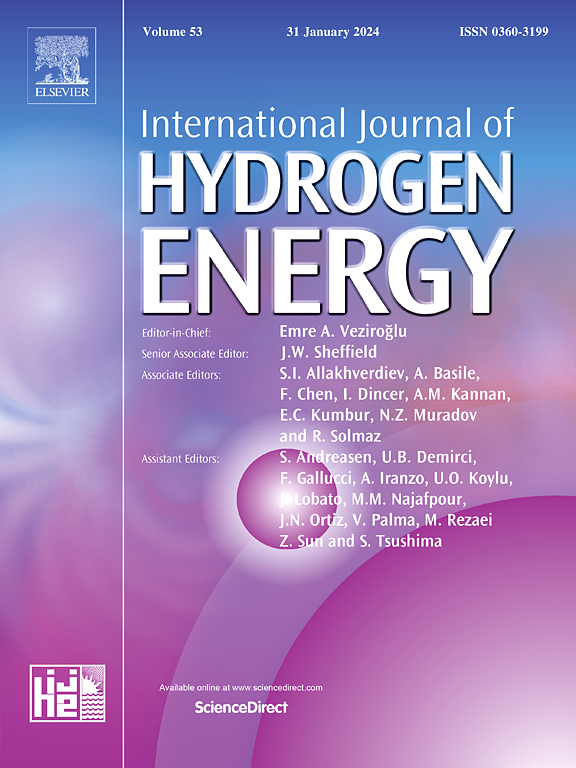
The objective of the International Journal of Hydrogen Energy is to facilitate the exchange of new ideas, technological advancements, and research findings in the field of Hydrogen Energy among scientists and engineers worldwide. This journal showcases original research, both analytical and experimental, covering various aspects of Hydrogen Energy. These include production, storage, transmission, utilization, enabling technologies, environmental impact, economic considerations, and global perspectives on hydrogen and its carriers such as NH3, CH4, alcohols, etc.
The utilization aspect encompasses various methods such as thermochemical (combustion), photochemical, electrochemical (fuel cells), and nuclear conversion of hydrogen, hydrogen isotopes, and hydrogen carriers into thermal, mechanical, and electrical energies. The applications of these energies can be found in transportation (including aerospace), industrial, commercial, and residential sectors.




 京公网安备 11010802042870号
京ICP备2023020795号-1
京公网安备 11010802042870号
京ICP备2023020795号-1

 分享
分享
 求助内容:
求助内容: 应助结果提醒方式:
 扫码关注我们
