{"title":"Comprehensive personality structure in the Persian language: High-dimensionality analyses of trait adjectives.","authors":"Naser Aghababaei,Gerard Saucier,Vinita Vader,Pooya Razavi","doi":"10.1037/pspp0000557","DOIUrl":null,"url":null,"abstract":"It is widely known that all languages have personality-trait concepts, but more controversial is how these concepts are organized (structured) based on application to actual human targets of description. Many assume that Big Five factors provide a universally applicable structural template, but evidence beyond European languages has particularly undermined this premise. The comparative reproducibility, across cultures, of structures of few broad factors (more parsimonious) versus many fine-grained factors (more comprehensive and predictive) also remains unclear. Here, issues of reproducibility and universality are examined in reference to real-person data from the non-Western cultural context associated with the Persian language. Self-reports from 767 Iranian adults employing 360 Persian personality terms were analyzed by both high-dimensionality and traditional approaches. Imported Big Five and six-factor structures were not well-supported. Although few-factor structures of one or eight factors showed the highest reproducibility (across method variations) in absolute terms, more comprehensive structures (of 20 or 42 factors) accounting for far more variance were nearly as reproducible, suggesting distinct structural layers, hierarchical only to a partial degree in a hierarchy. The 42-factor structure revealed not just many contents quite comparable to well-understood Western trait concepts but also some intriguing relatively culture-specific contents, thus indicating in a novel way how personality-structure studies can be revealing of culture and cultural differences. (PsycInfo Database Record (c) 2025 APA, all rights reserved).","PeriodicalId":16691,"journal":{"name":"Journal of personality and social psychology","volume":"48 1","pages":""},"PeriodicalIF":6.7000,"publicationDate":"2025-04-24","publicationTypes":"Journal Article","fieldsOfStudy":null,"isOpenAccess":false,"openAccessPdf":"","citationCount":"0","resultStr":null,"platform":"Semanticscholar","paperid":null,"PeriodicalName":"Journal of personality and social psychology","FirstCategoryId":"102","ListUrlMain":"https://doi.org/10.1037/pspp0000557","RegionNum":1,"RegionCategory":"心理学","ArticlePicture":[],"TitleCN":null,"AbstractTextCN":null,"PMCID":null,"EPubDate":"","PubModel":"","JCR":"Q1","JCRName":"PSYCHOLOGY, SOCIAL","Score":null,"Total":0}
引用次数: 0
Abstract
It is widely known that all languages have personality-trait concepts, but more controversial is how these concepts are organized (structured) based on application to actual human targets of description. Many assume that Big Five factors provide a universally applicable structural template, but evidence beyond European languages has particularly undermined this premise. The comparative reproducibility, across cultures, of structures of few broad factors (more parsimonious) versus many fine-grained factors (more comprehensive and predictive) also remains unclear. Here, issues of reproducibility and universality are examined in reference to real-person data from the non-Western cultural context associated with the Persian language. Self-reports from 767 Iranian adults employing 360 Persian personality terms were analyzed by both high-dimensionality and traditional approaches. Imported Big Five and six-factor structures were not well-supported. Although few-factor structures of one or eight factors showed the highest reproducibility (across method variations) in absolute terms, more comprehensive structures (of 20 or 42 factors) accounting for far more variance were nearly as reproducible, suggesting distinct structural layers, hierarchical only to a partial degree in a hierarchy. The 42-factor structure revealed not just many contents quite comparable to well-understood Western trait concepts but also some intriguing relatively culture-specific contents, thus indicating in a novel way how personality-structure studies can be revealing of culture and cultural differences. (PsycInfo Database Record (c) 2025 APA, all rights reserved).
期刊介绍:
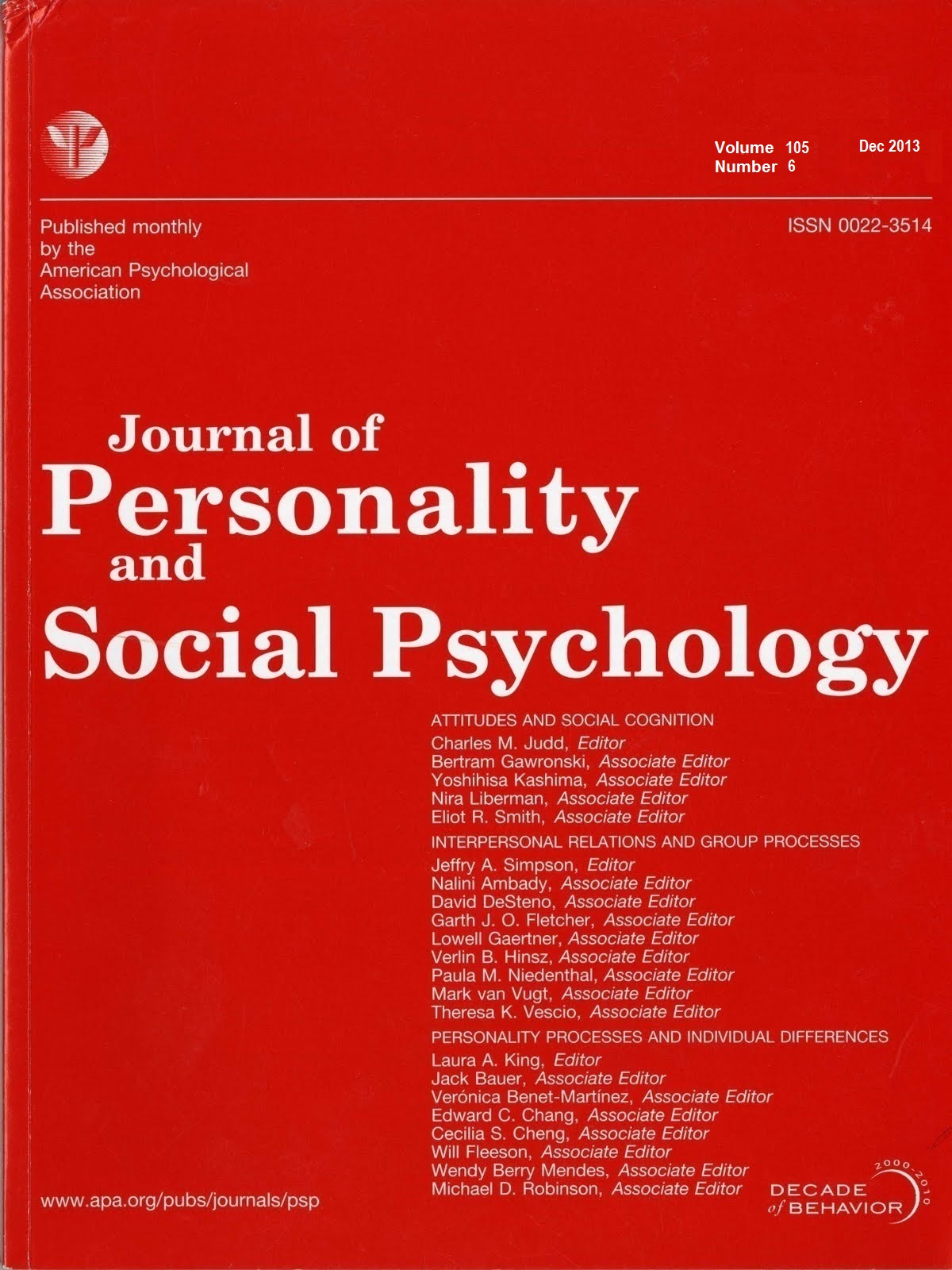
Journal of personality and social psychology publishes original papers in all areas of personality and social psychology and emphasizes empirical reports, but may include specialized theoretical, methodological, and review papers.Journal of personality and social psychology is divided into three independently edited sections. Attitudes and Social Cognition addresses all aspects of psychology (e.g., attitudes, cognition, emotion, motivation) that take place in significant micro- and macrolevel social contexts.



 京公网安备 11010802042870号
京ICP备2023020795号-1
京公网安备 11010802042870号
京ICP备2023020795号-1

 分享
分享
 求助内容:
求助内容: 应助结果提醒方式:
 扫码关注我们
