Yuhuan Zhai , Pingjing Li , Shuai Tang , Peijun Zhang , Hui Kang , Songhai Li
{"title":"Trace elements concentration, tissue distribution, and associated health risks in wild and captive pantropical spotted dolphins (Stenella attenuata)","authors":"Yuhuan Zhai , Pingjing Li , Shuai Tang , Peijun Zhang , Hui Kang , Songhai Li","doi":"10.1016/j.jhazmat.2025.138413","DOIUrl":null,"url":null,"abstract":"<div><div>Trace element (TEs) concentrations are key indicators for evaluating the health status of cetaceans. However, there is currently no research on TEs levels and tissue distributions in captive dolphins. Investigating TEs in wild and captive dolphins could provide critical insights into the effects of diets and habitats on TEs accumulation and improve healthcare protocols for captive dolphins. This study investigated concentrations of six TEs (Hg, Cd, Cr, Se, Cu, and Zn) in seven tissues (skin, muscle, liver, spleen, lung, kidney, and intestine) of wild (n = 8) and captive (n = 6) <em>Stenella attenuata</em>. The findings indicated that most studied wild and captive individuals exhibited medium levels of Hg, Cd, and Cr globally, with low health risks. However, alarming concentrations, such as 306 μg/g Hg in captive individuals and 178 μg/g Cd in wild individuals, suggested localized contamination persists. Tissue distributions of TEs indicated that ingestion and inhalation were the predominant exposure routes for wild and captive dolphins. Additionally, positive correlations between Hg levels in skin and liver and Cd levels in skin and kidney indicated that skin could serve as a healthy indicator for captive dolphins. Consuming odontocete tissue, even from healthy individuals, poses potential health risks to humans.</div></div>","PeriodicalId":361,"journal":{"name":"Journal of Hazardous Materials","volume":"493 ","pages":"Article 138413"},"PeriodicalIF":11.3000,"publicationDate":"2025-08-05","publicationTypes":"Journal Article","fieldsOfStudy":null,"isOpenAccess":false,"openAccessPdf":"","citationCount":"0","resultStr":null,"platform":"Semanticscholar","paperid":null,"PeriodicalName":"Journal of Hazardous Materials","FirstCategoryId":"93","ListUrlMain":"https://www.sciencedirect.com/science/article/pii/S0304389425013287","RegionNum":1,"RegionCategory":"环境科学与生态学","ArticlePicture":[],"TitleCN":null,"AbstractTextCN":null,"PMCID":null,"EPubDate":"2025/4/25 0:00:00","PubModel":"Epub","JCR":"Q1","JCRName":"ENGINEERING, ENVIRONMENTAL","Score":null,"Total":0}
引用次数: 0
Abstract
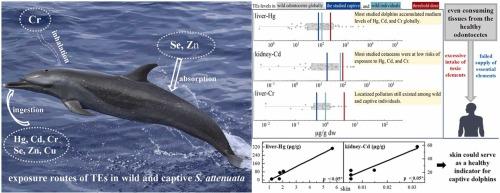
Trace element (TEs) concentrations are key indicators for evaluating the health status of cetaceans. However, there is currently no research on TEs levels and tissue distributions in captive dolphins. Investigating TEs in wild and captive dolphins could provide critical insights into the effects of diets and habitats on TEs accumulation and improve healthcare protocols for captive dolphins. This study investigated concentrations of six TEs (Hg, Cd, Cr, Se, Cu, and Zn) in seven tissues (skin, muscle, liver, spleen, lung, kidney, and intestine) of wild (n = 8) and captive (n = 6) Stenella attenuata. The findings indicated that most studied wild and captive individuals exhibited medium levels of Hg, Cd, and Cr globally, with low health risks. However, alarming concentrations, such as 306 μg/g Hg in captive individuals and 178 μg/g Cd in wild individuals, suggested localized contamination persists. Tissue distributions of TEs indicated that ingestion and inhalation were the predominant exposure routes for wild and captive dolphins. Additionally, positive correlations between Hg levels in skin and liver and Cd levels in skin and kidney indicated that skin could serve as a healthy indicator for captive dolphins. Consuming odontocete tissue, even from healthy individuals, poses potential health risks to humans.
期刊介绍:
The Journal of Hazardous Materials serves as a global platform for promoting cutting-edge research in the field of Environmental Science and Engineering. Our publication features a wide range of articles, including full-length research papers, review articles, and perspectives, with the aim of enhancing our understanding of the dangers and risks associated with various materials concerning public health and the environment. It is important to note that the term "environmental contaminants" refers specifically to substances that pose hazardous effects through contamination, while excluding those that do not have such impacts on the environment or human health. Moreover, we emphasize the distinction between wastes and hazardous materials in order to provide further clarity on the scope of the journal. We have a keen interest in exploring specific compounds and microbial agents that have adverse effects on the environment.



 京公网安备 11010802042870号
京ICP备2023020795号-1
京公网安备 11010802042870号
京ICP备2023020795号-1

 分享
分享
 求助内容:
求助内容: 应助结果提醒方式:
 扫码关注我们
