Hyun Chung, Sangwon Lee, Seokwoo Ko, Sun Uk Hwang, Alireza Zargaran, Seok Su Sohn
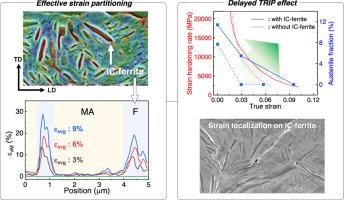
{"title":"Ultrastrong and ductile martensitic low-density steel achieved by local strain partitioning into ferrite and delayed TRIP effect","authors":"Hyun Chung, Sangwon Lee, Seokwoo Ko, Sun Uk Hwang, Alireza Zargaran, Seok Su Sohn","doi":"10.1016/j.jmst.2025.03.042","DOIUrl":null,"url":null,"abstract":"Martensitic-based microstructures in low-density steels offer high strength and improved specific strength, combined with the lightweight effect of aluminum (Al). However, while Al effectively reduces density, it simultaneously promotes the formation of coarse ferrite and expands the two-phase (α + γ) intercritical temperature range. Thus, increasing the Al content for higher weight reduction inevitably leads to ferrite formation and impedes further strengthening. To achieve both high strength and ductility while incorporating ferrite, it is crucial to elucidate the effects of ferrite fraction, size, and distribution on mechanical properties and deformation behavior, particularly in relation to phase interactions. In this study, three model steels were developed through controlled annealing temperatures, producing distinct triplex microstructures comprising ferrite, martensite, and retained austenite (RA). The role of each phase in strain partitioning was investigated using ex-situ microscopic digital image correlation and electron back-scattered diffraction analysis. Key findings reveal that the martensitic matrix ensures an ultrahigh strength level (1758 MPa), while a moderate fraction (∼17%) and homogeneous distribution of intercritical-ferrite (IC-ferrite) enable sustainable strain-hardening behavior by delaying the transformation-induced plasticity (TRIP) effect. Strain partitioning into IC-ferrite reduces local strains in the martensitic matrix, preventing early exhaustion of the TRIP effect and facilitating ductile fracture behavior. This strategy leverages the presence of ferrite, offering significant advantages for applications requiring both ultrahigh strength and ductility.","PeriodicalId":16154,"journal":{"name":"Journal of Materials Science & Technology","volume":"92 1","pages":""},"PeriodicalIF":14.3000,"publicationDate":"2025-04-24","publicationTypes":"Journal Article","fieldsOfStudy":null,"isOpenAccess":false,"openAccessPdf":"","citationCount":"0","resultStr":null,"platform":"Semanticscholar","paperid":null,"PeriodicalName":"Journal of Materials Science & Technology","FirstCategoryId":"88","ListUrlMain":"https://doi.org/10.1016/j.jmst.2025.03.042","RegionNum":1,"RegionCategory":"材料科学","ArticlePicture":[],"TitleCN":null,"AbstractTextCN":null,"PMCID":null,"EPubDate":"","PubModel":"","JCR":"Q1","JCRName":"MATERIALS SCIENCE, MULTIDISCIPLINARY","Score":null,"Total":0}
引用次数: 0
Abstract
Martensitic-based microstructures in low-density steels offer high strength and improved specific strength, combined with the lightweight effect of aluminum (Al). However, while Al effectively reduces density, it simultaneously promotes the formation of coarse ferrite and expands the two-phase (α + γ) intercritical temperature range. Thus, increasing the Al content for higher weight reduction inevitably leads to ferrite formation and impedes further strengthening. To achieve both high strength and ductility while incorporating ferrite, it is crucial to elucidate the effects of ferrite fraction, size, and distribution on mechanical properties and deformation behavior, particularly in relation to phase interactions. In this study, three model steels were developed through controlled annealing temperatures, producing distinct triplex microstructures comprising ferrite, martensite, and retained austenite (RA). The role of each phase in strain partitioning was investigated using ex-situ microscopic digital image correlation and electron back-scattered diffraction analysis. Key findings reveal that the martensitic matrix ensures an ultrahigh strength level (1758 MPa), while a moderate fraction (∼17%) and homogeneous distribution of intercritical-ferrite (IC-ferrite) enable sustainable strain-hardening behavior by delaying the transformation-induced plasticity (TRIP) effect. Strain partitioning into IC-ferrite reduces local strains in the martensitic matrix, preventing early exhaustion of the TRIP effect and facilitating ductile fracture behavior. This strategy leverages the presence of ferrite, offering significant advantages for applications requiring both ultrahigh strength and ductility.
期刊介绍:
Journal of Materials Science & Technology strives to promote global collaboration in the field of materials science and technology. It primarily publishes original research papers, invited review articles, letters, research notes, and summaries of scientific achievements. The journal covers a wide range of materials science and technology topics, including metallic materials, inorganic nonmetallic materials, and composite materials.




 京公网安备 11010802042870号
京ICP备2023020795号-1
京公网安备 11010802042870号
京ICP备2023020795号-1

 分享
分享
 求助内容:
求助内容: 应助结果提醒方式:
 扫码关注我们
