{"title":"Revealing atomic strengthening mechanism in CoNiV medium-entropy alloy via machine learning-guided simulations","authors":"Wenyue Li, Xiongjun Liu, Leqing Liu, Qing Du, Deye Lin, Xin Chen, Dong He, Shudao Wang, Yuan Wu, Hui Wang, Suihe Jiang, Xiaobin Zhang, Zhaoping Lu","doi":"10.1016/j.jmst.2025.04.005","DOIUrl":null,"url":null,"abstract":"High/medium entropy alloys (H/MEAs) have shown unique strengthening behavior and mechanical properties because of the presence of massive local chemical orderings. Nevertheless, dynamic interactions between chemical short-range orders (CSROs) and dislocations, and the underlying atomic strengthening mechanism remain elusive. In this work, we first developed a novel machine learning-embedded atom method (ML-EAM) potential of the CoNiV system, trained on a comprehensive first-principles dataset, which enables accurate and efficient modeling of CSRO formation and dislocation dynamics. Then, we investigated the strengthening mechanisms of CSROs in CoNiV MEA through machine learning-augmented molecular dynamics (MD) simulations. Hybrid MD/Monte Carlo simulations reveal that CSRO domains possess an L1<sub>2</sub> (NiCo)<sub>3</sub>V structure, whose size increases with lowering annealing temperatures. These domains significantly enhance strength by impeding dislocation motion through complex energy pathways, increasing depinning forces, and reducing mobility. Moreover, the MD simulations combined with theoretical analysis elucidate the competition between CSRO-assisted strengthening (via antiphase boundary formation) and solid solution weakening (via reduced atomic misfit volume). Phonon-drag effects are also amplified by CSROs, further resisting dislocation glide. Our results demonstrate that L1<sub>2</sub>-CSROs strengthen CoNiV MEA primarily through antiphase boundary and phonon-drag contributions, providing new insights for designing high-performance multi-principal-element alloys via tailoring CSROs.","PeriodicalId":16154,"journal":{"name":"Journal of Materials Science & Technology","volume":"17 1","pages":""},"PeriodicalIF":14.3000,"publicationDate":"2025-04-24","publicationTypes":"Journal Article","fieldsOfStudy":null,"isOpenAccess":false,"openAccessPdf":"","citationCount":"0","resultStr":null,"platform":"Semanticscholar","paperid":null,"PeriodicalName":"Journal of Materials Science & Technology","FirstCategoryId":"88","ListUrlMain":"https://doi.org/10.1016/j.jmst.2025.04.005","RegionNum":1,"RegionCategory":"材料科学","ArticlePicture":[],"TitleCN":null,"AbstractTextCN":null,"PMCID":null,"EPubDate":"","PubModel":"","JCR":"Q1","JCRName":"MATERIALS SCIENCE, MULTIDISCIPLINARY","Score":null,"Total":0}
引用次数: 0
Abstract
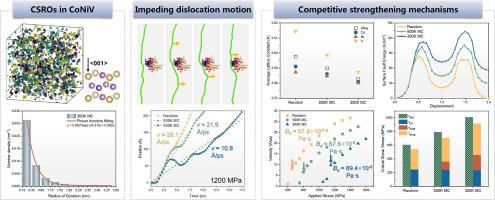
High/medium entropy alloys (H/MEAs) have shown unique strengthening behavior and mechanical properties because of the presence of massive local chemical orderings. Nevertheless, dynamic interactions between chemical short-range orders (CSROs) and dislocations, and the underlying atomic strengthening mechanism remain elusive. In this work, we first developed a novel machine learning-embedded atom method (ML-EAM) potential of the CoNiV system, trained on a comprehensive first-principles dataset, which enables accurate and efficient modeling of CSRO formation and dislocation dynamics. Then, we investigated the strengthening mechanisms of CSROs in CoNiV MEA through machine learning-augmented molecular dynamics (MD) simulations. Hybrid MD/Monte Carlo simulations reveal that CSRO domains possess an L12 (NiCo)3V structure, whose size increases with lowering annealing temperatures. These domains significantly enhance strength by impeding dislocation motion through complex energy pathways, increasing depinning forces, and reducing mobility. Moreover, the MD simulations combined with theoretical analysis elucidate the competition between CSRO-assisted strengthening (via antiphase boundary formation) and solid solution weakening (via reduced atomic misfit volume). Phonon-drag effects are also amplified by CSROs, further resisting dislocation glide. Our results demonstrate that L12-CSROs strengthen CoNiV MEA primarily through antiphase boundary and phonon-drag contributions, providing new insights for designing high-performance multi-principal-element alloys via tailoring CSROs.
期刊介绍:
Journal of Materials Science & Technology strives to promote global collaboration in the field of materials science and technology. It primarily publishes original research papers, invited review articles, letters, research notes, and summaries of scientific achievements. The journal covers a wide range of materials science and technology topics, including metallic materials, inorganic nonmetallic materials, and composite materials.



 京公网安备 11010802042870号
京ICP备2023020795号-1
京公网安备 11010802042870号
京ICP备2023020795号-1

 分享
分享
 求助内容:
求助内容: 应助结果提醒方式:
 扫码关注我们
