Woojin Lim, Bhavana Joshi, Edmund Samuel, Jung Woo Huh, Ali Aldalbahi, Govindasami Periyasami, Hae-Seok Lee, Bin Ding, Sam S. Yoon
{"title":"Shear stress-induced augmentation of electroactive phases of PVDF for high-power nanogenerator using supersonically sprayed Sr2SnO4 nanorods","authors":"Woojin Lim, Bhavana Joshi, Edmund Samuel, Jung Woo Huh, Ali Aldalbahi, Govindasami Periyasami, Hae-Seok Lee, Bin Ding, Sam S. Yoon","doi":"10.1016/j.jmst.2025.03.040","DOIUrl":null,"url":null,"abstract":"Supersonic spraying is a scalable, non-vacuum, rapid coating technique that uses a supersonic gas stream from a de Laval nozzle to deposit precursors under atmospheric conditions. In this study, the supersonic spraying of Sr<sub>2</sub>SnO<sub>4</sub> nanorods (SSO-NRs) was found to increase the content of electroactive <em>β</em>- and <em>γ</em>-phases in poly (vinylidene fluoride) (PVDF) by more than twofold. Specifically, shear stress between the PVDF and SSO-NRs, induced by supersonic blowing, amplified the <em>β</em>- and <em>γ</em>-phases, which enhanced the energy-harvesting performance of a flexible piezoelectric nanogenerator (PENG). The swirling of the high-aspect-ratio SSO-NRs intensified the turbulence, thereby magnifying the influence of the shear stress. The supersonically driven shear stress caused multidirectional stretching, elongation, and twisting of PVDF and transformed a large amount of the <em>α</em>-phase into electroactive <em>β</em>- and <em>γ</em>-phases, as evidenced by X-ray diffractometry and infrared spectroscopy. The composite film with a minimal filler content of 2.5 wt.% exhibited a piezopotential of 41 V without additional poling. The optimal SSO/PVDF-based PENG delivered a high power density of 90 µW cm<sup>−2</sup> when subjected to a tapping force. Furthermore, the practical applicability of the PENG was demonstrated using air pressure, vibration, and human body movement. The fabricated PENG device was integrated with a supercapacitor electrode to exhibit a wide application range in wearable and portable electronics.","PeriodicalId":16154,"journal":{"name":"Journal of Materials Science & Technology","volume":"69 1","pages":""},"PeriodicalIF":14.3000,"publicationDate":"2025-04-24","publicationTypes":"Journal Article","fieldsOfStudy":null,"isOpenAccess":false,"openAccessPdf":"","citationCount":"0","resultStr":null,"platform":"Semanticscholar","paperid":null,"PeriodicalName":"Journal of Materials Science & Technology","FirstCategoryId":"88","ListUrlMain":"https://doi.org/10.1016/j.jmst.2025.03.040","RegionNum":1,"RegionCategory":"材料科学","ArticlePicture":[],"TitleCN":null,"AbstractTextCN":null,"PMCID":null,"EPubDate":"","PubModel":"","JCR":"Q1","JCRName":"MATERIALS SCIENCE, MULTIDISCIPLINARY","Score":null,"Total":0}
引用次数: 0
Abstract
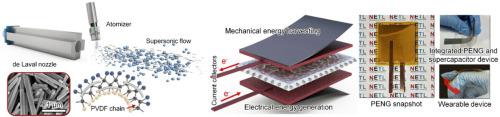
Supersonic spraying is a scalable, non-vacuum, rapid coating technique that uses a supersonic gas stream from a de Laval nozzle to deposit precursors under atmospheric conditions. In this study, the supersonic spraying of Sr2SnO4 nanorods (SSO-NRs) was found to increase the content of electroactive β- and γ-phases in poly (vinylidene fluoride) (PVDF) by more than twofold. Specifically, shear stress between the PVDF and SSO-NRs, induced by supersonic blowing, amplified the β- and γ-phases, which enhanced the energy-harvesting performance of a flexible piezoelectric nanogenerator (PENG). The swirling of the high-aspect-ratio SSO-NRs intensified the turbulence, thereby magnifying the influence of the shear stress. The supersonically driven shear stress caused multidirectional stretching, elongation, and twisting of PVDF and transformed a large amount of the α-phase into electroactive β- and γ-phases, as evidenced by X-ray diffractometry and infrared spectroscopy. The composite film with a minimal filler content of 2.5 wt.% exhibited a piezopotential of 41 V without additional poling. The optimal SSO/PVDF-based PENG delivered a high power density of 90 µW cm−2 when subjected to a tapping force. Furthermore, the practical applicability of the PENG was demonstrated using air pressure, vibration, and human body movement. The fabricated PENG device was integrated with a supercapacitor electrode to exhibit a wide application range in wearable and portable electronics.
期刊介绍:
Journal of Materials Science & Technology strives to promote global collaboration in the field of materials science and technology. It primarily publishes original research papers, invited review articles, letters, research notes, and summaries of scientific achievements. The journal covers a wide range of materials science and technology topics, including metallic materials, inorganic nonmetallic materials, and composite materials.



 京公网安备 11010802042870号
京ICP备2023020795号-1
京公网安备 11010802042870号
京ICP备2023020795号-1

 分享
分享
 求助内容:
求助内容: 应助结果提醒方式:
 扫码关注我们
