Aleksandra Ziółkowska, Wiktoria Błaszkiewicz and Tomasz Kruczyński
{"title":"The effect of substituents on the P–P and PC bond properties in phosphanylphosphaalkenes†","authors":"Aleksandra Ziółkowska, Wiktoria Błaszkiewicz and Tomasz Kruczyński","doi":"10.1039/D5DT00692A","DOIUrl":null,"url":null,"abstract":"<p >A new lithium salt of diphosphane, (<em>i</em>Pr<small><sub>2</sub></small>N)PhP–P(SiMe<small><sub>3</sub></small>)Li (<strong>2</strong>), featuring two substituents with distinct electronic characterstics, is reported. A subsequent reaction of the compound <strong>2</strong> with benzophenone was yielded a novel phosphanylphosphaalkene (<strong>3</strong>). The isolated compound was subsequently treated with <em>n</em>BuLi and PhLi to obtain stable activators (<strong>3a</strong> and <strong>3b</strong>) for the potential polymerization of phosphorus-rich compounds.</p>","PeriodicalId":71,"journal":{"name":"Dalton Transactions","volume":" 20","pages":" 8041-8044"},"PeriodicalIF":3.3000,"publicationDate":"2025-04-25","publicationTypes":"Journal Article","fieldsOfStudy":null,"isOpenAccess":false,"openAccessPdf":"","citationCount":"0","resultStr":null,"platform":"Semanticscholar","paperid":null,"PeriodicalName":"Dalton Transactions","FirstCategoryId":"92","ListUrlMain":"https://pubs.rsc.org/en/content/articlelanding/2025/dt/d5dt00692a","RegionNum":3,"RegionCategory":"化学","ArticlePicture":[],"TitleCN":null,"AbstractTextCN":null,"PMCID":null,"EPubDate":"","PubModel":"","JCR":"Q2","JCRName":"CHEMISTRY, INORGANIC & NUCLEAR","Score":null,"Total":0}
引用次数: 0
Abstract
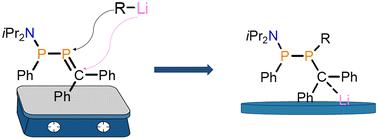
A new lithium salt of diphosphane, (iPr2N)PhP–P(SiMe3)Li (2), featuring two substituents with distinct electronic characterstics, is reported. A subsequent reaction of the compound 2 with benzophenone was yielded a novel phosphanylphosphaalkene (3). The isolated compound was subsequently treated with nBuLi and PhLi to obtain stable activators (3a and 3b) for the potential polymerization of phosphorus-rich compounds.
期刊介绍:
Dalton Transactions is a journal for all areas of inorganic chemistry, which encompasses the organometallic, bioinorganic and materials chemistry of the elements, with applications including synthesis, catalysis, energy conversion/storage, electrical devices and medicine. Dalton Transactions welcomes high-quality, original submissions in all of these areas and more, where the advancement of knowledge in inorganic chemistry is significant.



 京公网安备 11010802042870号
京ICP备2023020795号-1
京公网安备 11010802042870号
京ICP备2023020795号-1

 分享
分享
 求助内容:
求助内容: 应助结果提醒方式:
 扫码关注我们
