Bowen Li, Ning Lin, Zhaowu Wang, Baojie Chen, Changyong Lan, Xiaocui Li, You Meng, Weijun Wang, Mingqi Ding, Pengshan Xie, Yuxuan Zhang, Zenghui Wu, Dengji Li, Fu-Rong Chen, Chi Hou Chan, Zhongrui Wang, Johnny C. Ho
{"title":"Tunable Bipolar Photothermoelectric Response from Mott Activation for In-Sensor Image Preprocessing","authors":"Bowen Li, Ning Lin, Zhaowu Wang, Baojie Chen, Changyong Lan, Xiaocui Li, You Meng, Weijun Wang, Mingqi Ding, Pengshan Xie, Yuxuan Zhang, Zenghui Wu, Dengji Li, Fu-Rong Chen, Chi Hou Chan, Zhongrui Wang, Johnny C. Ho","doi":"10.1002/adma.202502915","DOIUrl":null,"url":null,"abstract":"<p>In-sensor image preprocessing, a subset of edge computing, offers a solution to mitigate frequent analog-digital conversions and the von Neumann bottleneck in conventional digital hardware. However, an efficient in-sensor device array with large-scale integration capability for high-density and low-power sensory processing is still lacking and highly desirable. This work introduces an adjustable broadband photothermoelectric detector based on a phase-change vanadium dioxide thin-film transistor. This transistor employs a vanadium dioxide/gallium nitride three-terminal structure with a gate-tunable phase transition at the gate-source junctions. This design allows for modulable photothermoelectric responsivities and alteration of the short-circuit photocurrent's polarities. The devices exhibit linear gate dependence for the broadband photoresponse and linear light-intensity dependence for both positive and negative photoresponsivities. The device's energy consumption is as low as 8 pJ per spike, which is one order of magnitude lower than that of previous Mott materials-based in-sensor preprocessing devices. A wafer-scale bipolar phototransistor array has also been fabricated by standard micro-/nano-fabrication techniques, exhibiting excellent stability and endurance (over 5000 cycles). More importantly, an integrated in-sensor convolutional network is successfully designed for simultaneous broadband image classification, medical image denoising, and retinal vessel segmentation, delivering exceptional performance and paving the way for future smart edge sensors.</p>","PeriodicalId":114,"journal":{"name":"Advanced Materials","volume":"37 27","pages":""},"PeriodicalIF":26.8000,"publicationDate":"2025-04-25","publicationTypes":"Journal Article","fieldsOfStudy":null,"isOpenAccess":false,"openAccessPdf":"","citationCount":"0","resultStr":null,"platform":"Semanticscholar","paperid":null,"PeriodicalName":"Advanced Materials","FirstCategoryId":"88","ListUrlMain":"https://advanced.onlinelibrary.wiley.com/doi/10.1002/adma.202502915","RegionNum":1,"RegionCategory":"材料科学","ArticlePicture":[],"TitleCN":null,"AbstractTextCN":null,"PMCID":null,"EPubDate":"","PubModel":"","JCR":"Q1","JCRName":"CHEMISTRY, MULTIDISCIPLINARY","Score":null,"Total":0}
引用次数: 0
Abstract
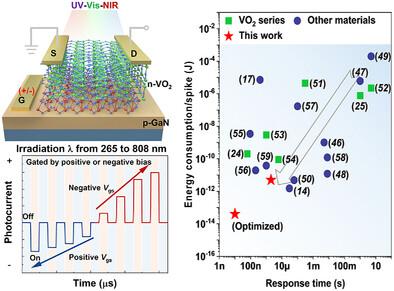
In-sensor image preprocessing, a subset of edge computing, offers a solution to mitigate frequent analog-digital conversions and the von Neumann bottleneck in conventional digital hardware. However, an efficient in-sensor device array with large-scale integration capability for high-density and low-power sensory processing is still lacking and highly desirable. This work introduces an adjustable broadband photothermoelectric detector based on a phase-change vanadium dioxide thin-film transistor. This transistor employs a vanadium dioxide/gallium nitride three-terminal structure with a gate-tunable phase transition at the gate-source junctions. This design allows for modulable photothermoelectric responsivities and alteration of the short-circuit photocurrent's polarities. The devices exhibit linear gate dependence for the broadband photoresponse and linear light-intensity dependence for both positive and negative photoresponsivities. The device's energy consumption is as low as 8 pJ per spike, which is one order of magnitude lower than that of previous Mott materials-based in-sensor preprocessing devices. A wafer-scale bipolar phototransistor array has also been fabricated by standard micro-/nano-fabrication techniques, exhibiting excellent stability and endurance (over 5000 cycles). More importantly, an integrated in-sensor convolutional network is successfully designed for simultaneous broadband image classification, medical image denoising, and retinal vessel segmentation, delivering exceptional performance and paving the way for future smart edge sensors.
期刊介绍:
Advanced Materials, one of the world's most prestigious journals and the foundation of the Advanced portfolio, is the home of choice for best-in-class materials science for more than 30 years. Following this fast-growing and interdisciplinary field, we are considering and publishing the most important discoveries on any and all materials from materials scientists, chemists, physicists, engineers as well as health and life scientists and bringing you the latest results and trends in modern materials-related research every week.







 京公网安备 11010802042870号
京ICP备2023020795号-1
京公网安备 11010802042870号
京ICP备2023020795号-1

 分享
分享
 求助内容:
求助内容: 应助结果提醒方式:
 扫码关注我们
