{"title":"Super-Wide Color Tunability from a Single Electrochromic Device through In Situ Reconstruction of Optical Cavity","authors":"Xueqing Tang, Zishou Hu, Zhenyong Wang, Xinzhou Wu, Zhen Wang, Wenming Su, Shan Cong, Fengxia Geng, Zhigang Zhao","doi":"10.1002/adma.202417511","DOIUrl":null,"url":null,"abstract":"<p>Electrochromic (EC) displays, as non-emissive (passive) displays with low energy consumption, have garnered significant attention from both industry and academia in recent years. Nevertheless, traditional EC technology faces challenges in achieving full-color displays within a single device due to its limited color gamut, even though full-color capability is highly desirable for eliminating the need for complex RGB subpixel mosaics. Herein, a new strategy is proposed utilizing in situ, electrically driven reconstruction of optical cavities on an electrochromic electrode surface to fabricate EC devices with super-wide color tunability. The device fabricated by this approach can create a wide variety of colors from yellow, orange, red, violet, blue, and cyan to green in a single EC device that almost spans the entire visible region (Δhue approaches 360°). Apart from the super-wide color tunability, the devices also have small working voltage window (0.2-1.8 V), outstanding bistability (>8 h), extremely low power consumption (≈2.3 mW cm<sup>−2</sup>) and good cycling ability (≈4.3% decay rate after 1,000 cycles). Moreover, the super-wide color tunability of these EC devices has been demonstrated in diverse applications, including shifting rainbow flower images, color palettes, and information displays.</p>","PeriodicalId":114,"journal":{"name":"Advanced Materials","volume":"37 27","pages":""},"PeriodicalIF":26.8000,"publicationDate":"2025-04-25","publicationTypes":"Journal Article","fieldsOfStudy":null,"isOpenAccess":false,"openAccessPdf":"","citationCount":"0","resultStr":null,"platform":"Semanticscholar","paperid":null,"PeriodicalName":"Advanced Materials","FirstCategoryId":"88","ListUrlMain":"https://advanced.onlinelibrary.wiley.com/doi/10.1002/adma.202417511","RegionNum":1,"RegionCategory":"材料科学","ArticlePicture":[],"TitleCN":null,"AbstractTextCN":null,"PMCID":null,"EPubDate":"","PubModel":"","JCR":"Q1","JCRName":"CHEMISTRY, MULTIDISCIPLINARY","Score":null,"Total":0}
引用次数: 0
Abstract
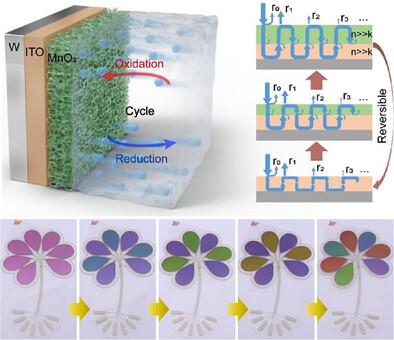
Electrochromic (EC) displays, as non-emissive (passive) displays with low energy consumption, have garnered significant attention from both industry and academia in recent years. Nevertheless, traditional EC technology faces challenges in achieving full-color displays within a single device due to its limited color gamut, even though full-color capability is highly desirable for eliminating the need for complex RGB subpixel mosaics. Herein, a new strategy is proposed utilizing in situ, electrically driven reconstruction of optical cavities on an electrochromic electrode surface to fabricate EC devices with super-wide color tunability. The device fabricated by this approach can create a wide variety of colors from yellow, orange, red, violet, blue, and cyan to green in a single EC device that almost spans the entire visible region (Δhue approaches 360°). Apart from the super-wide color tunability, the devices also have small working voltage window (0.2-1.8 V), outstanding bistability (>8 h), extremely low power consumption (≈2.3 mW cm−2) and good cycling ability (≈4.3% decay rate after 1,000 cycles). Moreover, the super-wide color tunability of these EC devices has been demonstrated in diverse applications, including shifting rainbow flower images, color palettes, and information displays.
期刊介绍:
Advanced Materials, one of the world's most prestigious journals and the foundation of the Advanced portfolio, is the home of choice for best-in-class materials science for more than 30 years. Following this fast-growing and interdisciplinary field, we are considering and publishing the most important discoveries on any and all materials from materials scientists, chemists, physicists, engineers as well as health and life scientists and bringing you the latest results and trends in modern materials-related research every week.






 京公网安备 11010802042870号
京ICP备2023020795号-1
京公网安备 11010802042870号
京ICP备2023020795号-1

 分享
分享
 求助内容:
求助内容: 应助结果提醒方式:
 扫码关注我们
