{"title":"Stakeholder participation for effective post-disaster risk communication: The role of relationship quality","authors":"Rui Yang , Bo Liu , Na Li","doi":"10.1016/j.ijdrr.2025.105510","DOIUrl":null,"url":null,"abstract":"<div><div>The stakeholder participation approach (SPA) is widely applied in post-disaster risk communication (PDRC). While existing literature emphasizes the critical role of stakeholder relationships in achieving effective PDRC, our understanding of these relationships and their impact on PDRC effectiveness remains limited. This study addresses this gap by introducing the concept of <em>relationship quality</em> and examining its conceptualization and influence on perceived PDRC effectiveness. Drawing on structural equation modeling (SEM) and survey data from a post-flood reconstruction project in Yan'an, China, the study validates relationship quality as a meaningful construct within the PDRC context, comprising four key dimensions: trust, fairness, communication, and coordination. The results reveal that trust, communication, and coordination serve as chain mediators in the relationship between fairness and PDRC effectiveness. Based on these findings, the study proposes several strategies for enhancing PDRC effectiveness through SPA, including shifting governance from a vertical to a horizontal structure, prioritizing relationship quality management, and recognizing the contributions of individual stakeholders.</div></div>","PeriodicalId":13915,"journal":{"name":"International journal of disaster risk reduction","volume":"123 ","pages":"Article 105510"},"PeriodicalIF":4.5000,"publicationDate":"2025-06-01","publicationTypes":"Journal Article","fieldsOfStudy":null,"isOpenAccess":false,"openAccessPdf":"","citationCount":"0","resultStr":null,"platform":"Semanticscholar","paperid":null,"PeriodicalName":"International journal of disaster risk reduction","FirstCategoryId":"89","ListUrlMain":"https://www.sciencedirect.com/science/article/pii/S2212420925003346","RegionNum":1,"RegionCategory":"地球科学","ArticlePicture":[],"TitleCN":null,"AbstractTextCN":null,"PMCID":null,"EPubDate":"2025/4/21 0:00:00","PubModel":"Epub","JCR":"Q1","JCRName":"GEOSCIENCES, MULTIDISCIPLINARY","Score":null,"Total":0}
引用次数: 0
Abstract
The stakeholder participation approach (SPA) is widely applied in post-disaster risk communication (PDRC). While existing literature emphasizes the critical role of stakeholder relationships in achieving effective PDRC, our understanding of these relationships and their impact on PDRC effectiveness remains limited. This study addresses this gap by introducing the concept of relationship quality and examining its conceptualization and influence on perceived PDRC effectiveness. Drawing on structural equation modeling (SEM) and survey data from a post-flood reconstruction project in Yan'an, China, the study validates relationship quality as a meaningful construct within the PDRC context, comprising four key dimensions: trust, fairness, communication, and coordination. The results reveal that trust, communication, and coordination serve as chain mediators in the relationship between fairness and PDRC effectiveness. Based on these findings, the study proposes several strategies for enhancing PDRC effectiveness through SPA, including shifting governance from a vertical to a horizontal structure, prioritizing relationship quality management, and recognizing the contributions of individual stakeholders.
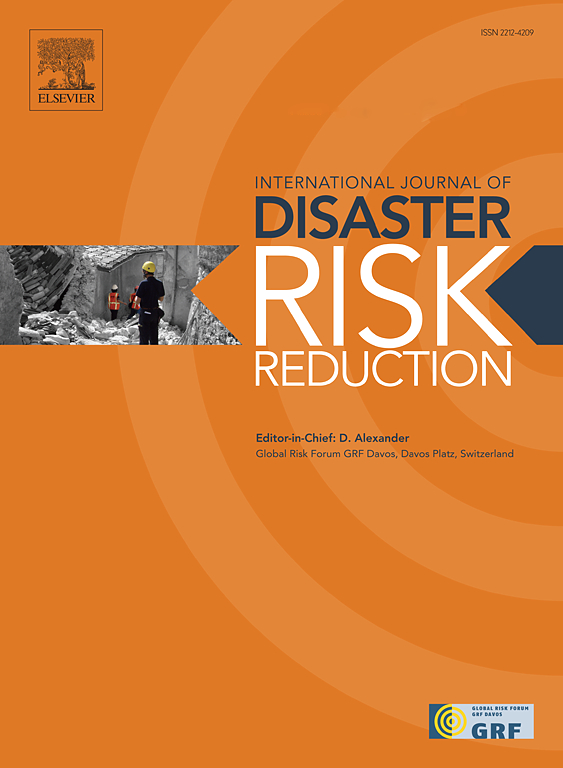
期刊介绍:
The International Journal of Disaster Risk Reduction (IJDRR) is the journal for researchers, policymakers and practitioners across diverse disciplines: earth sciences and their implications; environmental sciences; engineering; urban studies; geography; and the social sciences. IJDRR publishes fundamental and applied research, critical reviews, policy papers and case studies with a particular focus on multi-disciplinary research that aims to reduce the impact of natural, technological, social and intentional disasters. IJDRR stimulates exchange of ideas and knowledge transfer on disaster research, mitigation, adaptation, prevention and risk reduction at all geographical scales: local, national and international.
Key topics:-
-multifaceted disaster and cascading disasters
-the development of disaster risk reduction strategies and techniques
-discussion and development of effective warning and educational systems for risk management at all levels
-disasters associated with climate change
-vulnerability analysis and vulnerability trends
-emerging risks
-resilience against disasters.
The journal particularly encourages papers that approach risk from a multi-disciplinary perspective.



 京公网安备 11010802042870号
京ICP备2023020795号-1
京公网安备 11010802042870号
京ICP备2023020795号-1

 分享
分享
 求助内容:
求助内容: 应助结果提醒方式:
 扫码关注我们
