Abstract CT248: Using adaptive design elements to respond to regulatory changes and emerging data in a phase 1-2 study of OR502 - A best-in-class antibody targeting leukocyte immunoglobulin-like receptor B2 (LILRB2)
David Sommerhalder, Mohamad Salkeni, Andrae Vandross, Nenad Sarapa, Myriam N. Bouchlaka, Kamal Puri, Lesley Skingley, Mike Yefimenko, Alice Bexon, Shiraj Sen
{"title":"Abstract CT248: Using adaptive design elements to respond to regulatory changes and emerging data in a phase 1-2 study of OR502 - A best-in-class antibody targeting leukocyte immunoglobulin-like receptor B2 (LILRB2)","authors":"David Sommerhalder, Mohamad Salkeni, Andrae Vandross, Nenad Sarapa, Myriam N. Bouchlaka, Kamal Puri, Lesley Skingley, Mike Yefimenko, Alice Bexon, Shiraj Sen","doi":"10.1158/1538-7445.am2025-ct248","DOIUrl":null,"url":null,"abstract":"Background: OR502 is a best-in-class LILRB2 antagonist antibody with strong pre-clinical evidence of efficacy, now confirmed by durable clinical monotherapy responses. OR502 prevents LILRB2-mediated immunosuppression of myeloid cells by blocking LILBR2 binding to human leukocyte antigen-class I proteins. It potentiates Th1-like innate immune responses, rescues T-cells from M2c macrophage-mediated immune suppression and restores T-cell proliferation and effector functions. OR502 reduces and prevents immunosuppressive phenotype of existing and new tumor-associated macrophages. Combination with anti-PD-1 amplifies activity in M2c/T-cell coculture. Durable responses were seen in patients with mucosal melanoma, non-small cell lung cancer (NSCLC) and dedifferentiated liposarcoma in phase 1. Dose escalation is now complete and this abstract focuses on the study design to support dose selection. FDA’s Project Optimus has changed the requirements for oncology drugs to progress to later phase trials. It is essential to explore dose-response and identify the minimal effective dose in a randomized fashion to gain regulatory approval for further clinical development. Methods: Study OR502-101 [NCT06090266] was designed to comply with Project Optimus. The dose escalation component was completed in ∼40 subjects consisting of two arms: A1 (IV OR502 100, 200, 400, 800 and 1600 mg, once every 3 weeks [Q3W]) and A2 (IV OR502 3QW with standard dose cemiplimab). The OR502 dose selected for the second part of the study is 800 mg Q3W based on safety, efficacy, pharmacokinetics (PK) and receptor occupancy (RO). As dose escalation concluded, despite strong efficacy signals, we realized it was premature to move to randomized dose-finding. Following FDA interactions, we decided that objective efficacy rather than pharmacodynamic signals should be confirmed prior to initiating two-dose expansion cohorts. The protocol’s adaptive elements, combined with Safety Committee oversight, facilitated design modification without amendments. Consequently, two new mini-expansion cohorts of 10 to 20 subjects are recruiting. Subjects with cutaneous melanoma will receive IV OR502 800 mg 3QW and subjects with NSCLC will receive IV OR502 800 mg 3QW + cemiplimab. All subjects must have disease which has progressed following ≥12 weeks of prior PD-(L)1-based therapy and ≥ 2 lines of treatment. The primary objective of the mini-expansion cohorts is to confirm efficacy signal in the chosen indications. Study endpoints including adverse events, PK and RO will also be reported. Twenty subjects per cohort provide greater statistical confidence to continue development. In a challenging regulatory environment, this study design using adaptive elements provides the flexibility needed to ensure the rapid progress of drug development. Citation Format: David Sommerhalder, Mohamad Salkeni, Andrae Vandross, Nenad Sarapa, Myriam N. Bouchlaka, Kamal Puri, Lesley Skingley, Mike Yefimenko, Alice Bexon, Shiraj Sen. Using adaptive design elements to respond to regulatory changes and emerging data in a phase 1-2 study of OR502 - A best-in-class antibody targeting leukocyte immunoglobulin-like receptor B2 (LILRB2) [abstract]. In: Proceedings of the American Association for Cancer Research Annual Meeting 2025; Part 2 (Late-Breaking, Clinical Trial, and Invited s); 2025 Apr 25-30; Chicago, IL. Philadelphia (PA): AACR; Cancer Res 2025;85(8_Suppl_2): nr CT248.","PeriodicalId":9441,"journal":{"name":"Cancer research","volume":"29 1","pages":""},"PeriodicalIF":16.6000,"publicationDate":"2025-04-25","publicationTypes":"Journal Article","fieldsOfStudy":null,"isOpenAccess":false,"openAccessPdf":"","citationCount":"0","resultStr":null,"platform":"Semanticscholar","paperid":null,"PeriodicalName":"Cancer research","FirstCategoryId":"3","ListUrlMain":"https://doi.org/10.1158/1538-7445.am2025-ct248","RegionNum":1,"RegionCategory":"医学","ArticlePicture":[],"TitleCN":null,"AbstractTextCN":null,"PMCID":null,"EPubDate":"","PubModel":"","JCR":"Q1","JCRName":"ONCOLOGY","Score":null,"Total":0}
引用次数: 0
Abstract
Background: OR502 is a best-in-class LILRB2 antagonist antibody with strong pre-clinical evidence of efficacy, now confirmed by durable clinical monotherapy responses. OR502 prevents LILRB2-mediated immunosuppression of myeloid cells by blocking LILBR2 binding to human leukocyte antigen-class I proteins. It potentiates Th1-like innate immune responses, rescues T-cells from M2c macrophage-mediated immune suppression and restores T-cell proliferation and effector functions. OR502 reduces and prevents immunosuppressive phenotype of existing and new tumor-associated macrophages. Combination with anti-PD-1 amplifies activity in M2c/T-cell coculture. Durable responses were seen in patients with mucosal melanoma, non-small cell lung cancer (NSCLC) and dedifferentiated liposarcoma in phase 1. Dose escalation is now complete and this abstract focuses on the study design to support dose selection. FDA’s Project Optimus has changed the requirements for oncology drugs to progress to later phase trials. It is essential to explore dose-response and identify the minimal effective dose in a randomized fashion to gain regulatory approval for further clinical development. Methods: Study OR502-101 [NCT06090266] was designed to comply with Project Optimus. The dose escalation component was completed in ∼40 subjects consisting of two arms: A1 (IV OR502 100, 200, 400, 800 and 1600 mg, once every 3 weeks [Q3W]) and A2 (IV OR502 3QW with standard dose cemiplimab). The OR502 dose selected for the second part of the study is 800 mg Q3W based on safety, efficacy, pharmacokinetics (PK) and receptor occupancy (RO). As dose escalation concluded, despite strong efficacy signals, we realized it was premature to move to randomized dose-finding. Following FDA interactions, we decided that objective efficacy rather than pharmacodynamic signals should be confirmed prior to initiating two-dose expansion cohorts. The protocol’s adaptive elements, combined with Safety Committee oversight, facilitated design modification without amendments. Consequently, two new mini-expansion cohorts of 10 to 20 subjects are recruiting. Subjects with cutaneous melanoma will receive IV OR502 800 mg 3QW and subjects with NSCLC will receive IV OR502 800 mg 3QW + cemiplimab. All subjects must have disease which has progressed following ≥12 weeks of prior PD-(L)1-based therapy and ≥ 2 lines of treatment. The primary objective of the mini-expansion cohorts is to confirm efficacy signal in the chosen indications. Study endpoints including adverse events, PK and RO will also be reported. Twenty subjects per cohort provide greater statistical confidence to continue development. In a challenging regulatory environment, this study design using adaptive elements provides the flexibility needed to ensure the rapid progress of drug development. Citation Format: David Sommerhalder, Mohamad Salkeni, Andrae Vandross, Nenad Sarapa, Myriam N. Bouchlaka, Kamal Puri, Lesley Skingley, Mike Yefimenko, Alice Bexon, Shiraj Sen. Using adaptive design elements to respond to regulatory changes and emerging data in a phase 1-2 study of OR502 - A best-in-class antibody targeting leukocyte immunoglobulin-like receptor B2 (LILRB2) [abstract]. In: Proceedings of the American Association for Cancer Research Annual Meeting 2025; Part 2 (Late-Breaking, Clinical Trial, and Invited s); 2025 Apr 25-30; Chicago, IL. Philadelphia (PA): AACR; Cancer Res 2025;85(8_Suppl_2): nr CT248.
期刊介绍:
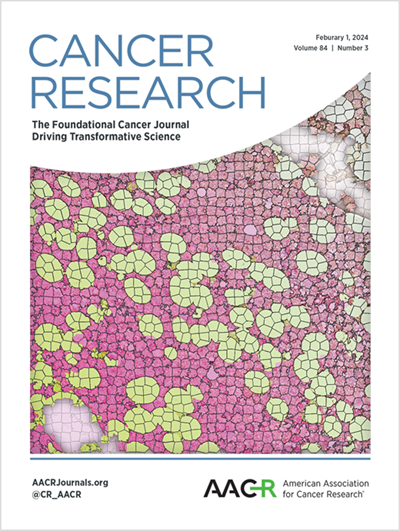
Cancer Research, published by the American Association for Cancer Research (AACR), is a journal that focuses on impactful original studies, reviews, and opinion pieces relevant to the broad cancer research community. Manuscripts that present conceptual or technological advances leading to insights into cancer biology are particularly sought after. The journal also places emphasis on convergence science, which involves bridging multiple distinct areas of cancer research.
With primary subsections including Cancer Biology, Cancer Immunology, Cancer Metabolism and Molecular Mechanisms, Translational Cancer Biology, Cancer Landscapes, and Convergence Science, Cancer Research has a comprehensive scope. It is published twice a month and has one volume per year, with a print ISSN of 0008-5472 and an online ISSN of 1538-7445.
Cancer Research is abstracted and/or indexed in various databases and platforms, including BIOSIS Previews (R) Database, MEDLINE, Current Contents/Life Sciences, Current Contents/Clinical Medicine, Science Citation Index, Scopus, and Web of Science.



 京公网安备 11010802042870号
京ICP备2023020795号-1
京公网安备 11010802042870号
京ICP备2023020795号-1

 分享
分享
 求助内容:
求助内容: 应助结果提醒方式:
 扫码关注我们
