Zhanpeng Sun, Junjie Zou, Rui Li, Zhaofu Zhang, Junqi Mai, Zijun Qi, David Vazquez Cortes, Qijun Wang, Gai Wu, Wei Shen, Sheng Liu
{"title":"Laser stealth dicing of β-Ga2O3: Theoretical and experimental studies","authors":"Zhanpeng Sun, Junjie Zou, Rui Li, Zhaofu Zhang, Junqi Mai, Zijun Qi, David Vazquez Cortes, Qijun Wang, Gai Wu, Wei Shen, Sheng Liu","doi":"10.1016/j.jmst.2025.03.044","DOIUrl":null,"url":null,"abstract":"Gallium oxide (Ga<sub>2</sub>O<sub>3</sub>) is an ultra-wide bandgap semiconductor with excellent potential for high-power and ultraviolet optoelectronic device applications. High-performance Ga<sub>2</sub>O<sub>3</sub>-based high-power devices rely heavily on precise processing, especially in wafer dicing. Laser stealth dicing (LSD) is an innovative laser technology that utilizes a focused laser to create subsurface modifications in the wafer without surface damage. LSD has broad application prospects in the field of semiconductor precision processing. In this work, the idea of achieving high-quality dicing of β-Ga<sub>2</sub>O<sub>3</sub> wafers via LSD was proposed. A combination of atomistic simulations and experiments was used to understand the underlying mechanism of LSD of β-Ga<sub>2</sub>O<sub>3</sub> wafers. On the one hand, the laser loading and fracture process of β-Ga<sub>2</sub>O<sub>3</sub> wafers were simulated using molecular dynamics (MD) methods as well as a machine learning potential. The effects of single-pulse energy on LSD were analyzed through the lattice residual pressure, the final total energy of the system, the internal atomic strain, and the maximum stress value during uniaxial tension. On the other hand, based on the MD simulations, LSD was successfully performed on β-Ga<sub>2</sub>O<sub>3</sub> wafers along three main crystal planes in the laboratory, resulting in good surface quality. This work not only provides profound optimization strategies for the LSD process of β-Ga<sub>2</sub>O<sub>3</sub>, establishing the foundation for high-quality dicing of β-Ga<sub>2</sub>O<sub>3</sub> wafers, but also verifies the accuracy of MD simulations in predicting trends related to the LSD, offering a potential approach for high-quality dicing of other materials in future research.","PeriodicalId":16154,"journal":{"name":"Journal of Materials Science & Technology","volume":"33 1","pages":""},"PeriodicalIF":14.3000,"publicationDate":"2025-04-26","publicationTypes":"Journal Article","fieldsOfStudy":null,"isOpenAccess":false,"openAccessPdf":"","citationCount":"0","resultStr":null,"platform":"Semanticscholar","paperid":null,"PeriodicalName":"Journal of Materials Science & Technology","FirstCategoryId":"88","ListUrlMain":"https://doi.org/10.1016/j.jmst.2025.03.044","RegionNum":1,"RegionCategory":"材料科学","ArticlePicture":[],"TitleCN":null,"AbstractTextCN":null,"PMCID":null,"EPubDate":"","PubModel":"","JCR":"Q1","JCRName":"MATERIALS SCIENCE, MULTIDISCIPLINARY","Score":null,"Total":0}
引用次数: 0
Abstract
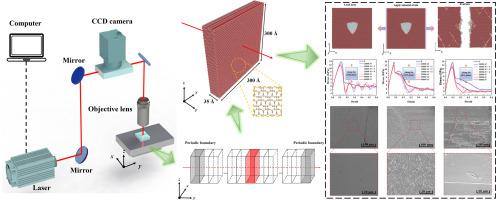
Gallium oxide (Ga2O3) is an ultra-wide bandgap semiconductor with excellent potential for high-power and ultraviolet optoelectronic device applications. High-performance Ga2O3-based high-power devices rely heavily on precise processing, especially in wafer dicing. Laser stealth dicing (LSD) is an innovative laser technology that utilizes a focused laser to create subsurface modifications in the wafer without surface damage. LSD has broad application prospects in the field of semiconductor precision processing. In this work, the idea of achieving high-quality dicing of β-Ga2O3 wafers via LSD was proposed. A combination of atomistic simulations and experiments was used to understand the underlying mechanism of LSD of β-Ga2O3 wafers. On the one hand, the laser loading and fracture process of β-Ga2O3 wafers were simulated using molecular dynamics (MD) methods as well as a machine learning potential. The effects of single-pulse energy on LSD were analyzed through the lattice residual pressure, the final total energy of the system, the internal atomic strain, and the maximum stress value during uniaxial tension. On the other hand, based on the MD simulations, LSD was successfully performed on β-Ga2O3 wafers along three main crystal planes in the laboratory, resulting in good surface quality. This work not only provides profound optimization strategies for the LSD process of β-Ga2O3, establishing the foundation for high-quality dicing of β-Ga2O3 wafers, but also verifies the accuracy of MD simulations in predicting trends related to the LSD, offering a potential approach for high-quality dicing of other materials in future research.
期刊介绍:
Journal of Materials Science & Technology strives to promote global collaboration in the field of materials science and technology. It primarily publishes original research papers, invited review articles, letters, research notes, and summaries of scientific achievements. The journal covers a wide range of materials science and technology topics, including metallic materials, inorganic nonmetallic materials, and composite materials.



 京公网安备 11010802042870号
京ICP备2023020795号-1
京公网安备 11010802042870号
京ICP备2023020795号-1

 分享
分享
 求助内容:
求助内容: 应助结果提醒方式:
 扫码关注我们
