Abhishek Kumar, Charles H. Devillers, Rita Meunier-Prest, Dimitri Sabat, Eric Lesniewska, Marcel Bouvet
{"title":"Bias Induced Ambipolar Transport in Organic Heterojunction Sensors","authors":"Abhishek Kumar, Charles H. Devillers, Rita Meunier-Prest, Dimitri Sabat, Eric Lesniewska, Marcel Bouvet","doi":"10.1002/aelm.202400865","DOIUrl":null,"url":null,"abstract":"<p>Interface engineering in organic heterostructures is an important approach to tuning the characteristics of organic electronic devices and improving their performances in applications, such as gas sensing. Herein, organic heterostructures containing, a polyporphine (pZnP-1), perfluorinated copper phthalocyanine (Cu(F<sub>16</sub>Pc)), and lutetium bis-phthalocyanine (LuPc<sub>2</sub>) are synthesized by a combination of electrochemical and PVD methods for investigation of charge transport and ammonia (NH<sub>3</sub>) sensing application. pZnP-1 is synthesized by controlled oxidative electropolymerization and reveals a rough surface, which influences the electrical nature of its interface with the phthalocyanine. The electrical properties of the heterojunction devices reveal distinct interfacial and bulk charge transport properties, which are modulated by the thickness of pZnP-1 and the external electric field. Indeed, the heterojunction device containing a thin film of pZnP-1 displays n-type behavior at low bias and p-type nature at higher bias; i.e., an ambipolar behavior, in which ambipolarity is triggered by the external electric field. On the other hand, the heterojunction device having a thick film of pZnP-1 exhibits p-type behavior at all the studied biases. Investigation of NH<sub>3</sub> sensing properties of the heterojunction devices highlights the advantages of introducing pZnP-1 in the heterostructures, which enhances the sensitivity, stability, repeatability, and humidity tolerance of the sensors.</p>","PeriodicalId":110,"journal":{"name":"Advanced Electronic Materials","volume":"11 9","pages":""},"PeriodicalIF":5.3000,"publicationDate":"2025-04-25","publicationTypes":"Journal Article","fieldsOfStudy":null,"isOpenAccess":false,"openAccessPdf":"https://onlinelibrary.wiley.com/doi/epdf/10.1002/aelm.202400865","citationCount":"0","resultStr":null,"platform":"Semanticscholar","paperid":null,"PeriodicalName":"Advanced Electronic Materials","FirstCategoryId":"88","ListUrlMain":"https://advanced.onlinelibrary.wiley.com/doi/10.1002/aelm.202400865","RegionNum":2,"RegionCategory":"材料科学","ArticlePicture":[],"TitleCN":null,"AbstractTextCN":null,"PMCID":null,"EPubDate":"","PubModel":"","JCR":"Q2","JCRName":"MATERIALS SCIENCE, MULTIDISCIPLINARY","Score":null,"Total":0}
引用次数: 0
Abstract
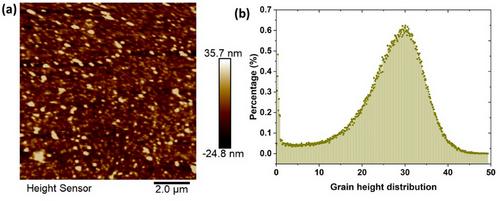
Interface engineering in organic heterostructures is an important approach to tuning the characteristics of organic electronic devices and improving their performances in applications, such as gas sensing. Herein, organic heterostructures containing, a polyporphine (pZnP-1), perfluorinated copper phthalocyanine (Cu(F16Pc)), and lutetium bis-phthalocyanine (LuPc2) are synthesized by a combination of electrochemical and PVD methods for investigation of charge transport and ammonia (NH3) sensing application. pZnP-1 is synthesized by controlled oxidative electropolymerization and reveals a rough surface, which influences the electrical nature of its interface with the phthalocyanine. The electrical properties of the heterojunction devices reveal distinct interfacial and bulk charge transport properties, which are modulated by the thickness of pZnP-1 and the external electric field. Indeed, the heterojunction device containing a thin film of pZnP-1 displays n-type behavior at low bias and p-type nature at higher bias; i.e., an ambipolar behavior, in which ambipolarity is triggered by the external electric field. On the other hand, the heterojunction device having a thick film of pZnP-1 exhibits p-type behavior at all the studied biases. Investigation of NH3 sensing properties of the heterojunction devices highlights the advantages of introducing pZnP-1 in the heterostructures, which enhances the sensitivity, stability, repeatability, and humidity tolerance of the sensors.
期刊介绍:
Advanced Electronic Materials is an interdisciplinary forum for peer-reviewed, high-quality, high-impact research in the fields of materials science, physics, and engineering of electronic and magnetic materials. It includes research on physics and physical properties of electronic and magnetic materials, spintronics, electronics, device physics and engineering, micro- and nano-electromechanical systems, and organic electronics, in addition to fundamental research.





 京公网安备 11010802042870号
京ICP备2023020795号-1
京公网安备 11010802042870号
京ICP备2023020795号-1

 分享
分享
 求助内容:
求助内容: 应助结果提醒方式:
 扫码关注我们
