{"title":"Achieving Ultra-Thin Solid Electrolyte Interphase for High-Performance Lithium Metal Anodes via Chloride-Assisted Electrochemical Corrosion","authors":"Xue Wang, Qiao Zhang, Zengwu Wei, Kaiwei Zhou, Xianhui Chen, Zhao Qian, Jun Wang, Xing Xin","doi":"10.1002/smll.202502682","DOIUrl":null,"url":null,"abstract":"<p>The thickness and composition of the solid electrolyte interphase (SEI) on lithium (Li) metal are critical factors influencing dendrite growth. This study introduces a novel electrolyte selection strategy based on electrochemical corrosion principles. By employing LiCl and LiNO<sub>3</sub> simultaneously, the electrolyte itself has a high donor number, low desolvation energy, high Li⁺ transference number and conductivity, and a moderate electrochemical stability window. In addition, it dynamically reduces the SEI thickness and reactivates dead Li, forming a ≈100 nm SEI enriched with LiF and Li<sub>2</sub>O on Li metal anode, which ensures the stable cycling of Li symmetric cells for 2000 h at a current density of 5 mA cm⁻<sup>2</sup>. Consequently, Li metal cells using LiFePO<sub>4</sub> (LFP) as the cathode with the LiNO<sub>3</sub>-LiCl-added electrolyte exhibit excellent cycling performance for 1600 cycles at 680 mA g⁻<sup>1</sup>. Even with a thin Li metal anode, the Li (5 µm)|LFP cell retains 95% capacity after 70 cycles at 170 mA g⁻<sup>1</sup>. The universality and feasibility of this electrolyte design are also validated in diverse battery chemistries such as anode-free Cu|LFP, Li|LiNi<sub>0.8</sub>Mn<sub>0.1</sub>Co<sub>0.1</sub>O<sub>2</sub> (NMC811), and Li|S cells, as well as in pouch cells with high-loading LFP and NMC811 cathodes, showcasing the promising electrolyte design strategy for Li metal batteries.</p>","PeriodicalId":228,"journal":{"name":"Small","volume":"21 24","pages":""},"PeriodicalIF":12.1000,"publicationDate":"2025-04-26","publicationTypes":"Journal Article","fieldsOfStudy":null,"isOpenAccess":false,"openAccessPdf":"","citationCount":"0","resultStr":null,"platform":"Semanticscholar","paperid":null,"PeriodicalName":"Small","FirstCategoryId":"88","ListUrlMain":"https://onlinelibrary.wiley.com/doi/10.1002/smll.202502682","RegionNum":2,"RegionCategory":"材料科学","ArticlePicture":[],"TitleCN":null,"AbstractTextCN":null,"PMCID":null,"EPubDate":"","PubModel":"","JCR":"Q1","JCRName":"CHEMISTRY, MULTIDISCIPLINARY","Score":null,"Total":0}
引用次数: 0
Abstract
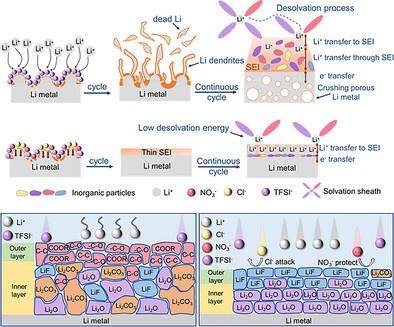
The thickness and composition of the solid electrolyte interphase (SEI) on lithium (Li) metal are critical factors influencing dendrite growth. This study introduces a novel electrolyte selection strategy based on electrochemical corrosion principles. By employing LiCl and LiNO3 simultaneously, the electrolyte itself has a high donor number, low desolvation energy, high Li⁺ transference number and conductivity, and a moderate electrochemical stability window. In addition, it dynamically reduces the SEI thickness and reactivates dead Li, forming a ≈100 nm SEI enriched with LiF and Li2O on Li metal anode, which ensures the stable cycling of Li symmetric cells for 2000 h at a current density of 5 mA cm⁻2. Consequently, Li metal cells using LiFePO4 (LFP) as the cathode with the LiNO3-LiCl-added electrolyte exhibit excellent cycling performance for 1600 cycles at 680 mA g⁻1. Even with a thin Li metal anode, the Li (5 µm)|LFP cell retains 95% capacity after 70 cycles at 170 mA g⁻1. The universality and feasibility of this electrolyte design are also validated in diverse battery chemistries such as anode-free Cu|LFP, Li|LiNi0.8Mn0.1Co0.1O2 (NMC811), and Li|S cells, as well as in pouch cells with high-loading LFP and NMC811 cathodes, showcasing the promising electrolyte design strategy for Li metal batteries.
锂金属表面固体电解质界面(SEI)的厚度和组成是影响枝晶生长的关键因素。本文介绍了一种基于电化学腐蚀原理的新型电解液选择策略。通过同时使用LiCl和LiNO3,电解质本身具有高的施主数、低的脱溶能、高的Li +转移数和导电性,以及中等的电化学稳定窗口。此外,它还动态地降低SEI厚度,使死锂重新活化,在锂金属阳极上形成一个≈100 nm富含LiF和Li2O的SEI,保证了锂对称电池在5 mA cm⁻2电流密度下稳定循环2000 h。因此,以LiFePO4 (LFP)为阴极,添加LiNO3 - LiCl -电解质的锂金属电池在680 mA g⁻1下可循环1600次,表现出优异的循环性能。即使使用薄的锂金属阳极,锂(5µm)|LFP电池在170 mA g⁻1下循环70次后仍能保持95%的容量。该电解质设计的通用性和可行性也在不同的电池化学结构中得到了验证,如无阳极的Cu|LFP、Li|LiNi0.8Mn0.1Co0.1O2 (NMC811)和Li|S电池,以及具有高负载LFP和NMC811阴极的袋状电池,展示了锂金属电池的电解质设计策略。
期刊介绍:
Small serves as an exceptional platform for both experimental and theoretical studies in fundamental and applied interdisciplinary research at the nano- and microscale. The journal offers a compelling mix of peer-reviewed Research Articles, Reviews, Perspectives, and Comments.
With a remarkable 2022 Journal Impact Factor of 13.3 (Journal Citation Reports from Clarivate Analytics, 2023), Small remains among the top multidisciplinary journals, covering a wide range of topics at the interface of materials science, chemistry, physics, engineering, medicine, and biology.
Small's readership includes biochemists, biologists, biomedical scientists, chemists, engineers, information technologists, materials scientists, physicists, and theoreticians alike.



 京公网安备 11010802042870号
京ICP备2023020795号-1
京公网安备 11010802042870号
京ICP备2023020795号-1

 分享
分享
 求助内容:
求助内容: 应助结果提醒方式:
 扫码关注我们
