Exploring MIL-101 (Cr) and Its Polymeric Composites as Potential Adsorbents for Volatile Iodine from Nuclear Off-gas: A Detailed Experimental and Computational Study
{"title":"Exploring MIL-101 (Cr) and Its Polymeric Composites as Potential Adsorbents for Volatile Iodine from Nuclear Off-gas: A Detailed Experimental and Computational Study","authors":"Siddhartha Kolay, Srinivasu Kancharlapalli, Soumen Samanta, Mohammad Muhiuddin, Purushottam Jha, Aniket Pagare, Ratikanta Mishra","doi":"10.1021/acs.iecr.4c04840","DOIUrl":null,"url":null,"abstract":"Owing to the rapid growth of nuclear energy as a sustainable, affordable, and clean energy source, the entrapment of radioactive iodine released from the nuclear off-gas stream is considered a vital concern. We view MOFs as potential futuristic adsorbents for this remedy. Herein, we examined the gravimetric iodine adsorption characteristics of radiation and chemically stable MIL-101(Cr) and its polymeric composites with variation of temperatures. The saturation adsorption capacity shown by pristine MIL-101(Cr) is 4.1 g I<sub>2</sub> g<sup>–1</sup>, and the saturation capacity of composites varies based on MIL-101(Cr)’s concentrations. MIL-101(Cr)@PES 2:1 shows an uptake capacity of 2.1 g I<sub>2</sub> /g<sub>bead</sub>, which is ∼ 350% superior to the reported HKUST-1@PES and ∼150% higher compared to MOF-808@PVDF<sub>0.7</sub>. Based on various spectroscopic studies and DFT calculations, probable host–guest interactions leading to enhanced I<sub>2</sub> adsorption have been elucidated. The open Cr metal site acts as the initial adsorption site for I<sub>2</sub> that gets converted into iodide and afterward to higher polyiodide through the transfer of charge from the host matrix. These findings suggest that MIL-101(Cr) can be considered one of the potential alternate adsorbents for radioactive iodine.","PeriodicalId":39,"journal":{"name":"Industrial & Engineering Chemistry Research","volume":"14 1","pages":""},"PeriodicalIF":3.9000,"publicationDate":"2025-04-25","publicationTypes":"Journal Article","fieldsOfStudy":null,"isOpenAccess":false,"openAccessPdf":"","citationCount":"0","resultStr":null,"platform":"Semanticscholar","paperid":null,"PeriodicalName":"Industrial & Engineering Chemistry Research","FirstCategoryId":"5","ListUrlMain":"https://doi.org/10.1021/acs.iecr.4c04840","RegionNum":3,"RegionCategory":"工程技术","ArticlePicture":[],"TitleCN":null,"AbstractTextCN":null,"PMCID":null,"EPubDate":"","PubModel":"","JCR":"Q2","JCRName":"ENGINEERING, CHEMICAL","Score":null,"Total":0}
引用次数: 0
Abstract
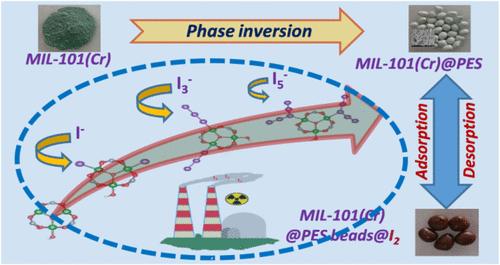
Owing to the rapid growth of nuclear energy as a sustainable, affordable, and clean energy source, the entrapment of radioactive iodine released from the nuclear off-gas stream is considered a vital concern. We view MOFs as potential futuristic adsorbents for this remedy. Herein, we examined the gravimetric iodine adsorption characteristics of radiation and chemically stable MIL-101(Cr) and its polymeric composites with variation of temperatures. The saturation adsorption capacity shown by pristine MIL-101(Cr) is 4.1 g I2 g–1, and the saturation capacity of composites varies based on MIL-101(Cr)’s concentrations. MIL-101(Cr)@PES 2:1 shows an uptake capacity of 2.1 g I2 /gbead, which is ∼ 350% superior to the reported HKUST-1@PES and ∼150% higher compared to MOF-808@PVDF0.7. Based on various spectroscopic studies and DFT calculations, probable host–guest interactions leading to enhanced I2 adsorption have been elucidated. The open Cr metal site acts as the initial adsorption site for I2 that gets converted into iodide and afterward to higher polyiodide through the transfer of charge from the host matrix. These findings suggest that MIL-101(Cr) can be considered one of the potential alternate adsorbents for radioactive iodine.
由于核能作为一种可持续的、负担得起的和清洁的能源迅速发展,从核废气流中释放的放射性碘的捕获被认为是一个至关重要的问题。我们认为mof是潜在的未来吸附剂。本文研究了辐射稳定性和化学稳定性良好的MIL-101(Cr)及其聚合物复合材料对碘的吸附特性随温度的变化。原始MIL-101(Cr)的饱和吸附容量为4.1 g I2 g -1,复合材料的饱和吸附容量随MIL-101(Cr)浓度的变化而变化。MIL-101(Cr)@PES 2:1显示摄取能力为2.1 g I2 /gbead,比报道的HKUST-1@PES高~ 350%,比MOF-808@PVDF0.7高~ 150%。基于各种光谱研究和DFT计算,可能的主-客体相互作用导致I2吸附增强已经阐明。开放的金属铬位点作为I2的初始吸附位点,I2通过宿主基质的电荷转移转化为碘化物,然后转化为更高的多碘化物。这些发现表明MIL-101(Cr)可以被认为是放射性碘的潜在替代吸附剂之一。
期刊介绍:
ndustrial & Engineering Chemistry, with variations in title and format, has been published since 1909 by the American Chemical Society. Industrial & Engineering Chemistry Research is a weekly publication that reports industrial and academic research in the broad fields of applied chemistry and chemical engineering with special focus on fundamentals, processes, and products.



 京公网安备 11010802042870号
京ICP备2023020795号-1
京公网安备 11010802042870号
京ICP备2023020795号-1

 分享
分享
 求助内容:
求助内容: 应助结果提醒方式:
 扫码关注我们
