{"title":"Two-Stage Hybrid Interval Stochastic Programming for Sustainable Utility Systems with Energy Storage","authors":"Kangyuan Yang, Hua Mei, Liang Zhao","doi":"10.1021/acs.iecr.5c00338","DOIUrl":null,"url":null,"abstract":"The utility system is a crucial power source for chemical production processes, and the sustainable utility system is one of the key research topics in the field of energy and chemical engineering. To reduce the carbon emissions of the system, this study integrates the utility system with renewable energy and energy storage devices, transforming it into a sustainable utility system. To address the impact of multiscale uncertainties in renewable energy supply and steam demand on system decision optimization, this study develops a two-stage hybrid interval-stochastic programming method using stochastic intervals to model multiscale uncertainties to enhance modeling flexibility and reduce computational time. In the first stage, the capacities of renewable energy and storage systems are planned. The second stage involves solving an optimization problem under the uncertainties of renewable energy. The stochastic behavior of wind speed, solar irradiance, and steam demand is captured using scenario trees in the stochastic programming framework. In constructing the scenario tree, uncertainties are modeled by combining stochastic intervals. A risk coefficient is defined for the approximate representation of stochastic intervals to address the challenge of solving interval uncertainties while ensuring the flexibility of steam and power generation among the utility system, renewable energy system, and storage devices. Finally, a case study of a utility system in an actual ethylene chemical process validated the economic and environmental benefits of sustainable retrofitting, as well as the effectiveness of the proposed method in handling uncertainties. The optimization results indicate that the proposed model reduces carbon emissions by 5.2%, and the proposed method decreases computational time by 91% compared to stochastic programming.","PeriodicalId":39,"journal":{"name":"Industrial & Engineering Chemistry Research","volume":"4 1","pages":""},"PeriodicalIF":3.9000,"publicationDate":"2025-04-25","publicationTypes":"Journal Article","fieldsOfStudy":null,"isOpenAccess":false,"openAccessPdf":"","citationCount":"0","resultStr":null,"platform":"Semanticscholar","paperid":null,"PeriodicalName":"Industrial & Engineering Chemistry Research","FirstCategoryId":"5","ListUrlMain":"https://doi.org/10.1021/acs.iecr.5c00338","RegionNum":3,"RegionCategory":"工程技术","ArticlePicture":[],"TitleCN":null,"AbstractTextCN":null,"PMCID":null,"EPubDate":"","PubModel":"","JCR":"Q2","JCRName":"ENGINEERING, CHEMICAL","Score":null,"Total":0}
引用次数: 0
Abstract
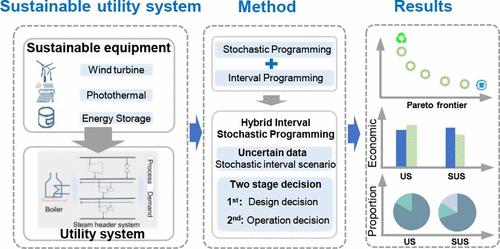
The utility system is a crucial power source for chemical production processes, and the sustainable utility system is one of the key research topics in the field of energy and chemical engineering. To reduce the carbon emissions of the system, this study integrates the utility system with renewable energy and energy storage devices, transforming it into a sustainable utility system. To address the impact of multiscale uncertainties in renewable energy supply and steam demand on system decision optimization, this study develops a two-stage hybrid interval-stochastic programming method using stochastic intervals to model multiscale uncertainties to enhance modeling flexibility and reduce computational time. In the first stage, the capacities of renewable energy and storage systems are planned. The second stage involves solving an optimization problem under the uncertainties of renewable energy. The stochastic behavior of wind speed, solar irradiance, and steam demand is captured using scenario trees in the stochastic programming framework. In constructing the scenario tree, uncertainties are modeled by combining stochastic intervals. A risk coefficient is defined for the approximate representation of stochastic intervals to address the challenge of solving interval uncertainties while ensuring the flexibility of steam and power generation among the utility system, renewable energy system, and storage devices. Finally, a case study of a utility system in an actual ethylene chemical process validated the economic and environmental benefits of sustainable retrofitting, as well as the effectiveness of the proposed method in handling uncertainties. The optimization results indicate that the proposed model reduces carbon emissions by 5.2%, and the proposed method decreases computational time by 91% compared to stochastic programming.
期刊介绍:
ndustrial & Engineering Chemistry, with variations in title and format, has been published since 1909 by the American Chemical Society. Industrial & Engineering Chemistry Research is a weekly publication that reports industrial and academic research in the broad fields of applied chemistry and chemical engineering with special focus on fundamentals, processes, and products.



 京公网安备 11010802042870号
京ICP备2023020795号-1
京公网安备 11010802042870号
京ICP备2023020795号-1

 分享
分享
 求助内容:
求助内容: 应助结果提醒方式:
 扫码关注我们
