Enhancing Catalytic Transfer Hydrogenolysis Performance for Efficient and Selective C–O Bond Cleavage in Lignin: A Synergistic Interaction between Metal Sites and Oxygen Defects in Ni–W Catalysts
{"title":"Enhancing Catalytic Transfer Hydrogenolysis Performance for Efficient and Selective C–O Bond Cleavage in Lignin: A Synergistic Interaction between Metal Sites and Oxygen Defects in Ni–W Catalysts","authors":"Han-Bing Gao, Yue-Lun Wang, Dao-Ran Liu, Jin-Xuan Xie, Le-Le Qiu, Jian Xiao, Jing Liang, Fang-Jing Liu, Yun-Peng Zhao","doi":"10.1021/acs.iecr.5c01131","DOIUrl":null,"url":null,"abstract":"Achieving high efficiency and selectivity in cleaving aryl C–O bonds is critical for lignin valorization and the production of aromatic chemicals. A green and sustainable approach has been developed using bimetallic Ni–W catalysts, which controlled the hydrogen supply and mediated hydrogen transfer via in situ hydrogen donors. An appropriate W/Ni ratio is essential for enhancing the supply of active hydrogen, the adsorption capacity for reactive molecules, and the efficiency of hydrogen transfer, thereby optimizing the overall catalytic performance. A comprehensive investigation was conducted on the factors influencing the catalytic transfer hydrogenolysis of lignin derivatives, focusing on the reaction temperature, solvent, hydrogen source, pressure, and duration. Under optimal conditions (180 °C, 1.0 MPa N<sub>2</sub>, and <2.5 h), various lignin-derived aryl ethers achieved complete conversion with 100% monomer selectivity. This study demonstrated the excellent reusability of the Ni–W catalyst for four cycles. More significantly, the mechanisms underlying active hydrogen transfer, transfer hydrogenolysis, and bimetallic interactions were elucidated. The integration of Ni and W species significantly enhanced the synergy among active metal sites, oxygen defects, and acid sites. This synergistic mechanism enabled H<sup>•</sup> and H<sup>+</sup> to function as the primary active hydrogen species. Furthermore, the in situ generation and targeted migration of H<sup>•</sup> radicals and H<sup>+</sup> ions facilitated the preferential cleavage of C–O bonds over the hydrogenation of aromatic units within lignin, leading to the formation of high-value aromatic monomers.","PeriodicalId":39,"journal":{"name":"Industrial & Engineering Chemistry Research","volume":"5 1","pages":""},"PeriodicalIF":3.9000,"publicationDate":"2025-04-26","publicationTypes":"Journal Article","fieldsOfStudy":null,"isOpenAccess":false,"openAccessPdf":"","citationCount":"0","resultStr":null,"platform":"Semanticscholar","paperid":null,"PeriodicalName":"Industrial & Engineering Chemistry Research","FirstCategoryId":"5","ListUrlMain":"https://doi.org/10.1021/acs.iecr.5c01131","RegionNum":3,"RegionCategory":"工程技术","ArticlePicture":[],"TitleCN":null,"AbstractTextCN":null,"PMCID":null,"EPubDate":"","PubModel":"","JCR":"Q2","JCRName":"ENGINEERING, CHEMICAL","Score":null,"Total":0}
引用次数: 0
Abstract
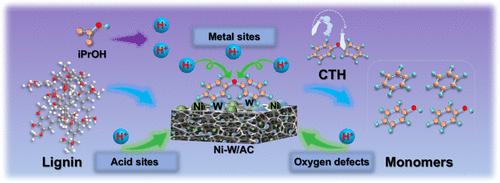
Achieving high efficiency and selectivity in cleaving aryl C–O bonds is critical for lignin valorization and the production of aromatic chemicals. A green and sustainable approach has been developed using bimetallic Ni–W catalysts, which controlled the hydrogen supply and mediated hydrogen transfer via in situ hydrogen donors. An appropriate W/Ni ratio is essential for enhancing the supply of active hydrogen, the adsorption capacity for reactive molecules, and the efficiency of hydrogen transfer, thereby optimizing the overall catalytic performance. A comprehensive investigation was conducted on the factors influencing the catalytic transfer hydrogenolysis of lignin derivatives, focusing on the reaction temperature, solvent, hydrogen source, pressure, and duration. Under optimal conditions (180 °C, 1.0 MPa N2, and <2.5 h), various lignin-derived aryl ethers achieved complete conversion with 100% monomer selectivity. This study demonstrated the excellent reusability of the Ni–W catalyst for four cycles. More significantly, the mechanisms underlying active hydrogen transfer, transfer hydrogenolysis, and bimetallic interactions were elucidated. The integration of Ni and W species significantly enhanced the synergy among active metal sites, oxygen defects, and acid sites. This synergistic mechanism enabled H• and H+ to function as the primary active hydrogen species. Furthermore, the in situ generation and targeted migration of H• radicals and H+ ions facilitated the preferential cleavage of C–O bonds over the hydrogenation of aromatic units within lignin, leading to the formation of high-value aromatic monomers.
期刊介绍:
ndustrial & Engineering Chemistry, with variations in title and format, has been published since 1909 by the American Chemical Society. Industrial & Engineering Chemistry Research is a weekly publication that reports industrial and academic research in the broad fields of applied chemistry and chemical engineering with special focus on fundamentals, processes, and products.



 京公网安备 11010802042870号
京ICP备2023020795号-1
京公网安备 11010802042870号
京ICP备2023020795号-1

 分享
分享
 求助内容:
求助内容: 应助结果提醒方式:
 扫码关注我们
