Renxing Wu, Hui Chen, Yichen Zhou, Yihao Guo, Zhangbin Ji, Long Li, Yuanfan Yang, Guoqiu Wang, Jian Zhou, Yongqing Fu
{"title":"Advances in Silicon Carbides and Their MEMS Pressure Sensors for High Temperature and Pressure Applications","authors":"Renxing Wu, Hui Chen, Yichen Zhou, Yihao Guo, Zhangbin Ji, Long Li, Yuanfan Yang, Guoqiu Wang, Jian Zhou, Yongqing Fu","doi":"10.1021/acsami.5c03045","DOIUrl":null,"url":null,"abstract":"High-temperature pressure sensors have recently attracted considerable interest for potential applications in the automotive, aerospace, and deep-well drilling industries, where they are required for monitoring gas or liquid pressures under extremely high temperatures and/or high pressures in harsh corrosive environments. Silicon carbide (SiC) is a third-generation semiconductor material with a wide band gap and excellent high-temperature stability and is regarded as a good candidate for overcoming the high-temperature intolerance of traditional pressure sensors. Currently, there are few reviews on recent advances in the synthesis, characterization, sensing mechanisms, design methodology, fabrication processes, operation, and application issues of SiC-based pressure sensors used under extreme application conditions. This review explores the following key topics: (i) key properties and special attributes of SiC materials; (ii) synthesis of SiC materials and thin films for high-temperature pressure sensor applications and processing of SiC materials, including etching, ohmic contacts, and bonding; (iii) recent development of SiC piezoresistive pressure sensors, including those based on silicon-on-insulator and all-SiC designs; (iv) recently reported SiC capacitive pressure sensors, including both 3C-SiC-based and all-SiC designs; and (v) advances in SiC-based fiber-optic pressure sensors. Finally, we highlight the key challenges and future prospects of next-generation SiC-based high-temperature pressure sensors.","PeriodicalId":5,"journal":{"name":"ACS Applied Materials & Interfaces","volume":"55 1","pages":""},"PeriodicalIF":8.2000,"publicationDate":"2025-04-26","publicationTypes":"Journal Article","fieldsOfStudy":null,"isOpenAccess":false,"openAccessPdf":"","citationCount":"0","resultStr":null,"platform":"Semanticscholar","paperid":null,"PeriodicalName":"ACS Applied Materials & Interfaces","FirstCategoryId":"88","ListUrlMain":"https://doi.org/10.1021/acsami.5c03045","RegionNum":2,"RegionCategory":"材料科学","ArticlePicture":[],"TitleCN":null,"AbstractTextCN":null,"PMCID":null,"EPubDate":"","PubModel":"","JCR":"Q1","JCRName":"MATERIALS SCIENCE, MULTIDISCIPLINARY","Score":null,"Total":0}
引用次数: 0
Abstract
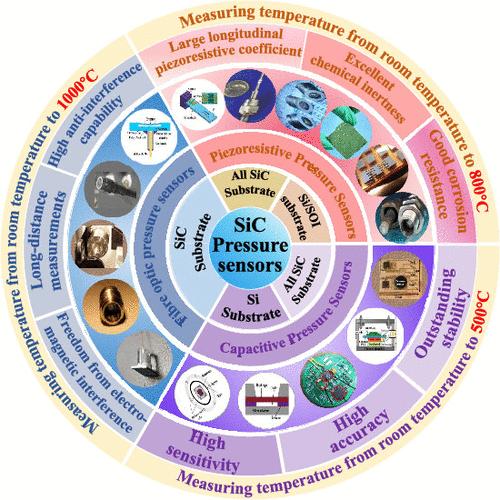
High-temperature pressure sensors have recently attracted considerable interest for potential applications in the automotive, aerospace, and deep-well drilling industries, where they are required for monitoring gas or liquid pressures under extremely high temperatures and/or high pressures in harsh corrosive environments. Silicon carbide (SiC) is a third-generation semiconductor material with a wide band gap and excellent high-temperature stability and is regarded as a good candidate for overcoming the high-temperature intolerance of traditional pressure sensors. Currently, there are few reviews on recent advances in the synthesis, characterization, sensing mechanisms, design methodology, fabrication processes, operation, and application issues of SiC-based pressure sensors used under extreme application conditions. This review explores the following key topics: (i) key properties and special attributes of SiC materials; (ii) synthesis of SiC materials and thin films for high-temperature pressure sensor applications and processing of SiC materials, including etching, ohmic contacts, and bonding; (iii) recent development of SiC piezoresistive pressure sensors, including those based on silicon-on-insulator and all-SiC designs; (iv) recently reported SiC capacitive pressure sensors, including both 3C-SiC-based and all-SiC designs; and (v) advances in SiC-based fiber-optic pressure sensors. Finally, we highlight the key challenges and future prospects of next-generation SiC-based high-temperature pressure sensors.
期刊介绍:
ACS Applied Materials & Interfaces is a leading interdisciplinary journal that brings together chemists, engineers, physicists, and biologists to explore the development and utilization of newly-discovered materials and interfacial processes for specific applications. Our journal has experienced remarkable growth since its establishment in 2009, both in terms of the number of articles published and the impact of the research showcased. We are proud to foster a truly global community, with the majority of published articles originating from outside the United States, reflecting the rapid growth of applied research worldwide.



 京公网安备 11010802042870号
京ICP备2023020795号-1
京公网安备 11010802042870号
京ICP备2023020795号-1

 分享
分享
 求助内容:
求助内容: 应助结果提醒方式:
 扫码关注我们
