Rajendra Singh , Chae-seung Lim , Sung Soo Park , Hayoung Kim , Woo Hyoung Lee , Sanghwa Park , Keugtae Kim
{"title":"Activated carbon-based hot water-assisted backwashing system for active disinfection of Chironomus riparius larvae","authors":"Rajendra Singh , Chae-seung Lim , Sung Soo Park , Hayoung Kim , Woo Hyoung Lee , Sanghwa Park , Keugtae Kim","doi":"10.1016/j.scitotenv.2025.179475","DOIUrl":null,"url":null,"abstract":"<div><div>The presence of midge larvae in tap water is a critical issue for the environmental health of water sources, as well as for water quality and safety. Although methods such as ozone treatment, coagulation and chemical applications have been attempted as primary removal methods, they have not yet succeeded in completely eradicating larvae. This study identified the use of hot water for filter backwashing as an effective method for fully eliminating larvae in water treatment facilities. Despite its apparent simplicity, this approach has not been previously explored for larval disinfection. We developed a bench-scale system that utilizes activated carbon and hot water-assisted backwashing. Our research shows that filter backwashing can achieve total disinfection of <em>Chironomus riparius</em> larvae at 45 °C in just 3 min. Furthermore, a cost assessment was conducted to determine the cost efficiency of the designed system for implementation in water treatment facilities. An economic evaluation based on the Bucheon Water Treatment Plant (with a daily flow capacity of 600,000 m<sup>3</sup>) revealed an additional cost of $3.65 per 1000 m<sup>3</sup> of water to ensure effective larval control. This study provides an efficient and environmentally sustainable solution for removing midge larvae from water treatment facilities.</div></div>","PeriodicalId":422,"journal":{"name":"Science of the Total Environment","volume":"979 ","pages":"Article 179475"},"PeriodicalIF":8.0000,"publicationDate":"2025-06-01","publicationTypes":"Journal Article","fieldsOfStudy":null,"isOpenAccess":false,"openAccessPdf":"","citationCount":"0","resultStr":null,"platform":"Semanticscholar","paperid":null,"PeriodicalName":"Science of the Total Environment","FirstCategoryId":"93","ListUrlMain":"https://www.sciencedirect.com/science/article/pii/S004896972501112X","RegionNum":1,"RegionCategory":"环境科学与生态学","ArticlePicture":[],"TitleCN":null,"AbstractTextCN":null,"PMCID":null,"EPubDate":"2025/4/27 0:00:00","PubModel":"Epub","JCR":"Q1","JCRName":"ENVIRONMENTAL SCIENCES","Score":null,"Total":0}
引用次数: 0
Abstract
The presence of midge larvae in tap water is a critical issue for the environmental health of water sources, as well as for water quality and safety. Although methods such as ozone treatment, coagulation and chemical applications have been attempted as primary removal methods, they have not yet succeeded in completely eradicating larvae. This study identified the use of hot water for filter backwashing as an effective method for fully eliminating larvae in water treatment facilities. Despite its apparent simplicity, this approach has not been previously explored for larval disinfection. We developed a bench-scale system that utilizes activated carbon and hot water-assisted backwashing. Our research shows that filter backwashing can achieve total disinfection of Chironomus riparius larvae at 45 °C in just 3 min. Furthermore, a cost assessment was conducted to determine the cost efficiency of the designed system for implementation in water treatment facilities. An economic evaluation based on the Bucheon Water Treatment Plant (with a daily flow capacity of 600,000 m3) revealed an additional cost of $3.65 per 1000 m3 of water to ensure effective larval control. This study provides an efficient and environmentally sustainable solution for removing midge larvae from water treatment facilities.
期刊介绍:
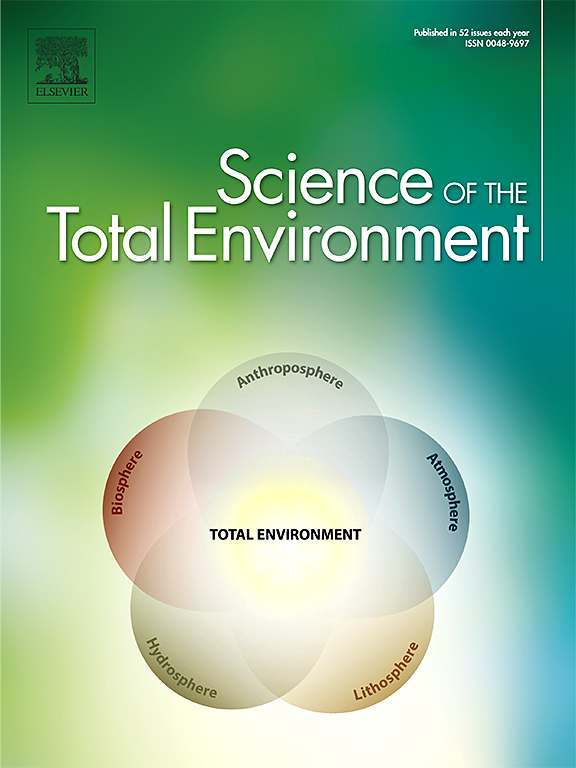
The Science of the Total Environment is an international journal dedicated to scientific research on the environment and its interaction with humanity. It covers a wide range of disciplines and seeks to publish innovative, hypothesis-driven, and impactful research that explores the entire environment, including the atmosphere, lithosphere, hydrosphere, biosphere, and anthroposphere.
The journal's updated Aims & Scope emphasizes the importance of interdisciplinary environmental research with broad impact. Priority is given to studies that advance fundamental understanding and explore the interconnectedness of multiple environmental spheres. Field studies are preferred, while laboratory experiments must demonstrate significant methodological advancements or mechanistic insights with direct relevance to the environment.




 京公网安备 11010802042870号
京ICP备2023020795号-1
京公网安备 11010802042870号
京ICP备2023020795号-1

 分享
分享
 求助内容:
求助内容: 应助结果提醒方式:
 扫码关注我们
