{"title":"Identifiability, exchangeability, and epidemiological confounding.","authors":"S Greenland, J M Robins","doi":"10.1093/ije/15.3.413","DOIUrl":null,"url":null,"abstract":"<p><p>Non-identifiability of parameters is a well-recognized problem in classical statistics, and Bayesian statisticians have long recognized the importance of exchangeability assumptions in making statistical inferences. A seemingly unrelated problem in epidemiology is that of confounding: bias in estimation of the effects of an exposure on disease risk, due to inherent differences in risk between exposed and unexposed individuals. Using a simple deterministic model for exposure effects, a logical connection is drawn between the concepts of identifiability, exchangeability, and confounding. This connection allows one to view the problem of confounding as arising from problems of identifiability, and reveals the exchangeability assumptions that are implicit in confounder control methods. It also provides further justification for confounder definitions based on comparability of exposure groups, as opposed to collapsibility-based definitions.</p>","PeriodicalId":14147,"journal":{"name":"International journal of epidemiology","volume":"15 3","pages":"413-9"},"PeriodicalIF":5.9000,"publicationDate":"1986-09-01","publicationTypes":"Journal Article","fieldsOfStudy":null,"isOpenAccess":false,"openAccessPdf":"https://sci-hub-pdf.com/10.1093/ije/15.3.413","citationCount":"615","resultStr":null,"platform":"Semanticscholar","paperid":null,"PeriodicalName":"International journal of epidemiology","FirstCategoryId":"3","ListUrlMain":"https://doi.org/10.1093/ije/15.3.413","RegionNum":2,"RegionCategory":"医学","ArticlePicture":[],"TitleCN":null,"AbstractTextCN":null,"PMCID":null,"EPubDate":"","PubModel":"","JCR":"Q1","JCRName":"PUBLIC, ENVIRONMENTAL & OCCUPATIONAL HEALTH","Score":null,"Total":0}
引用次数: 615
Abstract
Non-identifiability of parameters is a well-recognized problem in classical statistics, and Bayesian statisticians have long recognized the importance of exchangeability assumptions in making statistical inferences. A seemingly unrelated problem in epidemiology is that of confounding: bias in estimation of the effects of an exposure on disease risk, due to inherent differences in risk between exposed and unexposed individuals. Using a simple deterministic model for exposure effects, a logical connection is drawn between the concepts of identifiability, exchangeability, and confounding. This connection allows one to view the problem of confounding as arising from problems of identifiability, and reveals the exchangeability assumptions that are implicit in confounder control methods. It also provides further justification for confounder definitions based on comparability of exposure groups, as opposed to collapsibility-based definitions.
期刊介绍:
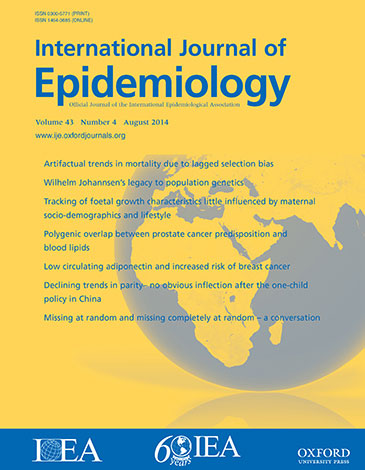
The International Journal of Epidemiology is a vital resource for individuals seeking to stay updated on the latest advancements and emerging trends in the field of epidemiology worldwide.
The journal fosters communication among researchers, educators, and practitioners involved in the study, teaching, and application of epidemiology pertaining to both communicable and non-communicable diseases. It also includes research on health services and medical care.
Furthermore, the journal presents new methodologies in epidemiology and statistics, catering to professionals working in social and preventive medicine. Published six times a year, the International Journal of Epidemiology provides a comprehensive platform for the analysis of data.
Overall, this journal is an indispensable tool for staying informed and connected within the dynamic realm of epidemiology.



 京公网安备 11010802042870号
京ICP备2023020795号-1
京公网安备 11010802042870号
京ICP备2023020795号-1

 分享
分享
 求助内容:
求助内容: 应助结果提醒方式:
 扫码关注我们
