{"title":"Influence of reduced oxygen availability on cerebral metabolic changes during bicuculline-induced seizures in rats.","authors":"G Blennow, B Nilsson, B K Siesjö","doi":"10.1038/jcbfm.1985.59","DOIUrl":null,"url":null,"abstract":"<p><p>The objective of the present work was to study cerebral energy metabolism at threshold levels of hypoxia, i.e., degrees of hypoxia that abolish cerebral electrical activity, in the \"normal\" and in the epileptic brain. Seizures were induced by intravenous bicuculline and cerebral oxygen availability was reduced by a combination of lowered PO2 and reduced blood pressure to give a transformation of the burst suppression pattern to either one with single spikes or overt EEG flattening. Nonepileptic control animals were exposed to degrees of hypoxia that gave either a markedly depressed EEG pattern with sparse slow waves or EEG flattening. Epileptic and nonepileptic groups proved comparable in terms of calculated oxygen availability and cerebral oxygen consumption at the threshold of \"transmission failure.\" At levels of hypoxia that markedly attenuated or completely abolished seizure discharge, the cerebral metabolic changes were more marked than in comparable nonepileptic animals. These changes comprised an imminent severe perturbation of cerebral cortical phosphorylation potential, a pronounced lactic acidosis with a precipitous redox change, and a marked accumulation of ammonia. The more labile energy balance of the epileptic brain may indicate that the \"seizure state\" either increases cellular energy demands in spite of the electrical silence or reduces the efficiency of ATP production at the prevailing oxygen availability. It is conceivable that energy failure elicited by complicating hypoxia can aggravate or precipitate brain cell damage in epilepsy.</p>","PeriodicalId":15325,"journal":{"name":"Journal of Cerebral Blood Flow and Metabolism","volume":"5 3","pages":"439-45"},"PeriodicalIF":4.5000,"publicationDate":"1985-09-01","publicationTypes":"Journal Article","fieldsOfStudy":null,"isOpenAccess":false,"openAccessPdf":"https://sci-hub-pdf.com/10.1038/jcbfm.1985.59","citationCount":"29","resultStr":null,"platform":"Semanticscholar","paperid":null,"PeriodicalName":"Journal of Cerebral Blood Flow and Metabolism","FirstCategoryId":"3","ListUrlMain":"https://doi.org/10.1038/jcbfm.1985.59","RegionNum":2,"RegionCategory":"医学","ArticlePicture":[],"TitleCN":null,"AbstractTextCN":null,"PMCID":null,"EPubDate":"","PubModel":"","JCR":"Q1","JCRName":"ENDOCRINOLOGY & METABOLISM","Score":null,"Total":0}
引用次数: 29
Abstract
The objective of the present work was to study cerebral energy metabolism at threshold levels of hypoxia, i.e., degrees of hypoxia that abolish cerebral electrical activity, in the "normal" and in the epileptic brain. Seizures were induced by intravenous bicuculline and cerebral oxygen availability was reduced by a combination of lowered PO2 and reduced blood pressure to give a transformation of the burst suppression pattern to either one with single spikes or overt EEG flattening. Nonepileptic control animals were exposed to degrees of hypoxia that gave either a markedly depressed EEG pattern with sparse slow waves or EEG flattening. Epileptic and nonepileptic groups proved comparable in terms of calculated oxygen availability and cerebral oxygen consumption at the threshold of "transmission failure." At levels of hypoxia that markedly attenuated or completely abolished seizure discharge, the cerebral metabolic changes were more marked than in comparable nonepileptic animals. These changes comprised an imminent severe perturbation of cerebral cortical phosphorylation potential, a pronounced lactic acidosis with a precipitous redox change, and a marked accumulation of ammonia. The more labile energy balance of the epileptic brain may indicate that the "seizure state" either increases cellular energy demands in spite of the electrical silence or reduces the efficiency of ATP production at the prevailing oxygen availability. It is conceivable that energy failure elicited by complicating hypoxia can aggravate or precipitate brain cell damage in epilepsy.
期刊介绍:
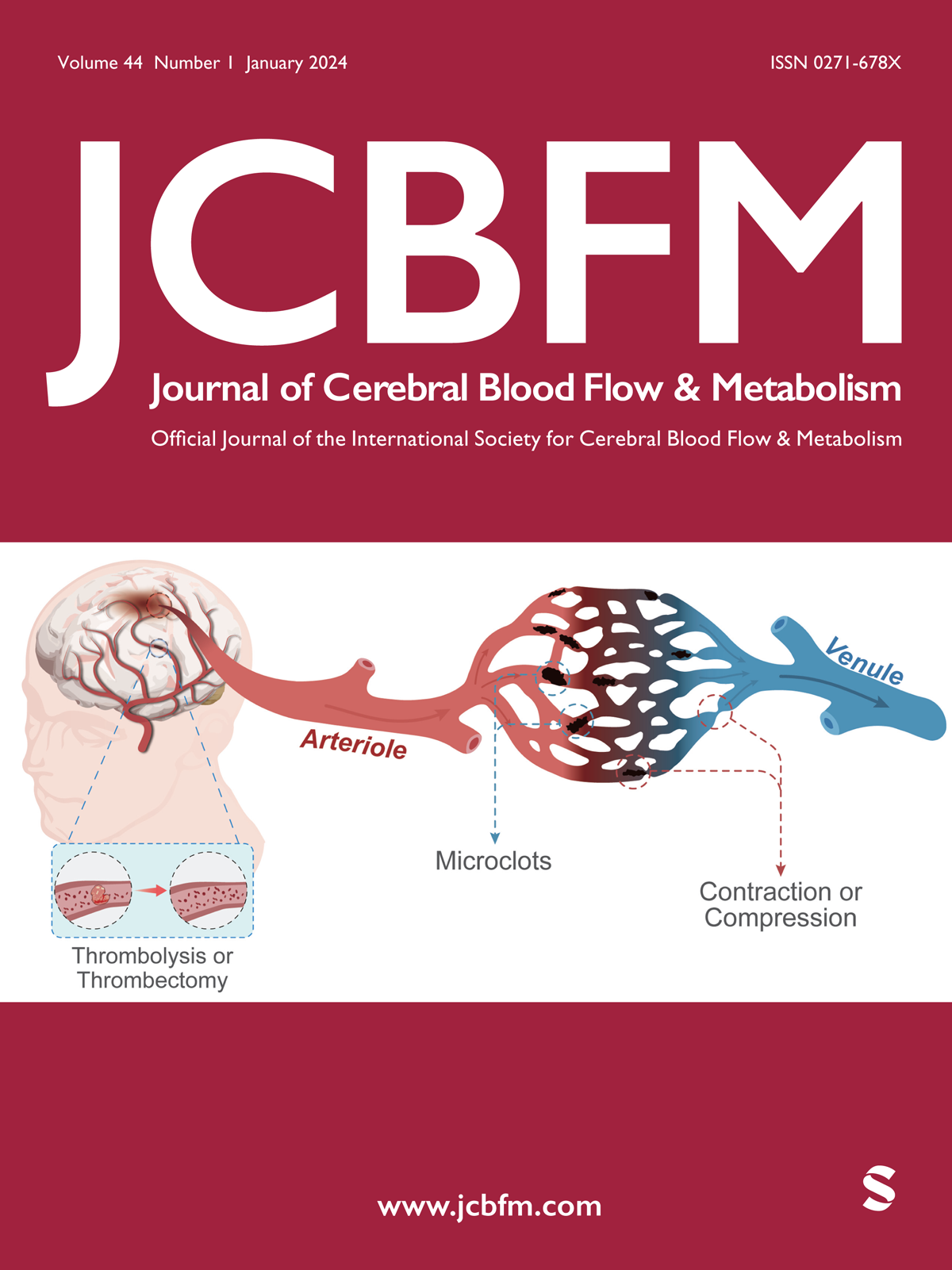
JCBFM is the official journal of the International Society for Cerebral Blood Flow & Metabolism, which is committed to publishing high quality, independently peer-reviewed research and review material. JCBFM stands at the interface between basic and clinical neurovascular research, and features timely and relevant research highlighting experimental, theoretical, and clinical aspects of brain circulation, metabolism and imaging. The journal is relevant to any physician or scientist with an interest in brain function, cerebrovascular disease, cerebral vascular regulation and brain metabolism, including neurologists, neurochemists, physiologists, pharmacologists, anesthesiologists, neuroradiologists, neurosurgeons, neuropathologists and neuroscientists.




 京公网安备 11010802042870号
京ICP备2023020795号-1
京公网安备 11010802042870号
京ICP备2023020795号-1

 分享
分享
 求助内容:
求助内容: 应助结果提醒方式:
 扫码关注我们
