Frédéric Dutheil , Aurélie Comptour , Roxane Morlon , Martial Mermillod , Bruno Pereira , Julien S. Baker , Morteza Charkhabi , Maëlys Clinchamps , Nicolas Bourdel
{"title":"Autism spectrum disorder and air pollution: A systematic review and meta-analysis","authors":"Frédéric Dutheil , Aurélie Comptour , Roxane Morlon , Martial Mermillod , Bruno Pereira , Julien S. Baker , Morteza Charkhabi , Maëlys Clinchamps , Nicolas Bourdel","doi":"10.1016/j.envpol.2021.116856","DOIUrl":null,"url":null,"abstract":"<div><p><span>Despite the widely-known effects of air pollution, pollutants exposure surrounding pregnancy and the risk for autism spectrum disorder (ASD) in newborns remains controversial. The purpose of our study was to carry out a systematic review and meta-analyses of the risk of ASD in newborns following air pollution exposure during the perinatal period (preconception to second year of life). The PubMed, Cochrane Library, Embase and ScienceDirect databases were searched for articles, published up to July 2020, with the keywords “air pollution” and “autism”. Three models were used for each meta-analysis: a global model based on all risks listed in included articles, a pessimistic model based on less favorable data only, and an optimistic model based on the most favorable data only. 28 studies corresponding to a total of 758 997 newborns were included (47190 ASD and 703980 controls). Maternal exposure to all pollutants was associated with an increased risk of ASD in newborns by 3.9% using the global model and by 12.3% using the optimistic model, while the pessimistic model found no change. Each increase of 5 μg/m</span><sup>3</sup><span><span> in particulate matter <2.5 μm (PM2.5) was associated with an increased risk of ASD in newborns, regardless of the model used (global +7%, pessimistic +5%, optimistic +15%). This risk increased during preconception (global +17%), during pregnancy (global +5%, and optimistic +16%), and during the postnatal period (global +11% and optimistic +16%). Evidence levels were poor for other pollutants (PM10, </span>NOx<span>, O3, metals, solvents, styrene, PAHs, pesticides). PM2.5 was associated with a greater risk than PM10 (coefficient 0.20, 95CI −0.02 to 0.42), NOx (0.29, 0.08 to 0.50) or solvents (0.24, 0.04 to 0.44). All models revealed that exposure to pollutants, notably PM2.5 during pregnancy, was associated with an increased risk of ASD in newborns. Pregnancy and postnatal periods seem to be the most at-risk periods.</span></span></p></div>","PeriodicalId":311,"journal":{"name":"Environmental Pollution","volume":"278 ","pages":"Article 116856"},"PeriodicalIF":7.3000,"publicationDate":"2021-06-01","publicationTypes":"Journal Article","fieldsOfStudy":null,"isOpenAccess":false,"openAccessPdf":"https://sci-hub-pdf.com/10.1016/j.envpol.2021.116856","citationCount":"31","resultStr":null,"platform":"Semanticscholar","paperid":null,"PeriodicalName":"Environmental Pollution","FirstCategoryId":"93","ListUrlMain":"https://www.sciencedirect.com/science/article/pii/S0269749121004383","RegionNum":2,"RegionCategory":"环境科学与生态学","ArticlePicture":[],"TitleCN":null,"AbstractTextCN":null,"PMCID":null,"EPubDate":"2021/3/2 0:00:00","PubModel":"Epub","JCR":"Q1","JCRName":"ENVIRONMENTAL SCIENCES","Score":null,"Total":0}
引用次数: 31
Abstract
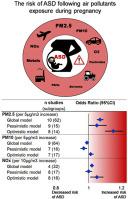
Despite the widely-known effects of air pollution, pollutants exposure surrounding pregnancy and the risk for autism spectrum disorder (ASD) in newborns remains controversial. The purpose of our study was to carry out a systematic review and meta-analyses of the risk of ASD in newborns following air pollution exposure during the perinatal period (preconception to second year of life). The PubMed, Cochrane Library, Embase and ScienceDirect databases were searched for articles, published up to July 2020, with the keywords “air pollution” and “autism”. Three models were used for each meta-analysis: a global model based on all risks listed in included articles, a pessimistic model based on less favorable data only, and an optimistic model based on the most favorable data only. 28 studies corresponding to a total of 758 997 newborns were included (47190 ASD and 703980 controls). Maternal exposure to all pollutants was associated with an increased risk of ASD in newborns by 3.9% using the global model and by 12.3% using the optimistic model, while the pessimistic model found no change. Each increase of 5 μg/m3 in particulate matter <2.5 μm (PM2.5) was associated with an increased risk of ASD in newborns, regardless of the model used (global +7%, pessimistic +5%, optimistic +15%). This risk increased during preconception (global +17%), during pregnancy (global +5%, and optimistic +16%), and during the postnatal period (global +11% and optimistic +16%). Evidence levels were poor for other pollutants (PM10, NOx, O3, metals, solvents, styrene, PAHs, pesticides). PM2.5 was associated with a greater risk than PM10 (coefficient 0.20, 95CI −0.02 to 0.42), NOx (0.29, 0.08 to 0.50) or solvents (0.24, 0.04 to 0.44). All models revealed that exposure to pollutants, notably PM2.5 during pregnancy, was associated with an increased risk of ASD in newborns. Pregnancy and postnatal periods seem to be the most at-risk periods.
期刊介绍:
Environmental Pollution is an international peer-reviewed journal that publishes high-quality research papers and review articles covering all aspects of environmental pollution and its impacts on ecosystems and human health.
Subject areas include, but are not limited to:
• Sources and occurrences of pollutants that are clearly defined and measured in environmental compartments, food and food-related items, and human bodies;
• Interlinks between contaminant exposure and biological, ecological, and human health effects, including those of climate change;
• Contaminants of emerging concerns (including but not limited to antibiotic resistant microorganisms or genes, microplastics/nanoplastics, electronic wastes, light, and noise) and/or their biological, ecological, or human health effects;
• Laboratory and field studies on the remediation/mitigation of environmental pollution via new techniques and with clear links to biological, ecological, or human health effects;
• Modeling of pollution processes, patterns, or trends that is of clear environmental and/or human health interest;
• New techniques that measure and examine environmental occurrences, transport, behavior, and effects of pollutants within the environment or the laboratory, provided that they can be clearly used to address problems within regional or global environmental compartments.



 京公网安备 11010802042870号
京ICP备2023020795号-1
京公网安备 11010802042870号
京ICP备2023020795号-1

 分享
分享
 求助内容:
求助内容: 应助结果提醒方式:
 扫码关注我们
