Kaiquan Zhang , Yanlin Lv , Jiaqi Meng , Jie Wang , Aidong Peng , Xuefei Wang , Zhiyuan Tian
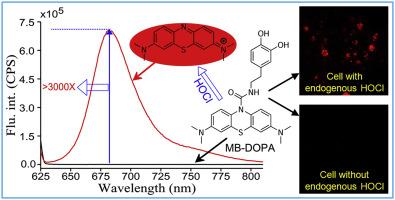
{"title":"A single-chromophore-based agent enables rapid sensing of intracellular hypochlorous acid and in-situ photodynamic therapy to cancer cells","authors":"Kaiquan Zhang , Yanlin Lv , Jiaqi Meng , Jie Wang , Aidong Peng , Xuefei Wang , Zhiyuan Tian","doi":"10.1016/j.aca.2019.02.005","DOIUrl":null,"url":null,"abstract":"<div><p>A single-chromophore-based photoactive agent (MB-DOPA) capable of rapid sensing of nanomolar hypochlorous acid (HOCl) and <em>in-situ</em> generating photocytotoxicity to cancer cells was developed using dopamine moiety as the recognition unit and methylene blue (MB) moiety as the fluorescence signaling unit. Specifically, HOCl triggered conversion of the nonfluorescent MB-DOPA to MB enabling far-red fluorescence emission (<em>λ</em><sub>max</sub> ∼ 683 nm) and additional ability to photogenerate <sup>1</sup>O<sub>2</sub> species. Owing to the catechol nature of dopamine characterized with strong electron-donating property, MB-DOPA underwent HOCl-mediated conversion with response time of ∼20 s and a strong fluorescence OFF-to-ON contrast by a factor of more than 3000. The preliminary bioimaging results confirmed the intracellular HOCl sensing ability of MB-DOPA and the <em>in-situ</em> photodynamic therapy (PDT) effectiveness for inducing massive apoptosis of cancer cells. The figure of merits of MB-DOPA, including ability for sensing of nanomolar HOCl with high specificity, rapid response, practicality for intracellular fluorescence imaging, and the <em>in-situ</em> generation of <sup>1</sup>O<sub>2</sub> for killing tumor cells, is expected to enable diagnosis of early-stage oncogenesis based on the highly specific detection of abnormal HOCl levels in the transformed cells and the simultaneous treatment in biomedical applications.</p></div>","PeriodicalId":240,"journal":{"name":"Analytica Chimica Acta","volume":"1061 ","pages":"Pages 142-151"},"PeriodicalIF":6.0000,"publicationDate":"2019-07-11","publicationTypes":"Journal Article","fieldsOfStudy":null,"isOpenAccess":false,"openAccessPdf":"https://sci-hub-pdf.com/10.1016/j.aca.2019.02.005","citationCount":"7","resultStr":null,"platform":"Semanticscholar","paperid":null,"PeriodicalName":"Analytica Chimica Acta","FirstCategoryId":"92","ListUrlMain":"https://www.sciencedirect.com/science/article/pii/S0003267019301655","RegionNum":2,"RegionCategory":"化学","ArticlePicture":[],"TitleCN":null,"AbstractTextCN":null,"PMCID":null,"EPubDate":"2019/2/14 0:00:00","PubModel":"Epub","JCR":"Q1","JCRName":"CHEMISTRY, ANALYTICAL","Score":null,"Total":0}
引用次数: 7
Abstract
A single-chromophore-based photoactive agent (MB-DOPA) capable of rapid sensing of nanomolar hypochlorous acid (HOCl) and in-situ generating photocytotoxicity to cancer cells was developed using dopamine moiety as the recognition unit and methylene blue (MB) moiety as the fluorescence signaling unit. Specifically, HOCl triggered conversion of the nonfluorescent MB-DOPA to MB enabling far-red fluorescence emission (λmax ∼ 683 nm) and additional ability to photogenerate 1O2 species. Owing to the catechol nature of dopamine characterized with strong electron-donating property, MB-DOPA underwent HOCl-mediated conversion with response time of ∼20 s and a strong fluorescence OFF-to-ON contrast by a factor of more than 3000. The preliminary bioimaging results confirmed the intracellular HOCl sensing ability of MB-DOPA and the in-situ photodynamic therapy (PDT) effectiveness for inducing massive apoptosis of cancer cells. The figure of merits of MB-DOPA, including ability for sensing of nanomolar HOCl with high specificity, rapid response, practicality for intracellular fluorescence imaging, and the in-situ generation of 1O2 for killing tumor cells, is expected to enable diagnosis of early-stage oncogenesis based on the highly specific detection of abnormal HOCl levels in the transformed cells and the simultaneous treatment in biomedical applications.
期刊介绍:
Analytica Chimica Acta has an open access mirror journal Analytica Chimica Acta: X, sharing the same aims and scope, editorial team, submission system and rigorous peer review.
Analytica Chimica Acta provides a forum for the rapid publication of original research, and critical, comprehensive reviews dealing with all aspects of fundamental and applied modern analytical chemistry. The journal welcomes the submission of research papers which report studies concerning the development of new and significant analytical methodologies. In determining the suitability of submitted articles for publication, particular scrutiny will be placed on the degree of novelty and impact of the research and the extent to which it adds to the existing body of knowledge in analytical chemistry.



 京公网安备 11010802042870号
京ICP备2023020795号-1
京公网安备 11010802042870号
京ICP备2023020795号-1

 分享
分享
 求助内容:
求助内容: 应助结果提醒方式:
 扫码关注我们
