Effective methylation of phosphonic acids related to chemical warfare agents mediated by trimethyloxonium tetrafluoroborate for their qualitative detection and identification by gas chromatography-mass spectrometry
Carlos A. Valdez , Roald N. Leif , Armando Alcaraz
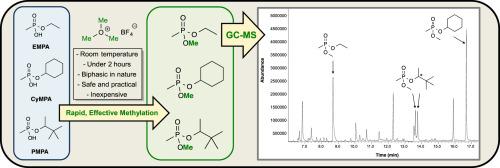
{"title":"Effective methylation of phosphonic acids related to chemical warfare agents mediated by trimethyloxonium tetrafluoroborate for their qualitative detection and identification by gas chromatography-mass spectrometry","authors":"Carlos A. Valdez , Roald N. Leif , Armando Alcaraz","doi":"10.1016/j.aca.2016.05.034","DOIUrl":null,"url":null,"abstract":"<div><p><span><span>The effective methylation of </span>phosphonic acids<span> related to chemical warfare agents (CWAs) employing trimethyloxonium tetrafluoroborate (TMO·BF</span></span><sub>4</sub><span>) for their qualitative detection and identification by gas chromatography-mass spectrometry (GC-MS) is presented. The methylation occurs in rapid fashion (1 h) and can be conveniently carried out at ambient temperature, thus providing a safer alternative to the universally employed diazomethane-based methylation protocols. Optimization of the methylation parameters led us to conclude that methylene chloride<span> was the ideal solvent to carry out the derivatization, and that even though methylated products can be observed surfacing after only 1 h, additional time was not found to be detrimental but beneficial to the process particularly when dealing with analytes at low concentrations (∼10 μg mL</span></span><sup>−1</sup>). Due to its insolubility in methylene chloride, TMO·BF<sub>4</sub><span><span> conveniently settles to the bottom during the reaction and does not produce additional interfering by-products that may further complicate the GC-MS analysis. The method was demonstrated to successfully methylate a variety of Schedule 2 phosphonic acids, including their half esters, resulting in derivatives that were readily detected and identified using the instrument's spectral library. Most importantly, the method was shown to simultaneously methylate a mixture of the organophosphorus-based nerve agent hydrolysis products: pinacolyl methylphosphonate (PMPA), cyclohexyl methylphosphonate (CyMPA) and </span>ethyl methylphosphonate (EMPA) (at a 10 μg mL</span><sup>−1</sup> concentration each) in a fatty acid ester-rich organic matrix (OPCW-PT-O3) featured in the 38th Organisation for the Prohibition of Chemical Weapons (OPCW) Proficiency Test. In addition, the protocol was found to effectively methylate <em>N,N</em><span>-diethylamino ethanesulfonic acid and </span><em>N,N</em><span>-diisopropylamino ethanesulfonic acid that are products arising from the oxidative degradation of the V-series agents VR and VX respectively. The work described herein represents the first report on the use of TMO·BF</span><sub>4</sub> as a viable, stable and safe agent for the methylation of phosphonic acids and their half esters and within the context of an OPCW Proficiency Test sample analysis.</p></div>","PeriodicalId":240,"journal":{"name":"Analytica Chimica Acta","volume":"933 ","pages":"Pages 134-143"},"PeriodicalIF":6.0000,"publicationDate":"2016-08-24","publicationTypes":"Journal Article","fieldsOfStudy":null,"isOpenAccess":false,"openAccessPdf":"https://sci-hub-pdf.com/10.1016/j.aca.2016.05.034","citationCount":"28","resultStr":null,"platform":"Semanticscholar","paperid":null,"PeriodicalName":"Analytica Chimica Acta","FirstCategoryId":"92","ListUrlMain":"https://www.sciencedirect.com/science/article/pii/S0003267016307097","RegionNum":2,"RegionCategory":"化学","ArticlePicture":[],"TitleCN":null,"AbstractTextCN":null,"PMCID":null,"EPubDate":"","PubModel":"","JCR":"Q1","JCRName":"CHEMISTRY, ANALYTICAL","Score":null,"Total":0}
引用次数: 28
Abstract
The effective methylation of phosphonic acids related to chemical warfare agents (CWAs) employing trimethyloxonium tetrafluoroborate (TMO·BF4) for their qualitative detection and identification by gas chromatography-mass spectrometry (GC-MS) is presented. The methylation occurs in rapid fashion (1 h) and can be conveniently carried out at ambient temperature, thus providing a safer alternative to the universally employed diazomethane-based methylation protocols. Optimization of the methylation parameters led us to conclude that methylene chloride was the ideal solvent to carry out the derivatization, and that even though methylated products can be observed surfacing after only 1 h, additional time was not found to be detrimental but beneficial to the process particularly when dealing with analytes at low concentrations (∼10 μg mL−1). Due to its insolubility in methylene chloride, TMO·BF4 conveniently settles to the bottom during the reaction and does not produce additional interfering by-products that may further complicate the GC-MS analysis. The method was demonstrated to successfully methylate a variety of Schedule 2 phosphonic acids, including their half esters, resulting in derivatives that were readily detected and identified using the instrument's spectral library. Most importantly, the method was shown to simultaneously methylate a mixture of the organophosphorus-based nerve agent hydrolysis products: pinacolyl methylphosphonate (PMPA), cyclohexyl methylphosphonate (CyMPA) and ethyl methylphosphonate (EMPA) (at a 10 μg mL−1 concentration each) in a fatty acid ester-rich organic matrix (OPCW-PT-O3) featured in the 38th Organisation for the Prohibition of Chemical Weapons (OPCW) Proficiency Test. In addition, the protocol was found to effectively methylate N,N-diethylamino ethanesulfonic acid and N,N-diisopropylamino ethanesulfonic acid that are products arising from the oxidative degradation of the V-series agents VR and VX respectively. The work described herein represents the first report on the use of TMO·BF4 as a viable, stable and safe agent for the methylation of phosphonic acids and their half esters and within the context of an OPCW Proficiency Test sample analysis.
期刊介绍:
Analytica Chimica Acta has an open access mirror journal Analytica Chimica Acta: X, sharing the same aims and scope, editorial team, submission system and rigorous peer review.
Analytica Chimica Acta provides a forum for the rapid publication of original research, and critical, comprehensive reviews dealing with all aspects of fundamental and applied modern analytical chemistry. The journal welcomes the submission of research papers which report studies concerning the development of new and significant analytical methodologies. In determining the suitability of submitted articles for publication, particular scrutiny will be placed on the degree of novelty and impact of the research and the extent to which it adds to the existing body of knowledge in analytical chemistry.



 京公网安备 11010802042870号
京ICP备2023020795号-1
京公网安备 11010802042870号
京ICP备2023020795号-1

 分享
分享
 求助内容:
求助内容: 应助结果提醒方式:
 扫码关注我们
