One-pot microwave-assisted synthesis of blue emissive multifunctional N-S-P co-doped carbon dots as a nanoprobe for sequential detection of Cr(VI) and ascorbic acid in real samples, fluorescent ink and logic gate operation
{"title":"One-pot microwave-assisted synthesis of blue emissive multifunctional N-S-P co-doped carbon dots as a nanoprobe for sequential detection of Cr(VI) and ascorbic acid in real samples, fluorescent ink and logic gate operation","authors":"Harshita Laddha , Priya Yadav , Yachana Jain , Manish Sharma , Mohtashim Reza , Madhu Agarwal , Ragini Gupta","doi":"10.1016/j.molliq.2021.117088","DOIUrl":null,"url":null,"abstract":"<div><p>In this communication, blue light-emitting fluorescent N-S-P co-doped carbon dots (PGP-CDs) were synthesized by a simple, yet rapid procedure using microwave charring. Low cost, easily accessible precursors like glutathione, polyethylene glycol (PEG-400), and <em>o</em>-phosphoric acid (H<sub>3</sub>PO<sub>4</sub>) were used in the synthesis following which PGP-CDs obtained with a good quantum yield (15%) were well characterized. The HRTEM analysis showed that PGP-CDs were well distributed and spherical, with an average size of 4.5 nm. XPS analysis confirmed the chemical composition of doped N-S-P-CDs, and fluorescence spectroscopy revealed that they exhibit pH-independent and excitation wavelength-dependent fluorescence with excitation/emission maxima at 380/455 nm. Blue fluorescence of the PGP-CDs was exclusively quenched by the addition of carcinogenic Cr(VI) in the presence of other metal ions within a linear range of 0.1–100 µM which can be explained by the inner filter effect (IFE). The regeneration of carbon dots could be achieved by the addition of ascorbic acid (AA) and thus, PGP-CDs act as a sensitive fluorescent turn “on–off-on” nano-sensor in water. The limit of detection (LOD) for Cr(VI) was found to be 4 nM which is lesser than the permissible limit (0.9 µM) as prescribed by World Health Organisation (WHO) in drinking water. PGP-CDs show reversibility up to four cycles and on this basis, a combinatorial molecular logic gate consisting of a special combination of logic functions NAND & NOT has been constructed. Furthermore, PGP-CDs were also utilized as fluorescent ink without any chemical alteration. For real sample applications, PGP-CDs were also successfully applied to determine Cr(VI) in real water samples and PGP-CD + Cr(VI) complex to detect AA levels in food samples. Results obtained from real sample analysis suggest that PGP-CDs can be used as a potential nanoprobe that offers outstanding precision in detecting the trace amount of Cr(VI) and AA with a low detection limit.</p></div>","PeriodicalId":371,"journal":{"name":"Journal of Molecular Liquids","volume":"346 ","pages":"Article 117088"},"PeriodicalIF":5.2000,"publicationDate":"2022-01-15","publicationTypes":"Journal Article","fieldsOfStudy":null,"isOpenAccess":false,"openAccessPdf":"","citationCount":"22","resultStr":null,"platform":"Semanticscholar","paperid":null,"PeriodicalName":"Journal of Molecular Liquids","FirstCategoryId":"92","ListUrlMain":"https://www.sciencedirect.com/science/article/pii/S0167732221018122","RegionNum":2,"RegionCategory":"化学","ArticlePicture":[],"TitleCN":null,"AbstractTextCN":null,"PMCID":null,"EPubDate":"","PubModel":"","JCR":"Q2","JCRName":"CHEMISTRY, PHYSICAL","Score":null,"Total":0}
引用次数: 22
Abstract
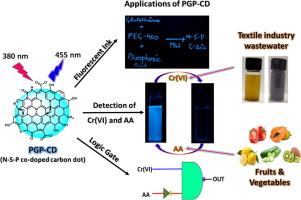
In this communication, blue light-emitting fluorescent N-S-P co-doped carbon dots (PGP-CDs) were synthesized by a simple, yet rapid procedure using microwave charring. Low cost, easily accessible precursors like glutathione, polyethylene glycol (PEG-400), and o-phosphoric acid (H3PO4) were used in the synthesis following which PGP-CDs obtained with a good quantum yield (15%) were well characterized. The HRTEM analysis showed that PGP-CDs were well distributed and spherical, with an average size of 4.5 nm. XPS analysis confirmed the chemical composition of doped N-S-P-CDs, and fluorescence spectroscopy revealed that they exhibit pH-independent and excitation wavelength-dependent fluorescence with excitation/emission maxima at 380/455 nm. Blue fluorescence of the PGP-CDs was exclusively quenched by the addition of carcinogenic Cr(VI) in the presence of other metal ions within a linear range of 0.1–100 µM which can be explained by the inner filter effect (IFE). The regeneration of carbon dots could be achieved by the addition of ascorbic acid (AA) and thus, PGP-CDs act as a sensitive fluorescent turn “on–off-on” nano-sensor in water. The limit of detection (LOD) for Cr(VI) was found to be 4 nM which is lesser than the permissible limit (0.9 µM) as prescribed by World Health Organisation (WHO) in drinking water. PGP-CDs show reversibility up to four cycles and on this basis, a combinatorial molecular logic gate consisting of a special combination of logic functions NAND & NOT has been constructed. Furthermore, PGP-CDs were also utilized as fluorescent ink without any chemical alteration. For real sample applications, PGP-CDs were also successfully applied to determine Cr(VI) in real water samples and PGP-CD + Cr(VI) complex to detect AA levels in food samples. Results obtained from real sample analysis suggest that PGP-CDs can be used as a potential nanoprobe that offers outstanding precision in detecting the trace amount of Cr(VI) and AA with a low detection limit.
期刊介绍:
The journal includes papers in the following areas:
– Simple organic liquids and mixtures
– Ionic liquids
– Surfactant solutions (including micelles and vesicles) and liquid interfaces
– Colloidal solutions and nanoparticles
– Thermotropic and lyotropic liquid crystals
– Ferrofluids
– Water, aqueous solutions and other hydrogen-bonded liquids
– Lubricants, polymer solutions and melts
– Molten metals and salts
– Phase transitions and critical phenomena in liquids and confined fluids
– Self assembly in complex liquids.– Biomolecules in solution
The emphasis is on the molecular (or microscopic) understanding of particular liquids or liquid systems, especially concerning structure, dynamics and intermolecular forces. The experimental techniques used may include:
– Conventional spectroscopy (mid-IR and far-IR, Raman, NMR, etc.)
– Non-linear optics and time resolved spectroscopy (psec, fsec, asec, ISRS, etc.)
– Light scattering (Rayleigh, Brillouin, PCS, etc.)
– Dielectric relaxation
– X-ray and neutron scattering and diffraction.
Experimental studies, computer simulations (MD or MC) and analytical theory will be considered for publication; papers just reporting experimental results that do not contribute to the understanding of the fundamentals of molecular and ionic liquids will not be accepted. Only papers of a non-routine nature and advancing the field will be considered for publication.



 京公网安备 11010802042870号
京ICP备2023020795号-1
京公网安备 11010802042870号
京ICP备2023020795号-1

 分享
分享
 求助内容:
求助内容: 应助结果提醒方式:
 扫码关注我们
