Design and synthesis of photocrosslinker and light blocker based on l-Amino acid polyester and their application in solvent-free resin formulation for DLP/SLA 3D printing

IF 4.5 2区 化学 Q2 POLYMER SCIENCE Polymer Pub Date : 2023-03-27 DOI:10.1016/j.polymer.2023.125781
Ganesh N. Kamble , Dheeraj Chandra Joshi , S.K. Asha
{"title":"Design and synthesis of photocrosslinker and light blocker based on l-Amino acid polyester and their application in solvent-free resin formulation for DLP/SLA 3D printing","authors":"Ganesh N. Kamble ,&nbsp;Dheeraj Chandra Joshi ,&nbsp;S.K. Asha","doi":"10.1016/j.polymer.2023.125781","DOIUrl":null,"url":null,"abstract":"<div><p><span>Customising material design for new technological applications like additive manufacturing (AM) is a challenging yet promising approach to create a palette of materials suitable for developing eco-friendly products. </span><span>l</span>-Glutamic acid and <span>l</span><span>-aspartic acid based aliphatic, photocurable polyester crosslinkers were designed and developed and incorporated into a solvent-free photocurable resin formulation with hydroxyl<span> (ethyl)methacrylate (HEMA). Proof-of-concept 3D printing of clear and transparent objects was demonstrated using digital light processing (DLP) and Stereolithography (SLA) techniques. Resolution of the 3D printed objects could be improved by incorporating a Dansyl labelled </span></span><span>l</span><span><span>-glutamic acid polyester, which not only aided in modulating the viscosity of the resin formulation but could also function as a light blocker, thereby avoiding polymerization of unwanted areas while 3D printing. The curing kinetics of the photocurable formulation was analyzed using photo differential Scanning Calorimetry. Enzymatic degradability studies of 3D printed films were undertaken in PBS buffer containing esterase enzyme and compared with 3D printed samples using HEMA and a commercial crosslinker (Trimethylolpropane triacrylate (TMPTA)). Scanning electron microscopy (SEM) was used to evaluate the morphology of the 3D printed films before and after enzymatic degradation in the PBS buffer for 60 days. The 3D printed </span>amino acid crosslinked films of HEMA presented high degree of degradation in contrast to the near total absence of any degradation in the 3D printed film crosslinked using TMPTA. The availability of new photocurable formulations that are enzymatically degradable are highly sought after for 3D printing applications.</span></p></div>","PeriodicalId":405,"journal":{"name":"Polymer","volume":"270 ","pages":"Article 125781"},"PeriodicalIF":4.5000,"publicationDate":"2023-03-27","publicationTypes":"Journal Article","fieldsOfStudy":null,"isOpenAccess":false,"openAccessPdf":"","citationCount":"2","resultStr":null,"platform":"Semanticscholar","paperid":null,"PeriodicalName":"Polymer","FirstCategoryId":"92","ListUrlMain":"https://www.sciencedirect.com/science/article/pii/S0032386123001118","RegionNum":2,"RegionCategory":"化学","ArticlePicture":[],"TitleCN":null,"AbstractTextCN":null,"PMCID":null,"EPubDate":"","PubModel":"","JCR":"Q2","JCRName":"POLYMER SCIENCE","Score":null,"Total":0}
引用次数: 2

Abstract

Customising material design for new technological applications like additive manufacturing (AM) is a challenging yet promising approach to create a palette of materials suitable for developing eco-friendly products. l-Glutamic acid and l-aspartic acid based aliphatic, photocurable polyester crosslinkers were designed and developed and incorporated into a solvent-free photocurable resin formulation with hydroxyl (ethyl)methacrylate (HEMA). Proof-of-concept 3D printing of clear and transparent objects was demonstrated using digital light processing (DLP) and Stereolithography (SLA) techniques. Resolution of the 3D printed objects could be improved by incorporating a Dansyl labelled l-glutamic acid polyester, which not only aided in modulating the viscosity of the resin formulation but could also function as a light blocker, thereby avoiding polymerization of unwanted areas while 3D printing. The curing kinetics of the photocurable formulation was analyzed using photo differential Scanning Calorimetry. Enzymatic degradability studies of 3D printed films were undertaken in PBS buffer containing esterase enzyme and compared with 3D printed samples using HEMA and a commercial crosslinker (Trimethylolpropane triacrylate (TMPTA)). Scanning electron microscopy (SEM) was used to evaluate the morphology of the 3D printed films before and after enzymatic degradation in the PBS buffer for 60 days. The 3D printed amino acid crosslinked films of HEMA presented high degree of degradation in contrast to the near total absence of any degradation in the 3D printed film crosslinked using TMPTA. The availability of new photocurable formulations that are enzymatically degradable are highly sought after for 3D printing applications.
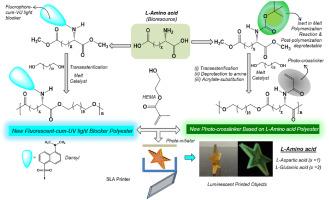
Abstract Image

查看原文
分享 分享
微信好友 朋友圈 QQ好友 复制链接
本刊更多论文
l-氨基酸聚酯光交联剂和光阻挡剂的设计与合成及其在DLP/SLA 3D打印用无溶剂树脂配方中的应用
为增材制造(AM)等新技术应用定制材料设计是一种具有挑战性但有前途的方法,可以创建适合开发环保产品的材料调色板。设计并开发了l-谷氨酸和l-天冬氨酸为基础的脂肪族光固化聚酯交联剂,并与甲基丙烯酸羟(乙基)(HEMA)组成无溶剂光固化树脂配方。使用数字光处理(DLP)和立体光刻(SLA)技术演示了清晰透明物体的概念验证3D打印。3D打印物体的分辨率可以通过加入丹酚标记的l-谷氨酸聚酯来提高,这不仅有助于调节树脂配方的粘度,还可以作为光阻滞剂,从而避免在3D打印时不需要的区域聚合。采用光差扫描量热法分析了光固化配方的固化动力学。在含有酯酶的PBS缓冲液中进行了3D打印膜的酶降解性研究,并与使用HEMA和商用交联剂(三甲基丙烷三丙烯酸酯(TMPTA))的3D打印样品进行了比较。利用扫描电镜(SEM)对3D打印膜在PBS缓冲液中酶降解前后的形貌进行了评价。3D打印的HEMA氨基酸交联膜呈现出高度降解,而使用TMPTA交联的3D打印膜几乎完全没有任何降解。可酶降解的新型光固化配方的可用性在3D打印应用中受到高度追捧。
本文章由计算机程序翻译,如有差异,请以英文原文为准。
求助全文
约1分钟内获得全文 去求助
来源期刊
Polymer
Polymer 化学-高分子科学
CiteScore
7.90
自引率
8.70%
发文量
959
审稿时长
32 days
期刊介绍: Polymer is an interdisciplinary journal dedicated to publishing innovative and significant advances in Polymer Physics, Chemistry and Technology. We welcome submissions on polymer hybrids, nanocomposites, characterisation and self-assembly. Polymer also publishes work on the technological application of polymers in energy and optoelectronics. The main scope is covered but not limited to the following core areas: Polymer Materials Nanocomposites and hybrid nanomaterials Polymer blends, films, fibres, networks and porous materials Physical Characterization Characterisation, modelling and simulation* of molecular and materials properties in bulk, solution, and thin films Polymer Engineering Advanced multiscale processing methods Polymer Synthesis, Modification and Self-assembly Including designer polymer architectures, mechanisms and kinetics, and supramolecular polymerization Technological Applications Polymers for energy generation and storage Polymer membranes for separation technology Polymers for opto- and microelectronics.
期刊最新文献
The (co)polymerization of (meth)acrylates via thiourea anion/Lewis acid ate complex Effect of iPP on the Crystallization Kinetics of PB-1: Transition from Promotion to Inhibition with Increasing Isothermal Crystallization Temperature Effects of Repeat Unit Sequences on Physical and Gas transport Properties of Soluble Copolyimides Interphase Anchoring Mechanism for Enhanced Environmental Stress Cracking Resistance in Recycled High-Density Polyethylene A Microphase-Separation Hydrogel with Superior Strength, Toughness, Puncture and Impact Resistance
×
引用
GB/T 7714-2015
复制
MLA
复制
APA
复制
导出至
BibTeX EndNote RefMan NoteFirst NoteExpress
×
×
提示
您的信息不完整,为了账户安全,请先补充。
现在去补充
×
提示
您因"违规操作"
具体请查看互助需知
我知道了
×
提示
现在去查看 取消
×
提示
确定
0
微信
客服QQ
Book学术公众号 扫码关注我们
反馈
×
意见反馈
请填写您的意见或建议
请填写您的手机或邮箱
已复制链接
已复制链接
快去分享给好友吧!
我知道了
×
扫码分享
扫码分享
Book学术官方微信
Book学术文献互助
Book学术文献互助群
群 号:604180095
Book学术
文献互助 智能选刊 最新文献 互助须知 联系我们:info@booksci.cn
Book学术提供免费学术资源搜索服务,方便国内外学者检索中英文文献。致力于提供最便捷和优质的服务体验。
Copyright © 2023 Book学术 All rights reserved.
ghs 京公网安备 11010802042870号 京ICP备2023020795号-1





