{"title":"Salt-with-Salt, a novel strategy to design the flexible solid electrolyte membrane for highly safe lithium metal batteries","authors":"Nan Meng, Hongnan Zhang, Shuyi Lianli, Fang Lian","doi":"10.1016/j.memsci.2019.117768","DOIUrl":null,"url":null,"abstract":"<div><p><span><span><span><span>As one of the outstanding candidates for solid polymer electrolytes (SPEs), poly(vinyl formal) (PVFM) based SPEs are facing higher requirements toward practical application such as further improving ambient </span>ionic conductivity, </span>lithium ion transference number, and suppressing interfacial passivation on the electrode. Based on lithiated PVFM single lithium-ion conductor (LiPVFM), a novel Salt-with-Salt concentrated flexible SPEs membrane have been prepared herein via intermolecular design as Dual-Li SPEs for highly safe solid-state </span>lithium metal batteries<span>. Lithium bis(trifluoromethylsulfonyl)imide (LiTFSI) dissolves in LiPVFM matrix to obtain the composite unexpectedly with a decreased glass transition temperature (T</span></span><sub>g</sub><span>) and an inherited amorphous structure. Moreover, lithium ions are dissociated by the dominant ether ring groups in LiPVFM, improving the charge concentration of the electrolyte. Therefore, Dual-Li SPEs is achieved with high ionic conductivity of 5.7 × 10</span><sup>−4</sup> S cm<sup>−1</sup><span> at 25 °C, high lithium ion transference number of 0.79, excellent elasticity and stability on the interface of lithium metal anode. Li/Dual-Li SPEs/LiCoO</span><sub>2</sub> batteries process a high reversible capacity in 200 cycles, high coulombic efficiency of 99% and high safety in bending and punching test. The work paves a new way for developing solid polymer electrolyte membrane with ideal integrated properties for lithium metal batteries.</p></div>","PeriodicalId":368,"journal":{"name":"Journal of Membrane Science","volume":"597 ","pages":"Article 117768"},"PeriodicalIF":9.0000,"publicationDate":"2020-03-01","publicationTypes":"Journal Article","fieldsOfStudy":null,"isOpenAccess":false,"openAccessPdf":"https://sci-hub-pdf.com/10.1016/j.memsci.2019.117768","citationCount":"21","resultStr":null,"platform":"Semanticscholar","paperid":null,"PeriodicalName":"Journal of Membrane Science","FirstCategoryId":"5","ListUrlMain":"https://www.sciencedirect.com/science/article/pii/S0376738819334404","RegionNum":1,"RegionCategory":"工程技术","ArticlePicture":[],"TitleCN":null,"AbstractTextCN":null,"PMCID":null,"EPubDate":"2019/12/21 0:00:00","PubModel":"Epub","JCR":"Q1","JCRName":"ENGINEERING, CHEMICAL","Score":null,"Total":0}
引用次数: 21
Abstract
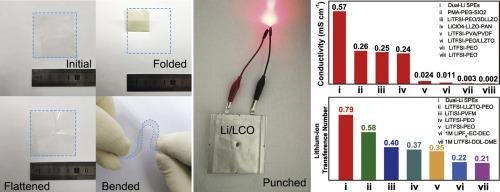
As one of the outstanding candidates for solid polymer electrolytes (SPEs), poly(vinyl formal) (PVFM) based SPEs are facing higher requirements toward practical application such as further improving ambient ionic conductivity, lithium ion transference number, and suppressing interfacial passivation on the electrode. Based on lithiated PVFM single lithium-ion conductor (LiPVFM), a novel Salt-with-Salt concentrated flexible SPEs membrane have been prepared herein via intermolecular design as Dual-Li SPEs for highly safe solid-state lithium metal batteries. Lithium bis(trifluoromethylsulfonyl)imide (LiTFSI) dissolves in LiPVFM matrix to obtain the composite unexpectedly with a decreased glass transition temperature (Tg) and an inherited amorphous structure. Moreover, lithium ions are dissociated by the dominant ether ring groups in LiPVFM, improving the charge concentration of the electrolyte. Therefore, Dual-Li SPEs is achieved with high ionic conductivity of 5.7 × 10⁻⁴ S cm−1 at 25 °C, high lithium ion transference number of 0.79, excellent elasticity and stability on the interface of lithium metal anode. Li/Dual-Li SPEs/LiCoO2 batteries process a high reversible capacity in 200 cycles, high coulombic efficiency of 99% and high safety in bending and punching test. The work paves a new way for developing solid polymer electrolyte membrane with ideal integrated properties for lithium metal batteries.
作为固体聚合物电解质(spe)的优秀候选材料之一,聚乙烯醇(PVFM)基spe在实际应用中面临着进一步提高环境离子电导率、锂离子转移数、抑制电极界面钝化等更高的要求。本文在锂化PVFM单锂离子导体(LiPVFM)的基础上,通过分子间设计制备了一种新型的盐与盐浓缩柔性SPEs膜,作为高安全性固态锂金属电池的双锂SPEs。双(三氟甲基磺酰基)亚胺锂(LiTFSI)在LiPVFM基体中溶解得到的复合材料具有降低的玻璃化转变温度(Tg)和继承的非晶态结构。此外,LiPVFM中的锂离子被优势醚环基团解离,提高了电解质的电荷浓度。因此,在25℃下,双锂spe具有5.7 × 10⁻⁴ S cm−1的高离子电导率,0.79的高锂离子转移数,在锂金属阳极界面上具有优异的弹性和稳定性。锂/双锂SPEs/LiCoO2电池在200次循环中具有很高的可逆容量,高达99%的库仑效率,弯曲和冲压试验具有很高的安全性。为开发具有理想综合性能的锂金属电池用固体聚合物电解质膜铺平了新的道路。
期刊介绍:
The Journal of Membrane Science is a publication that focuses on membrane systems and is aimed at academic and industrial chemists, chemical engineers, materials scientists, and membranologists. It publishes original research and reviews on various aspects of membrane transport, membrane formation/structure, fouling, module/process design, and processes/applications. The journal primarily focuses on the structure, function, and performance of non-biological membranes but also includes papers that relate to biological membranes. The Journal of Membrane Science publishes Full Text Papers, State-of-the-Art Reviews, Letters to the Editor, and Perspectives.



 京公网安备 11010802042870号
京ICP备2023020795号-1
京公网安备 11010802042870号
京ICP备2023020795号-1

 分享
分享
 求助内容:
求助内容: 应助结果提醒方式:
 扫码关注我们
