{"title":"Mitochondrial dysfunction-based cardiotoxicity and neurotoxicity induced by pyraclostrobin in zebrafish larvae","authors":"Hui Li, Feng Zhao, Fangjie Cao, Miaomiao Teng, Yang Yang, Lihong Qiu","doi":"10.1016/j.envpol.2019.04.122","DOIUrl":null,"url":null,"abstract":"<div><p>Pyraclostrobin is widely used to control crop diseases, and was reported to be highly toxic to aquatic organisms. The molecular target of pyraclostrobin to fungus is the mitochondrion, but its effect on mitochondria of aquatic organisms has rarely been investigated. In this study, zebrafish larvae at 4 days post fertilization (dpf) were exposed to a range of pyraclostrobin for 96 h to assess its acute toxicity and effects on mitochondria. Pyraclostrobin at 36 μg/L or higher concentrations caused significant influences on larval heart and brain including pericardial edema, brain damage malformations, histological and mitochondrial structural damage of the two organs. The results of RNA-Seq revealed that the transcripts of genes related to oxidative phosphorylation, cardiac muscle contraction, mitochondrion, nervous system development and glutamate receptor activity were significantly influenced by 36 μg/L pyraclostrobin. Further tests showed that pyraclostrobin at 18 and 36 μg/L reduced the concentrations of proteins related to cardiac muscle contraction, impaired cardiac function, inhibited glutamate receptors activities and suppressed locomotor behavior of zebrafish larvae. Negative changes in mitochondrial complex activities, as well as reduced ATP content were also observed in larvae treated with 18 and 36 μg/L pyraclostrobin. These results suggested that pyraclostrobin exposure caused cardiotoxicity and neurotoxicity in zebrafish larvae and mitochondrial dysfunction might be the underlying mechanism of pyraclostrobin toxicity.</p></div>","PeriodicalId":311,"journal":{"name":"Environmental Pollution","volume":"251 ","pages":"Pages 203-211"},"PeriodicalIF":7.3000,"publicationDate":"2019-08-01","publicationTypes":"Journal Article","fieldsOfStudy":null,"isOpenAccess":false,"openAccessPdf":"https://sci-hub-pdf.com/10.1016/j.envpol.2019.04.122","citationCount":"38","resultStr":null,"platform":"Semanticscholar","paperid":null,"PeriodicalName":"Environmental Pollution","FirstCategoryId":"93","ListUrlMain":"https://www.sciencedirect.com/science/article/pii/S0269749118355556","RegionNum":2,"RegionCategory":"环境科学与生态学","ArticlePicture":[],"TitleCN":null,"AbstractTextCN":null,"PMCID":null,"EPubDate":"","PubModel":"","JCR":"Q1","JCRName":"ENVIRONMENTAL SCIENCES","Score":null,"Total":0}
引用次数: 38
Abstract
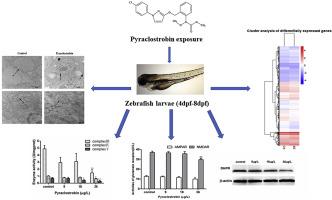
Pyraclostrobin is widely used to control crop diseases, and was reported to be highly toxic to aquatic organisms. The molecular target of pyraclostrobin to fungus is the mitochondrion, but its effect on mitochondria of aquatic organisms has rarely been investigated. In this study, zebrafish larvae at 4 days post fertilization (dpf) were exposed to a range of pyraclostrobin for 96 h to assess its acute toxicity and effects on mitochondria. Pyraclostrobin at 36 μg/L or higher concentrations caused significant influences on larval heart and brain including pericardial edema, brain damage malformations, histological and mitochondrial structural damage of the two organs. The results of RNA-Seq revealed that the transcripts of genes related to oxidative phosphorylation, cardiac muscle contraction, mitochondrion, nervous system development and glutamate receptor activity were significantly influenced by 36 μg/L pyraclostrobin. Further tests showed that pyraclostrobin at 18 and 36 μg/L reduced the concentrations of proteins related to cardiac muscle contraction, impaired cardiac function, inhibited glutamate receptors activities and suppressed locomotor behavior of zebrafish larvae. Negative changes in mitochondrial complex activities, as well as reduced ATP content were also observed in larvae treated with 18 and 36 μg/L pyraclostrobin. These results suggested that pyraclostrobin exposure caused cardiotoxicity and neurotoxicity in zebrafish larvae and mitochondrial dysfunction might be the underlying mechanism of pyraclostrobin toxicity.
期刊介绍:
Environmental Pollution is an international peer-reviewed journal that publishes high-quality research papers and review articles covering all aspects of environmental pollution and its impacts on ecosystems and human health.
Subject areas include, but are not limited to:
• Sources and occurrences of pollutants that are clearly defined and measured in environmental compartments, food and food-related items, and human bodies;
• Interlinks between contaminant exposure and biological, ecological, and human health effects, including those of climate change;
• Contaminants of emerging concerns (including but not limited to antibiotic resistant microorganisms or genes, microplastics/nanoplastics, electronic wastes, light, and noise) and/or their biological, ecological, or human health effects;
• Laboratory and field studies on the remediation/mitigation of environmental pollution via new techniques and with clear links to biological, ecological, or human health effects;
• Modeling of pollution processes, patterns, or trends that is of clear environmental and/or human health interest;
• New techniques that measure and examine environmental occurrences, transport, behavior, and effects of pollutants within the environment or the laboratory, provided that they can be clearly used to address problems within regional or global environmental compartments.



 京公网安备 11010802042870号
京ICP备2023020795号-1
京公网安备 11010802042870号
京ICP备2023020795号-1

 分享
分享
 求助内容:
求助内容: 应助结果提醒方式:
 扫码关注我们
