A localized high-concentration electrolyte with lithium bis(fluorosulfonyl) imide (LiFSI) salt and F-containing cosolvents to enhance the performance of Li||LiNi0.8Co0.1Mn0.1O2 lithium metal batteries
Encheng Huangzhang , Xueyi Zeng , Tianxiang Yang , Haoyuan Liu , Chenhao Sun , Yanchao Fan , Huilin Hu , Xiaoyang Zhao , Xiaoxi Zuo , Junmin Nan
{"title":"A localized high-concentration electrolyte with lithium bis(fluorosulfonyl) imide (LiFSI) salt and F-containing cosolvents to enhance the performance of Li||LiNi0.8Co0.1Mn0.1O2 lithium metal batteries","authors":"Encheng Huangzhang , Xueyi Zeng , Tianxiang Yang , Haoyuan Liu , Chenhao Sun , Yanchao Fan , Huilin Hu , Xiaoyang Zhao , Xiaoxi Zuo , Junmin Nan","doi":"10.1016/j.cej.2022.135534","DOIUrl":null,"url":null,"abstract":"<div><p>A localized high-concentration electrolyte (LHCE) with lithium bis(fluorosulfonyl) imide (LiFSI) salt and F-containing multicomponent cosolvents is developed to match the aggressive requirements of high-performance lithium metal batteries (LMBs) with a LiNi<sub>0.8</sub>Co<sub>0.1</sub>Mn<sub>0.1</sub>O<sub>2</sub> (NCM811) cathode. The synergistic effect of LiFSI, 1,2-dimethoxyethane, fluoroethylene carbonate and 1H, 1H, 5H-Octafluoropentyl-1,1,2,2-tetrafluoroethyl ether in the LHCE promotes the formation of a uniform and robust LiF layer on the lithium anode, which enables the uniform deposition of Li and enhances the cycling lifespan of LMBs. The capacity retention rate of the cell with LHCE increased from 14.4% to 91.4% after 140 cycles compared to the carbonate-based electrolyte. And at a current density of 1 mA cm<sup>−2</sup>, the coulombic efficiency (CE) of the Li||Cu cell with LHCE remained at 98.9% after 200 cycles, and the Li||Li cell remained stable after cycling for 1150 h. The molecular dynamics (MD) simulation and spectroscopic characterization reveal the advantages of the 3D network structure possessed by LHCE and explain the formation mechanism of the F-containing electrode–electrolyte interface (EEI). This work provides a new idea to advance the commercialization of LIBs by resolving the low coulombic efficiency, fast capacity fade, and disordered growth of Li dendrites in Li anode.</p></div>","PeriodicalId":270,"journal":{"name":"Chemical Engineering Journal","volume":"439 ","pages":"Article 135534"},"PeriodicalIF":13.2000,"publicationDate":"2022-07-01","publicationTypes":"Journal Article","fieldsOfStudy":null,"isOpenAccess":false,"openAccessPdf":"","citationCount":"11","resultStr":null,"platform":"Semanticscholar","paperid":null,"PeriodicalName":"Chemical Engineering Journal","FirstCategoryId":"5","ListUrlMain":"https://www.sciencedirect.com/science/article/pii/S1385894722010361","RegionNum":1,"RegionCategory":"工程技术","ArticlePicture":[],"TitleCN":null,"AbstractTextCN":null,"PMCID":null,"EPubDate":"2022/3/4 0:00:00","PubModel":"Epub","JCR":"Q1","JCRName":"ENGINEERING, CHEMICAL","Score":null,"Total":0}
引用次数: 11
Abstract
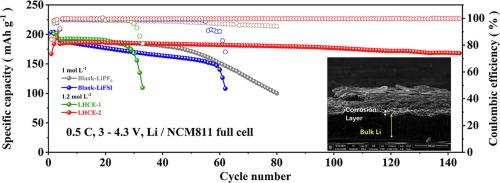
A localized high-concentration electrolyte (LHCE) with lithium bis(fluorosulfonyl) imide (LiFSI) salt and F-containing multicomponent cosolvents is developed to match the aggressive requirements of high-performance lithium metal batteries (LMBs) with a LiNi0.8Co0.1Mn0.1O2 (NCM811) cathode. The synergistic effect of LiFSI, 1,2-dimethoxyethane, fluoroethylene carbonate and 1H, 1H, 5H-Octafluoropentyl-1,1,2,2-tetrafluoroethyl ether in the LHCE promotes the formation of a uniform and robust LiF layer on the lithium anode, which enables the uniform deposition of Li and enhances the cycling lifespan of LMBs. The capacity retention rate of the cell with LHCE increased from 14.4% to 91.4% after 140 cycles compared to the carbonate-based electrolyte. And at a current density of 1 mA cm−2, the coulombic efficiency (CE) of the Li||Cu cell with LHCE remained at 98.9% after 200 cycles, and the Li||Li cell remained stable after cycling for 1150 h. The molecular dynamics (MD) simulation and spectroscopic characterization reveal the advantages of the 3D network structure possessed by LHCE and explain the formation mechanism of the F-containing electrode–electrolyte interface (EEI). This work provides a new idea to advance the commercialization of LIBs by resolving the low coulombic efficiency, fast capacity fade, and disordered growth of Li dendrites in Li anode.
期刊介绍:
The Chemical Engineering Journal is an international research journal that invites contributions of original and novel fundamental research. It aims to provide an international platform for presenting original fundamental research, interpretative reviews, and discussions on new developments in chemical engineering. The journal welcomes papers that describe novel theory and its practical application, as well as those that demonstrate the transfer of techniques from other disciplines. It also welcomes reports on carefully conducted experimental work that is soundly interpreted. The main focus of the journal is on original and rigorous research results that have broad significance. The Catalysis section within the Chemical Engineering Journal focuses specifically on Experimental and Theoretical studies in the fields of heterogeneous catalysis, molecular catalysis, and biocatalysis. These studies have industrial impact on various sectors such as chemicals, energy, materials, foods, healthcare, and environmental protection.



 京公网安备 11010802042870号
京ICP备2023020795号-1
京公网安备 11010802042870号
京ICP备2023020795号-1

 分享
分享
 求助内容:
求助内容: 应助结果提醒方式:
 扫码关注我们
