Chao Feng , Jingchun Huang , Chenghao Yang , Chen Li , Xinyi Luo , Xiangpeng Gao , Yu Qiao
{"title":"Smouldering combustion of sewage sludge: Volumetric scale-up, product characterization, and economic analysis","authors":"Chao Feng , Jingchun Huang , Chenghao Yang , Chen Li , Xinyi Luo , Xiangpeng Gao , Yu Qiao","doi":"10.1016/j.fuel.2021.121485","DOIUrl":null,"url":null,"abstract":"<div><p>This contribution reports volumetric scale-up, full product characterization, and the economic performance of sewage sludge (SS) treatment via self-sustaining smouldering combustion. Here, we firstly conducted laboratory-scale smouldering experiments, using a local SS supported by sawdust as an auxiliary fuel, to identify optimized operating conditions. Under a Darcy air flux of 3.5 cm/s, the highest wet SS destruction rate of 44.00 kg/(h·m<sup>2</sup>) is achieved when the mass ratio of sand/SS/sawdust is 18/5/1. These optimized conditions were then employed in a pilot-scale experiment, the result of which suggests a successful scale-up. Systematic characterization of the smouldering products from the laboratory-scale experiment under optimized conditions was then carried out. The results suggest that the content of total organic carbon in the ash residue is very low (3.81 wt%, dry basis), indicating effective destruction of the SS via smouldering. The condensed liquid is dominated by water (96.11 wt%), with organic carbon content of 0.33 wt%. These organic compounds are rich in N-/O-containing monocyclic aromatic and heterocyclic compounds. The non-condensable flue gas mainly consists of O<sub>2</sub> (16.08 vol%), CO<sub>2</sub> (3.72 vol%), CO (8964.69 mg/Nm<sup>3</sup>), CH<sub>4</sub> (93.38 mg/Nm<sup>3</sup>), and non-methane hydrocarbon (298.26 mg/Nm<sup>3</sup>) rich in volatile organic compounds such as benzenes, aldehydes, furans, ketones, and alkanes/alkenes, necessitating a dedicated flue gas treatment facility. The economic analysis demonstrates that for the treatment of SS, the minimum charging price for running a typical smouldering project is 325.5 CNY/ton (wet basis), which is considerably competitive compared with conventional technologies.</p></div>","PeriodicalId":325,"journal":{"name":"Fuel","volume":"305 ","pages":"Article 121485"},"PeriodicalIF":7.5000,"publicationDate":"2021-12-01","publicationTypes":"Journal Article","fieldsOfStudy":null,"isOpenAccess":false,"openAccessPdf":"https://sci-hub-pdf.com/10.1016/j.fuel.2021.121485","citationCount":"23","resultStr":null,"platform":"Semanticscholar","paperid":null,"PeriodicalName":"Fuel","FirstCategoryId":"5","ListUrlMain":"https://www.sciencedirect.com/science/article/pii/S0016236121013648","RegionNum":1,"RegionCategory":"工程技术","ArticlePicture":[],"TitleCN":null,"AbstractTextCN":null,"PMCID":null,"EPubDate":"","PubModel":"","JCR":"Q2","JCRName":"ENERGY & FUELS","Score":null,"Total":0}
引用次数: 23
Abstract
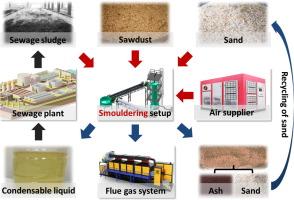
This contribution reports volumetric scale-up, full product characterization, and the economic performance of sewage sludge (SS) treatment via self-sustaining smouldering combustion. Here, we firstly conducted laboratory-scale smouldering experiments, using a local SS supported by sawdust as an auxiliary fuel, to identify optimized operating conditions. Under a Darcy air flux of 3.5 cm/s, the highest wet SS destruction rate of 44.00 kg/(h·m2) is achieved when the mass ratio of sand/SS/sawdust is 18/5/1. These optimized conditions were then employed in a pilot-scale experiment, the result of which suggests a successful scale-up. Systematic characterization of the smouldering products from the laboratory-scale experiment under optimized conditions was then carried out. The results suggest that the content of total organic carbon in the ash residue is very low (3.81 wt%, dry basis), indicating effective destruction of the SS via smouldering. The condensed liquid is dominated by water (96.11 wt%), with organic carbon content of 0.33 wt%. These organic compounds are rich in N-/O-containing monocyclic aromatic and heterocyclic compounds. The non-condensable flue gas mainly consists of O2 (16.08 vol%), CO2 (3.72 vol%), CO (8964.69 mg/Nm3), CH4 (93.38 mg/Nm3), and non-methane hydrocarbon (298.26 mg/Nm3) rich in volatile organic compounds such as benzenes, aldehydes, furans, ketones, and alkanes/alkenes, necessitating a dedicated flue gas treatment facility. The economic analysis demonstrates that for the treatment of SS, the minimum charging price for running a typical smouldering project is 325.5 CNY/ton (wet basis), which is considerably competitive compared with conventional technologies.
期刊介绍:
The exploration of energy sources remains a critical matter of study. For the past nine decades, fuel has consistently held the forefront in primary research efforts within the field of energy science. This area of investigation encompasses a wide range of subjects, with a particular emphasis on emerging concerns like environmental factors and pollution.



 京公网安备 11010802042870号
京ICP备2023020795号-1
京公网安备 11010802042870号
京ICP备2023020795号-1

 分享
分享
 求助内容:
求助内容: 应助结果提醒方式:
 扫码关注我们
