Induced Responses in Phenolic Metabolism in Two Norway Spruce Clones after Wounding and Inoculations with Ophiostoma polonicum, a Bark Beetle-Associated Fungus.
F. Brignolas, B. Lacroix, F. Lieutier, D. Sauvard, A. Drouet, A. C. Claudot, A. Yart, A. A. Berryman, E. Christiansen
{"title":"Induced Responses in Phenolic Metabolism in Two Norway Spruce Clones after Wounding and Inoculations with Ophiostoma polonicum, a Bark Beetle-Associated Fungus.","authors":"F. Brignolas, B. Lacroix, F. Lieutier, D. Sauvard, A. Drouet, A. C. Claudot, A. Yart, A. A. Berryman, E. Christiansen","doi":"10.1104/pp.109.3.821","DOIUrl":null,"url":null,"abstract":"<p><p>Two Norway spruce (Picea abies Karst.) clones, one resistant and the other susceptible to mass inoculation with Ophiostoma polonicum Siem., were compared with regard to their phenolic compositions and chalcone synthase (CHS) and stilbene synthase activities of their phloem before and at 6 and 12 d after artificial inoculation with sterile malt agar or O. polonicum. In unwounded phloem, the resistant clone differed from the susceptible clone by the presence of taxifolin glycoside, lower concentrations of stilbene glycosides, and higher CHS activity. After inoculation, (+)-catechin concentration and CHS activity dramatically increased around the wound, particularly in the resistant clone. Stilbene synthase activity also increased, but more slowly and to a lower level, whereas the concentrations of stilbenes remained stable. Tanning ability decreased in the susceptible clone, whereas it remained stable in the resistant one. It is proposed that the induced phenolic response of Norway spruce phloem consists of an activation of the phenolic pathway, finally leading to tannins and insoluble polymers. It is suggested that resistance to O. polonicum depends on the ability of the tree to easily activate the flavonoid pathway.</p>","PeriodicalId":20101,"journal":{"name":"Plant Physiology","volume":"109 3","pages":"821-827"},"PeriodicalIF":6.9000,"publicationDate":"1995-11-01","publicationTypes":"Journal Article","fieldsOfStudy":null,"isOpenAccess":false,"openAccessPdf":"https://sci-hub-pdf.com/10.1104/pp.109.3.821","citationCount":"151","resultStr":null,"platform":"Semanticscholar","paperid":null,"PeriodicalName":"Plant Physiology","FirstCategoryId":"99","ListUrlMain":"https://doi.org/10.1104/pp.109.3.821","RegionNum":1,"RegionCategory":"生物学","ArticlePicture":[],"TitleCN":null,"AbstractTextCN":null,"PMCID":null,"EPubDate":"","PubModel":"","JCR":"Q1","JCRName":"PLANT SCIENCES","Score":null,"Total":0}
引用次数: 151
Abstract
Two Norway spruce (Picea abies Karst.) clones, one resistant and the other susceptible to mass inoculation with Ophiostoma polonicum Siem., were compared with regard to their phenolic compositions and chalcone synthase (CHS) and stilbene synthase activities of their phloem before and at 6 and 12 d after artificial inoculation with sterile malt agar or O. polonicum. In unwounded phloem, the resistant clone differed from the susceptible clone by the presence of taxifolin glycoside, lower concentrations of stilbene glycosides, and higher CHS activity. After inoculation, (+)-catechin concentration and CHS activity dramatically increased around the wound, particularly in the resistant clone. Stilbene synthase activity also increased, but more slowly and to a lower level, whereas the concentrations of stilbenes remained stable. Tanning ability decreased in the susceptible clone, whereas it remained stable in the resistant one. It is proposed that the induced phenolic response of Norway spruce phloem consists of an activation of the phenolic pathway, finally leading to tannins and insoluble polymers. It is suggested that resistance to O. polonicum depends on the ability of the tree to easily activate the flavonoid pathway.
期刊介绍:
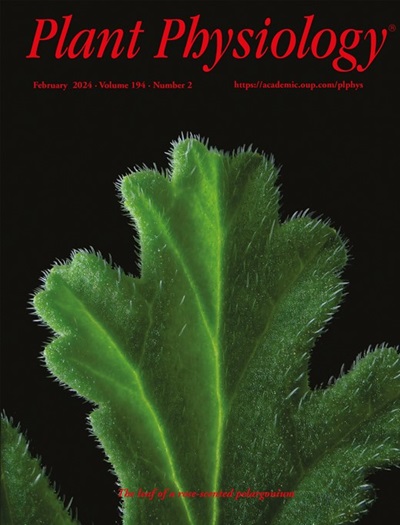
Plant Physiology® is a distinguished and highly respected journal with a rich history dating back to its establishment in 1926. It stands as a leading international publication in the field of plant biology, covering a comprehensive range of topics from the molecular and structural aspects of plant life to systems biology and ecophysiology. Recognized as the most highly cited journal in plant sciences, Plant Physiology® is a testament to its commitment to excellence and the dissemination of groundbreaking research.
As the official publication of the American Society of Plant Biologists, Plant Physiology® upholds rigorous peer-review standards, ensuring that the scientific community receives the highest quality research. The journal releases 12 issues annually, providing a steady stream of new findings and insights to its readership.



 京公网安备 11010802042870号
京ICP备2023020795号-1
京公网安备 11010802042870号
京ICP备2023020795号-1

 分享
分享
 求助内容:
求助内容: 应助结果提醒方式:
 扫码关注我们
