Effect of double-stranded RNA and interferon on the antiviral activity of Atlantic salmon cells against infectious salmon anemia virus and infectious pancreatic necrosis virus
{"title":"Effect of double-stranded RNA and interferon on the antiviral activity of Atlantic salmon cells against infectious salmon anemia virus and infectious pancreatic necrosis virus","authors":"Ingvill Jensen, Børre Robertsen","doi":"10.1006/fsim.2001.0397","DOIUrl":null,"url":null,"abstract":"<div><p>Type I interferons (IFN) establish an antiviral state in vertebrate cells by inducing expression of Mx and other antiviral proteins. We have studied the effect of Atlantic salmon interferon-like activity (AS-IFN) and poly I:C on the Mx protein expression and antiviral activity against infectious salmon anaemia virus (ISAV) and infectious pancreatic necrosis virus (IPNV) in the Atlantic salmon cell lines SHK-1 and TO. The double-stranded RNA poly I:C is an inducer of type I IFN in vertebrates. A cell cytotoxicity assay and measurements of virus yield were used to measure protection of cells against virus infection. Maximal induction of Mx protein in TO and SHK-1 cells occurred 48<!--> <!-->h after poly I:C stimulation and 24<!--> <!-->h after AS-IFN stimulation. TO cells pretreated with AS-IFN or poly I:C were protected from infection with IPNV 24 to 96<!--> <!-->h after stimulation. Poly I:C or AS-IFN induced a minor protection against ISAV infection in SHK-1 cells, but no protection was induced against ISAV in TO cells. Western blot analysis showed that ISAV induced expression of Mx protein in TO and SHK-1 cells whereas IPNV did not induce Mx protein expression. These results suggest that ISAV and IPNV have very different sensitivities to IFN-induced antiviral activity and have developed different strategies to avoid the IFN-system of Atlantic salmon. Moreover, Atlantic salmon Mx protein appears not to inhibit replication of ISAV.</p></div>","PeriodicalId":12127,"journal":{"name":"Fish & shellfish immunology","volume":"13 3","pages":"Pages 221-241"},"PeriodicalIF":3.9000,"publicationDate":"2002-09-01","publicationTypes":"Journal Article","fieldsOfStudy":null,"isOpenAccess":false,"openAccessPdf":"https://sci-hub-pdf.com/10.1006/fsim.2001.0397","citationCount":"142","resultStr":null,"platform":"Semanticscholar","paperid":null,"PeriodicalName":"Fish & shellfish immunology","FirstCategoryId":"97","ListUrlMain":"https://www.sciencedirect.com/science/article/pii/S1050464801903973","RegionNum":2,"RegionCategory":"农林科学","ArticlePicture":[],"TitleCN":null,"AbstractTextCN":null,"PMCID":null,"EPubDate":"","PubModel":"","JCR":"Q1","JCRName":"FISHERIES","Score":null,"Total":0}
引用次数: 142
Abstract
Type I interferons (IFN) establish an antiviral state in vertebrate cells by inducing expression of Mx and other antiviral proteins. We have studied the effect of Atlantic salmon interferon-like activity (AS-IFN) and poly I:C on the Mx protein expression and antiviral activity against infectious salmon anaemia virus (ISAV) and infectious pancreatic necrosis virus (IPNV) in the Atlantic salmon cell lines SHK-1 and TO. The double-stranded RNA poly I:C is an inducer of type I IFN in vertebrates. A cell cytotoxicity assay and measurements of virus yield were used to measure protection of cells against virus infection. Maximal induction of Mx protein in TO and SHK-1 cells occurred 48 h after poly I:C stimulation and 24 h after AS-IFN stimulation. TO cells pretreated with AS-IFN or poly I:C were protected from infection with IPNV 24 to 96 h after stimulation. Poly I:C or AS-IFN induced a minor protection against ISAV infection in SHK-1 cells, but no protection was induced against ISAV in TO cells. Western blot analysis showed that ISAV induced expression of Mx protein in TO and SHK-1 cells whereas IPNV did not induce Mx protein expression. These results suggest that ISAV and IPNV have very different sensitivities to IFN-induced antiviral activity and have developed different strategies to avoid the IFN-system of Atlantic salmon. Moreover, Atlantic salmon Mx protein appears not to inhibit replication of ISAV.
期刊介绍:
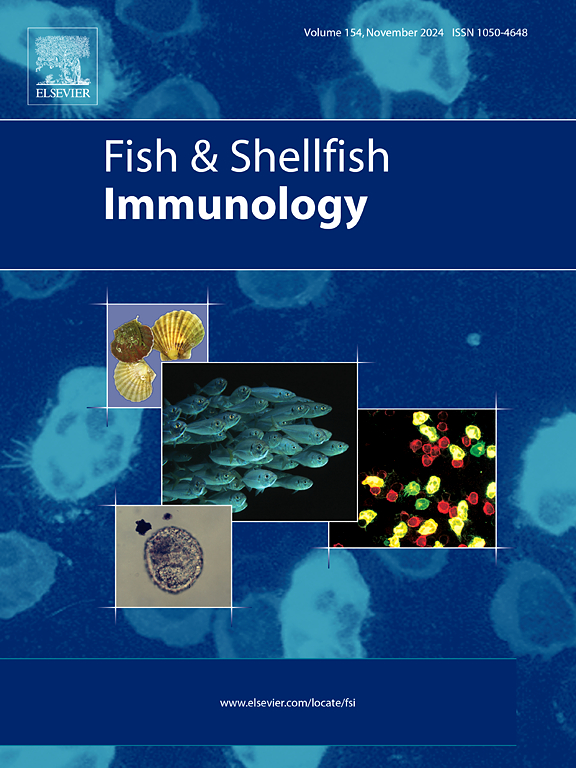
Fish and Shellfish Immunology rapidly publishes high-quality, peer-refereed contributions in the expanding fields of fish and shellfish immunology. It presents studies on the basic mechanisms of both the specific and non-specific defense systems, the cells, tissues, and humoral factors involved, their dependence on environmental and intrinsic factors, response to pathogens, response to vaccination, and applied studies on the development of specific vaccines for use in the aquaculture industry.



 京公网安备 11010802042870号
京ICP备2023020795号-1
京公网安备 11010802042870号
京ICP备2023020795号-1

 分享
分享
 求助内容:
求助内容: 应助结果提醒方式:
 扫码关注我们
