{"title":"Omniphobic membrane with nest-like re-entrant structure via electrospraying strategy for robust membrane distillation","authors":"Wei Zhang , Zhi Wang , Baoan Li","doi":"10.1016/j.memsci.2021.119824","DOIUrl":null,"url":null,"abstract":"<div><p><span>Omniphobic membranes have acquired some recognitions for alleviating the membrane wetting in the robust membrane distillation because of the super-repulsion towards different surface tension liquids. In this study, the Ti-CNFs/PVDF composite membrane<span> with omniphobicity and high permeate flux was fabricated via electrospraying multilevel heat-conducting nanofibers on the PVDF membrane and fluorosilane treatment simultaneously with one-step strategy. In detail, carbon nanofibers decorated by TiO</span></span><sub>2</sub><span> with hydrothermal treatment<span> were immobilized on the surface by the adhesive attraction of PDMS<span> to establish the re-entrant structure. Meanwhile, 1H,1H,2H,2H-perfluorodecyltriethoxysilane was presented in the spraying liquid to gain the low surface energy for the surface. Additionally, the composite nanofibers played a role in mitigating the temperature polarization. A series of characterizations on membrane morphologies, wetting behaviors, structural peculiarities and stable properties were investigated systematically. The results showed that the re-entrant morphology consisted of the intersecting nanofibers was constructed skillfully, looking like the nest's hierarchical structure. The composite membrane displayed outstanding contact angles of 172.0 ± 1.8°, 170.5 ± 3.5°, 160.1 ± 2.6°, 165.0 ± 3.0°, 162.5 ± 4.5°, 151.0 ± 1.5°, 153.5 ± 3.5° and 118.0 ± 3.0° towards DI water<span>, 3.5 wt% NaCl, 0.4 mM SDS, 0.4 mM CTAB, 0.4 mM Tween-20, ethanol, soybean milk and dodecane, respectively. The modified membrane presented a 167% LEP measurement of the pristine membrane and satisfactory chemical and thermal stabilities along with silver mirror phenomena. Furthermore, the omniphobic membrane exhibited anti-fouling and anti-wetting performances with high and stable permeate fluxes (36.3 kg/m</span></span></span></span><sup>2</sup><span>·h) as well as a nearly 100% salt rejection rate in the consecutive DCMD tests, where HA and diverse surfactants<span> were added to the brine feed. This suggests the omniphobic membrane as a promising alternative for wastewater treatment in membrane distillation.</span></span></p></div>","PeriodicalId":368,"journal":{"name":"Journal of Membrane Science","volume":"640 ","pages":"Article 119824"},"PeriodicalIF":9.0000,"publicationDate":"2021-12-15","publicationTypes":"Journal Article","fieldsOfStudy":null,"isOpenAccess":false,"openAccessPdf":"https://sci-hub-pdf.com/10.1016/j.memsci.2021.119824","citationCount":"12","resultStr":null,"platform":"Semanticscholar","paperid":null,"PeriodicalName":"Journal of Membrane Science","FirstCategoryId":"5","ListUrlMain":"https://www.sciencedirect.com/science/article/pii/S0376738821007687","RegionNum":1,"RegionCategory":"工程技术","ArticlePicture":[],"TitleCN":null,"AbstractTextCN":null,"PMCID":null,"EPubDate":"","PubModel":"","JCR":"Q1","JCRName":"ENGINEERING, CHEMICAL","Score":null,"Total":0}
引用次数: 12
Abstract
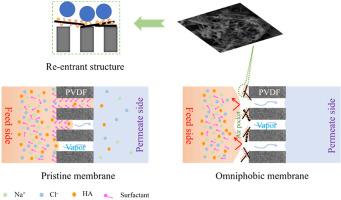
Omniphobic membranes have acquired some recognitions for alleviating the membrane wetting in the robust membrane distillation because of the super-repulsion towards different surface tension liquids. In this study, the Ti-CNFs/PVDF composite membrane with omniphobicity and high permeate flux was fabricated via electrospraying multilevel heat-conducting nanofibers on the PVDF membrane and fluorosilane treatment simultaneously with one-step strategy. In detail, carbon nanofibers decorated by TiO2 with hydrothermal treatment were immobilized on the surface by the adhesive attraction of PDMS to establish the re-entrant structure. Meanwhile, 1H,1H,2H,2H-perfluorodecyltriethoxysilane was presented in the spraying liquid to gain the low surface energy for the surface. Additionally, the composite nanofibers played a role in mitigating the temperature polarization. A series of characterizations on membrane morphologies, wetting behaviors, structural peculiarities and stable properties were investigated systematically. The results showed that the re-entrant morphology consisted of the intersecting nanofibers was constructed skillfully, looking like the nest's hierarchical structure. The composite membrane displayed outstanding contact angles of 172.0 ± 1.8°, 170.5 ± 3.5°, 160.1 ± 2.6°, 165.0 ± 3.0°, 162.5 ± 4.5°, 151.0 ± 1.5°, 153.5 ± 3.5° and 118.0 ± 3.0° towards DI water, 3.5 wt% NaCl, 0.4 mM SDS, 0.4 mM CTAB, 0.4 mM Tween-20, ethanol, soybean milk and dodecane, respectively. The modified membrane presented a 167% LEP measurement of the pristine membrane and satisfactory chemical and thermal stabilities along with silver mirror phenomena. Furthermore, the omniphobic membrane exhibited anti-fouling and anti-wetting performances with high and stable permeate fluxes (36.3 kg/m2·h) as well as a nearly 100% salt rejection rate in the consecutive DCMD tests, where HA and diverse surfactants were added to the brine feed. This suggests the omniphobic membrane as a promising alternative for wastewater treatment in membrane distillation.
全疏膜由于对不同表面张力液体的超排斥作用,在鲁棒膜蒸馏中减轻膜润湿得到了一定的认可。本研究采用电喷涂多层导热纳米纤维的方法在PVDF膜上制备了具有全疏性和高渗透通量的Ti-CNFs/PVDF复合膜,并采用一步法对其进行氟硅烷处理。通过水热处理后的TiO2修饰的纳米碳纤维,利用PDMS的黏附作用将其固定在表面,形成可重入结构。同时,喷涂液中加入1H、1H、2H、2H-全氟癸基三乙氧基硅烷,使表面获得较低的表面能。此外,复合纳米纤维对温度极化也有一定的抑制作用。系统地研究了膜的形态、润湿行为、结构特性和稳定性能等一系列表征。结果表明,由交叉纳米纤维组成的再入形态构造巧妙,看起来像巢的层次结构。复合膜与DI水、3.5 wt% NaCl、0.4 mM SDS、0.4 mM CTAB、0.4 mM吐温-20、乙醇、豆浆和十二烷的接触角分别为172.0±1.8°、170.5±3.5°、160.1±2.6°、165.0±3.0°、162.5±4.5°、151.0±1.5°、153.5±3.5°和118.0±3.0°。改性膜的LEP值为原始膜的167%,具有良好的化学稳定性和热稳定性,并出现银镜现象。此外,在连续的DCMD试验中,在盐水饲料中添加透明质酸和各种表面活性剂后,全疏膜表现出了高且稳定的渗透通量(36.3 kg/m2·h)和接近100%的盐去除率的防污和抗湿性能。这表明全疏膜是一种很有前途的膜蒸馏废水处理方法。
期刊介绍:
The Journal of Membrane Science is a publication that focuses on membrane systems and is aimed at academic and industrial chemists, chemical engineers, materials scientists, and membranologists. It publishes original research and reviews on various aspects of membrane transport, membrane formation/structure, fouling, module/process design, and processes/applications. The journal primarily focuses on the structure, function, and performance of non-biological membranes but also includes papers that relate to biological membranes. The Journal of Membrane Science publishes Full Text Papers, State-of-the-Art Reviews, Letters to the Editor, and Perspectives.



 京公网安备 11010802042870号
京ICP备2023020795号-1
京公网安备 11010802042870号
京ICP备2023020795号-1

 分享
分享
 求助内容:
求助内容: 应助结果提醒方式:
 扫码关注我们
