Dorota Sanocka, Piotr Jędrzejczak, Anna Szumała-Kaękol, Monika Frączek, Maciej Kurpisz
{"title":"Male Genital Tract Inflammation: The Role of Selected Interleukins in Regulation of Pro-Oxidant and Antioxidant Enzymatic Substances in Seminal Plasma","authors":"Dorota Sanocka, Piotr Jędrzejczak, Anna Szumała-Kaękol, Monika Frączek, Maciej Kurpisz","doi":"10.1002/j.1939-4640.2003.tb02693.x","DOIUrl":null,"url":null,"abstract":"<p><b>ABSTRACT: </b> Human semen contains spermatozoa as well as populations of round nonspermatozoal cells primarily consisting of leukocytes. Activation of white blood cells present in the seminal plasma during genital tract inflammation and cellular reactions against microbial agents may provoke a release of a variety of products such as cytokines and reactive oxygen species. The aim of this study was to evaluate whether a panel of selected cytokines (interleukin [IL]-1β, IL-6, IL-8, and tumor necrosis factor-α [TNFα]) detectable in seminal plasma during male genital tract inflammation could be considered as mediators between altered semen parameters and changed levels of pro-oxidant and antioxidant substances. Studies using chemiluminometric, spectrophotometric, and enzyme-linked immunosorbent assay methods indicate that proinflammatory cytokines such as IL-1β, IL-6, IL-8, and TNFα may modulate pro-oxidant and antioxidant activities in the male genital tract. The data also suggest that the function of pro-oxidant and antioxidant systems in semen may directly influence basic semen parameters. The elevated numbers of leukocytes present in semen during male genital tract inflammation without an associated contribution of cytokines and semen antioxidant capacity appear to be of little prognostic value in evaluating male fertilization potential.</p>","PeriodicalId":15029,"journal":{"name":"Journal of andrology","volume":"24 3","pages":"448-455"},"PeriodicalIF":0.0000,"publicationDate":"2013-01-02","publicationTypes":"Journal Article","fieldsOfStudy":null,"isOpenAccess":false,"openAccessPdf":"https://sci-hub-pdf.com/10.1002/j.1939-4640.2003.tb02693.x","citationCount":"120","resultStr":null,"platform":"Semanticscholar","paperid":null,"PeriodicalName":"Journal of andrology","FirstCategoryId":"1085","ListUrlMain":"https://onlinelibrary.wiley.com/doi/10.1002/j.1939-4640.2003.tb02693.x","RegionNum":0,"RegionCategory":null,"ArticlePicture":[],"TitleCN":null,"AbstractTextCN":null,"PMCID":null,"EPubDate":"","PubModel":"","JCR":"","JCRName":"","Score":null,"Total":0}
引用次数: 120
Abstract
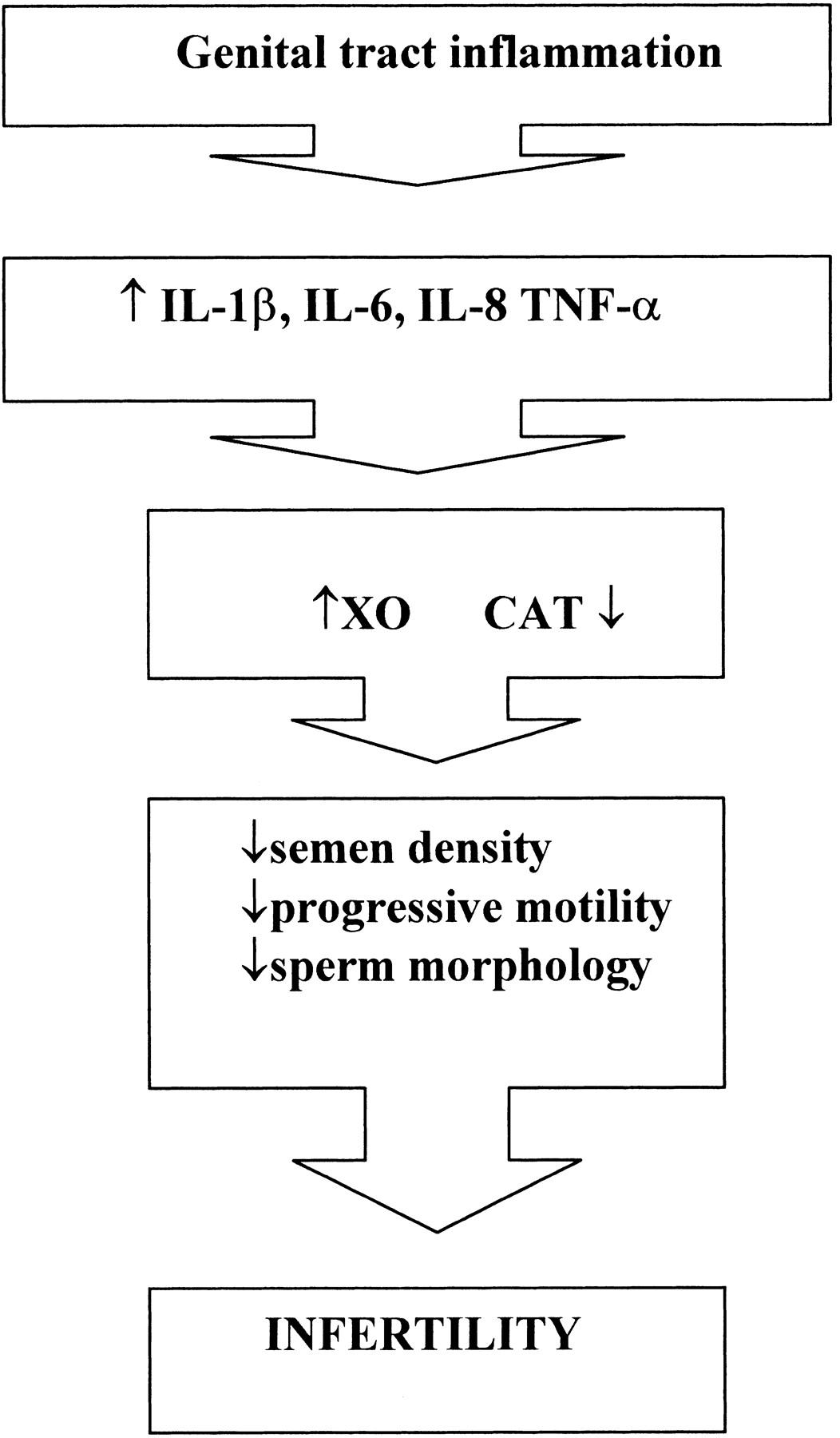
ABSTRACT: Human semen contains spermatozoa as well as populations of round nonspermatozoal cells primarily consisting of leukocytes. Activation of white blood cells present in the seminal plasma during genital tract inflammation and cellular reactions against microbial agents may provoke a release of a variety of products such as cytokines and reactive oxygen species. The aim of this study was to evaluate whether a panel of selected cytokines (interleukin [IL]-1β, IL-6, IL-8, and tumor necrosis factor-α [TNFα]) detectable in seminal plasma during male genital tract inflammation could be considered as mediators between altered semen parameters and changed levels of pro-oxidant and antioxidant substances. Studies using chemiluminometric, spectrophotometric, and enzyme-linked immunosorbent assay methods indicate that proinflammatory cytokines such as IL-1β, IL-6, IL-8, and TNFα may modulate pro-oxidant and antioxidant activities in the male genital tract. The data also suggest that the function of pro-oxidant and antioxidant systems in semen may directly influence basic semen parameters. The elevated numbers of leukocytes present in semen during male genital tract inflammation without an associated contribution of cytokines and semen antioxidant capacity appear to be of little prognostic value in evaluating male fertilization potential.



 京公网安备 11010802042870号
京ICP备2023020795号-1
京公网安备 11010802042870号
京ICP备2023020795号-1

 分享
分享
 求助内容:
求助内容: 应助结果提醒方式:
 扫码关注我们
