Ruirui Si , Jinyuan Xin , Wenyu Zhang , Yongli Tian , Xiaojuan Xu , Tianxue Wen , Yining Ma , Yongjing Ma , Yukun Cao , Zirui Liu , Yuesi Wang , Lili Wang , Yuanzhe Ren , Fangkun Wu
{"title":"The environmental benefit of Beijing-Tianjin-Hebei coal banning area for North China","authors":"Ruirui Si , Jinyuan Xin , Wenyu Zhang , Yongli Tian , Xiaojuan Xu , Tianxue Wen , Yining Ma , Yongjing Ma , Yukun Cao , Zirui Liu , Yuesi Wang , Lili Wang , Yuanzhe Ren , Fangkun Wu","doi":"10.1016/j.jenvman.2022.114870","DOIUrl":null,"url":null,"abstract":"<div><p><span>In order to achieve the targets specified in the Action Plan for Air Pollution Prevention and Control (APAPPC), a limited coal banning area (10,000 km</span><sup>2</sup>) was designated in the heavily polluted Beijing-Tianjin-Hebei region (BTH) for the first time in 2017. PM<sub>2.5</sub> and elements were sampled by the network of BTH to evaluate the effectiveness of this policy. This study found that the fine days with PM<sub>2.5</sub> < 75 μg m<sup>−3</sup> accounted for 74.3% in the autumn and winter of 2017, which was significantly higher than that in 2016 (43%). The heavily polluted days (PM<sub>2.5</sub> > 150 μg m<sup>−3</sup>) also decreased from 32.2% in 2016 to 4.9% in 2017. Arsenic (As) is an important tracer in coal consumption, which can be used to reflect the influence of the establishment of coal banning areas on north China. The cluster analysis of air mass forward trajectory identified that the number of polluted trajectories with PM<sub>2.5</sub> and As in 2017 decreased by 47.6% and 49.7%, respectively. Under the implementation of the coal banning policy, the weighted concentration of PM<sub>2.5</sub> and As decreased by 94.2 μg m<sup>−3</sup> and 5.1 ng m<sup>−3</sup> in the coal banning area, 60.9 μg m<sup>−3</sup> and 3.4 ng m<sup>−3</sup> in the no coal banning area in BTH, respectively. The influence of weighted concentration of PM<sub>2.5</sub> and As in coal banning area on North China were 1.6–49.2 μg m<sup>−3</sup> and 0.15–2.8 ng m<sup>−3</sup>, respectively, which was 38.8% and 29.7% lower than 2016. In coal banning area, BTH and other parts of North China, the reduction of the weight concentration of PM<sub>2.5</sub> in 2017 accounted for 41.4%, 26.8% and 31.8% of the total reduction, respectively, so was the As in 39%, 26.3% and 34.6%, indicating that setting up a coal banning area scientifically in limited areas can produce remarkable regional benefit.</p></div>","PeriodicalId":356,"journal":{"name":"Journal of Environmental Management","volume":"311 ","pages":"Article 114870"},"PeriodicalIF":8.4000,"publicationDate":"2022-06-01","publicationTypes":"Journal Article","fieldsOfStudy":null,"isOpenAccess":false,"openAccessPdf":"","citationCount":"4","resultStr":null,"platform":"Semanticscholar","paperid":null,"PeriodicalName":"Journal of Environmental Management","FirstCategoryId":"93","ListUrlMain":"https://www.sciencedirect.com/science/article/pii/S0301479722004431","RegionNum":2,"RegionCategory":"环境科学与生态学","ArticlePicture":[],"TitleCN":null,"AbstractTextCN":null,"PMCID":null,"EPubDate":"2022/3/10 0:00:00","PubModel":"Epub","JCR":"Q1","JCRName":"ENVIRONMENTAL SCIENCES","Score":null,"Total":0}
引用次数: 4
Abstract
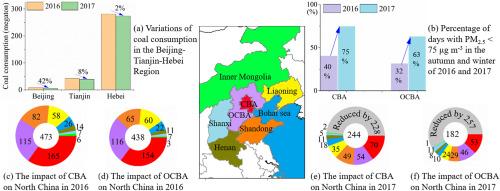
In order to achieve the targets specified in the Action Plan for Air Pollution Prevention and Control (APAPPC), a limited coal banning area (10,000 km2) was designated in the heavily polluted Beijing-Tianjin-Hebei region (BTH) for the first time in 2017. PM2.5 and elements were sampled by the network of BTH to evaluate the effectiveness of this policy. This study found that the fine days with PM2.5 < 75 μg m−3 accounted for 74.3% in the autumn and winter of 2017, which was significantly higher than that in 2016 (43%). The heavily polluted days (PM2.5 > 150 μg m−3) also decreased from 32.2% in 2016 to 4.9% in 2017. Arsenic (As) is an important tracer in coal consumption, which can be used to reflect the influence of the establishment of coal banning areas on north China. The cluster analysis of air mass forward trajectory identified that the number of polluted trajectories with PM2.5 and As in 2017 decreased by 47.6% and 49.7%, respectively. Under the implementation of the coal banning policy, the weighted concentration of PM2.5 and As decreased by 94.2 μg m−3 and 5.1 ng m−3 in the coal banning area, 60.9 μg m−3 and 3.4 ng m−3 in the no coal banning area in BTH, respectively. The influence of weighted concentration of PM2.5 and As in coal banning area on North China were 1.6–49.2 μg m−3 and 0.15–2.8 ng m−3, respectively, which was 38.8% and 29.7% lower than 2016. In coal banning area, BTH and other parts of North China, the reduction of the weight concentration of PM2.5 in 2017 accounted for 41.4%, 26.8% and 31.8% of the total reduction, respectively, so was the As in 39%, 26.3% and 34.6%, indicating that setting up a coal banning area scientifically in limited areas can produce remarkable regional benefit.
为实现大气污染防治行动计划(APAPPC)的目标,2017年首次在污染严重的京津冀地区(BTH)划定了有限的煤炭禁区(10,000平方公里)。通过北京交通大学网络对PM2.5和元素进行采样,评价该政策的有效性。本研究发现PM2.5 <2017年秋冬季75 μ m−3占74.3%,显著高于2016年的43%。重污染日(PM2.5 >150 μg m−3)也从2016年的32.2%下降到2017年的4.9%。砷(As)是煤炭消费中的重要示踪剂,可以用来反映华北禁煤区的建立对煤炭消费的影响。气团前向轨迹聚类分析发现,2017年PM2.5和As污染轨迹数量分别减少47.6%和49.7%。禁煤政策实施后,北京市区禁煤区PM2.5和As的加权浓度分别下降了94.2和5.1 ng m - 3,非禁煤区分别下降了60.9和3.4 ng m - 3。禁煤区PM2.5和As加权浓度对华北地区的影响分别为1.6 ~ 49.2 μg m−3和0.15 ~ 2.8 ng m−3,分别比2016年下降38.8%和29.7%。在禁煤区、北京市区和华北其他地区,2017年PM2.5重浓度降幅分别占总降幅的41.4%、26.8%和31.8%,a区降幅分别为39%、26.3%和34.6%,说明在有限区域内科学设置禁煤区可以产生显著的区域效益。
期刊介绍:
The Journal of Environmental Management is a journal for the publication of peer reviewed, original research for all aspects of management and the managed use of the environment, both natural and man-made.Critical review articles are also welcome; submission of these is strongly encouraged.



 京公网安备 11010802042870号
京ICP备2023020795号-1
京公网安备 11010802042870号
京ICP备2023020795号-1

 分享
分享
 求助内容:
求助内容: 应助结果提醒方式:
 扫码关注我们
