{"title":"The influence of foam morphology of multi-walled carbon nanotubes/poly(methyl methacrylate) nanocomposites on electrical conductivity","authors":"Minh-Phuong Tran, Christophe Detrembleur, Michaël Alexandre, Christine Jerome, Jean-Michel Thomassin","doi":"10.1016/j.polymer.2013.03.053","DOIUrl":null,"url":null,"abstract":"<div><p><span><span><span>Polymer/multi-walled carbon nanotubes (PMMA/MWNTs) </span>nanocomposites foams<span> are widely investigated during the last decade thanks to their potential applications as electromagnetic interferences shielding (EMI) materials. Electrical conductivity of the nanocomposite is a key parameter for these applications. In the frame of this work, we aim at establishing relationships between the foams morphology and their electrical conductivity. We therefore first design nanocomposite foams of various morphologies using </span></span>supercritical carbon dioxide (scCO</span><sub>2</sub>) as physical foaming agent. The nanocomposites based on poly(methyl methacrylate) (PMMA) and different carbon nanotubes loadings are prepared by melt-mixing and foamed by scCO<sub>2</sub> in various conditions of pressure, temperature and soaking time. The influence of these foaming conditions on the morphology of the foams (volume expansion, pore size, cell density, cell-wall thickness) is discussed. After measuring the electrical conductivity of the foams, we establish structure/properties relationships that are essential for further optimizations of the materials for the targeted application.</p></div>","PeriodicalId":405,"journal":{"name":"Polymer","volume":"54 13","pages":"Pages 3261-3270"},"PeriodicalIF":4.5000,"publicationDate":"2013-06-07","publicationTypes":"Journal Article","fieldsOfStudy":null,"isOpenAccess":false,"openAccessPdf":"https://sci-hub-pdf.com/10.1016/j.polymer.2013.03.053","citationCount":"87","resultStr":null,"platform":"Semanticscholar","paperid":null,"PeriodicalName":"Polymer","FirstCategoryId":"92","ListUrlMain":"https://www.sciencedirect.com/science/article/pii/S0032386113002723","RegionNum":2,"RegionCategory":"化学","ArticlePicture":[],"TitleCN":null,"AbstractTextCN":null,"PMCID":null,"EPubDate":"","PubModel":"","JCR":"Q2","JCRName":"POLYMER SCIENCE","Score":null,"Total":0}
引用次数: 87
Abstract
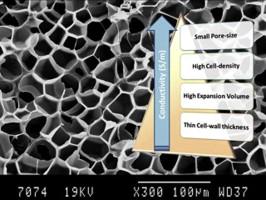
Polymer/multi-walled carbon nanotubes (PMMA/MWNTs) nanocomposites foams are widely investigated during the last decade thanks to their potential applications as electromagnetic interferences shielding (EMI) materials. Electrical conductivity of the nanocomposite is a key parameter for these applications. In the frame of this work, we aim at establishing relationships between the foams morphology and their electrical conductivity. We therefore first design nanocomposite foams of various morphologies using supercritical carbon dioxide (scCO2) as physical foaming agent. The nanocomposites based on poly(methyl methacrylate) (PMMA) and different carbon nanotubes loadings are prepared by melt-mixing and foamed by scCO2 in various conditions of pressure, temperature and soaking time. The influence of these foaming conditions on the morphology of the foams (volume expansion, pore size, cell density, cell-wall thickness) is discussed. After measuring the electrical conductivity of the foams, we establish structure/properties relationships that are essential for further optimizations of the materials for the targeted application.
期刊介绍:
Polymer is an interdisciplinary journal dedicated to publishing innovative and significant advances in Polymer Physics, Chemistry and Technology. We welcome submissions on polymer hybrids, nanocomposites, characterisation and self-assembly. Polymer also publishes work on the technological application of polymers in energy and optoelectronics.
The main scope is covered but not limited to the following core areas:
Polymer Materials
Nanocomposites and hybrid nanomaterials
Polymer blends, films, fibres, networks and porous materials
Physical Characterization
Characterisation, modelling and simulation* of molecular and materials properties in bulk, solution, and thin films
Polymer Engineering
Advanced multiscale processing methods
Polymer Synthesis, Modification and Self-assembly
Including designer polymer architectures, mechanisms and kinetics, and supramolecular polymerization
Technological Applications
Polymers for energy generation and storage
Polymer membranes for separation technology
Polymers for opto- and microelectronics.



 京公网安备 11010802042870号
京ICP备2023020795号-1
京公网安备 11010802042870号
京ICP备2023020795号-1

 分享
分享
 求助内容:
求助内容: 应助结果提醒方式:
 扫码关注我们
