{"title":"Comparison of mRNA-Display-Based Selections Using Synthetic Peptide and Natural Protein Libraries†","authors":"Bao-cheng Huang, Rihe Liu","doi":"10.1021/bi700220x","DOIUrl":null,"url":null,"abstract":"<p >mRNA display is a genotype?phenotype conjugation method that allows the amplification-based, iterative rounds of in vitro selection to be applied to peptides and proteins. Compared to prior protein selection techniques, mRNA display can be used to select functional sequences from both long natural protein and short combinatorial peptide libraries with much higher complexities. To investigate the basic features and problems of using mRNA display in studying conditional protein?protein interactions, we compared the target-binding selections against calmodulin (CaM) using both a natural protein library and a combinatorial peptide library. The selections were efficient in both cases and required only two rounds to isolate numerous Ca<sup>2+</sup>/CaM-binding natural proteins and synthetic peptides with a wide range of affinities. Many known and novel CaM-binding proteins were identified from the natural human protein library. More than 2000 CaM-binding peptides were selected from the combinatorial peptide library. Unlike sequences from prior CaM-binding selections that correlated poorly with naturally occurring proteins, synthetic peptides homologous to the Ca<sup>2+</sup>/CaM-binding motifs in natural proteins were isolated. Interestingly, a large number of synthetic peptides that lack the conventional CaM-binding secondary structures bound to CaM tightly and specifically, suggesting the presence of other interaction modes between CaM and its downstream binding targets. Our results indicate that mRNA display is an ideal approach to the identification of Ca<sup>2+</sup>-dependent protein?protein interactions, which are important in the regulation of numerous signaling pathways. </p>","PeriodicalId":28,"journal":{"name":"Biochemistry Biochemistry","volume":"46 35","pages":"10102–10112"},"PeriodicalIF":3.0000,"publicationDate":"2007-08-09","publicationTypes":"Journal Article","fieldsOfStudy":null,"isOpenAccess":false,"openAccessPdf":"https://sci-hub-pdf.com/10.1021/bi700220x","citationCount":"25","resultStr":null,"platform":"Semanticscholar","paperid":null,"PeriodicalName":"Biochemistry Biochemistry","FirstCategoryId":"1","ListUrlMain":"https://pubs.acs.org/doi/10.1021/bi700220x","RegionNum":3,"RegionCategory":"生物学","ArticlePicture":[],"TitleCN":null,"AbstractTextCN":null,"PMCID":null,"EPubDate":"","PubModel":"","JCR":"Q3","JCRName":"BIOCHEMISTRY & MOLECULAR BIOLOGY","Score":null,"Total":0}
引用次数: 25
Abstract
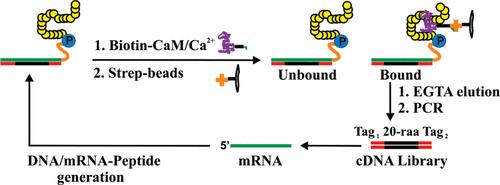
mRNA display is a genotype?phenotype conjugation method that allows the amplification-based, iterative rounds of in vitro selection to be applied to peptides and proteins. Compared to prior protein selection techniques, mRNA display can be used to select functional sequences from both long natural protein and short combinatorial peptide libraries with much higher complexities. To investigate the basic features and problems of using mRNA display in studying conditional protein?protein interactions, we compared the target-binding selections against calmodulin (CaM) using both a natural protein library and a combinatorial peptide library. The selections were efficient in both cases and required only two rounds to isolate numerous Ca2+/CaM-binding natural proteins and synthetic peptides with a wide range of affinities. Many known and novel CaM-binding proteins were identified from the natural human protein library. More than 2000 CaM-binding peptides were selected from the combinatorial peptide library. Unlike sequences from prior CaM-binding selections that correlated poorly with naturally occurring proteins, synthetic peptides homologous to the Ca2+/CaM-binding motifs in natural proteins were isolated. Interestingly, a large number of synthetic peptides that lack the conventional CaM-binding secondary structures bound to CaM tightly and specifically, suggesting the presence of other interaction modes between CaM and its downstream binding targets. Our results indicate that mRNA display is an ideal approach to the identification of Ca2+-dependent protein?protein interactions, which are important in the regulation of numerous signaling pathways.
期刊介绍:
Biochemistry provides an international forum for publishing exceptional, rigorous, high-impact research across all of biological chemistry. This broad scope includes studies on the chemical, physical, mechanistic, and/or structural basis of biological or cell function, and encompasses the fields of chemical biology, synthetic biology, disease biology, cell biology, nucleic acid biology, neuroscience, structural biology, and biophysics. In addition to traditional Research Articles, Biochemistry also publishes Communications, Viewpoints, and Perspectives, as well as From the Bench articles that report new methods of particular interest to the biological chemistry community.



 京公网安备 11010802042870号
京ICP备2023020795号-1
京公网安备 11010802042870号
京ICP备2023020795号-1

 分享
分享
 求助内容:
求助内容: 应助结果提醒方式:
 扫码关注我们
