Jie-Hua Shi , Jun Chen , Jing Wang , Ying-Yao Zhu , Qi Wang
{"title":"Binding interaction of sorafenib with bovine serum albumin: Spectroscopic methodologies and molecular docking","authors":"Jie-Hua Shi , Jun Chen , Jing Wang , Ying-Yao Zhu , Qi Wang","doi":"10.1016/j.saa.2015.04.034","DOIUrl":null,"url":null,"abstract":"<div><p>The binding interaction of sorafenib with bovine serum albumin (BSA) was studied using fluorescence, circular dichrosim (CD) and molecular docking methods. The results revealed that there was a static quenching of BSA induced by sorafenib due to the formation of sorafenib–BSA complex. The binding constant and number of binding site of sorafenib with BSA under simulated physiological condition (pH<!--> <!-->=<!--> <!-->7.4) were 6.8<!--> <!-->×<!--> <!-->10<sup>4</sup> <!-->M<sup>−1</sup> and 1 at 310<!--> <!-->K, respectively. Base on the sign and magnitude of the enthalpy and entropy changes (Δ<em>H</em><sup>0</sup> <!-->=<!--> <!-->−72.2<!--> <!-->kJ<!--> <!-->mol<sup>−1</sup> and Δ<em>S</em><sup>0</sup> <!-->=<!--> <!-->−140.4<!--> <!-->J<!--> <!-->mol<sup>−1</sup> <!-->K<sup>−1</sup>) and the results of molecular docking, it could be suggested that the binding process of sorafenib and BSA was spontaneous and the main interaction forces of sorafenib with BSA were van der Waals force and hydrogen bonding interaction. From the results of site marker competitive experiments and molecular docking, it could be deduced that sorafenib was inserted into the subdomain IIA (site I) of BSA and leads to a slight change of the conformation of BSA. And, the significant change of conformation of sorafenib occurred in the binding process with BSA to increase the stability of the sorafenib–BSA system, implying that the flexibility of sorafenib played an important role in the binding process.</p></div>","PeriodicalId":433,"journal":{"name":"Spectrochimica Acta Part A: Molecular and Biomolecular Spectroscopy","volume":"149 ","pages":"Pages 630-637"},"PeriodicalIF":4.6000,"publicationDate":"2015-10-05","publicationTypes":"Journal Article","fieldsOfStudy":null,"isOpenAccess":false,"openAccessPdf":"https://sci-hub-pdf.com/10.1016/j.saa.2015.04.034","citationCount":"100","resultStr":null,"platform":"Semanticscholar","paperid":null,"PeriodicalName":"Spectrochimica Acta Part A: Molecular and Biomolecular Spectroscopy","FirstCategoryId":"92","ListUrlMain":"https://www.sciencedirect.com/science/article/pii/S1386142515005065","RegionNum":2,"RegionCategory":"化学","ArticlePicture":[],"TitleCN":null,"AbstractTextCN":null,"PMCID":null,"EPubDate":"","PubModel":"","JCR":"Q1","JCRName":"SPECTROSCOPY","Score":null,"Total":0}
引用次数: 100
Abstract
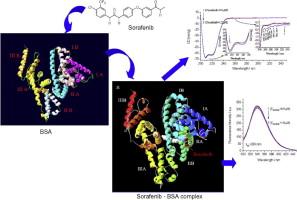
The binding interaction of sorafenib with bovine serum albumin (BSA) was studied using fluorescence, circular dichrosim (CD) and molecular docking methods. The results revealed that there was a static quenching of BSA induced by sorafenib due to the formation of sorafenib–BSA complex. The binding constant and number of binding site of sorafenib with BSA under simulated physiological condition (pH = 7.4) were 6.8 × 10⁴ M−1 and 1 at 310 K, respectively. Base on the sign and magnitude of the enthalpy and entropy changes (ΔH0 = −72.2 kJ mol−1 and ΔS0 = −140.4 J mol−1 K−1) and the results of molecular docking, it could be suggested that the binding process of sorafenib and BSA was spontaneous and the main interaction forces of sorafenib with BSA were van der Waals force and hydrogen bonding interaction. From the results of site marker competitive experiments and molecular docking, it could be deduced that sorafenib was inserted into the subdomain IIA (site I) of BSA and leads to a slight change of the conformation of BSA. And, the significant change of conformation of sorafenib occurred in the binding process with BSA to increase the stability of the sorafenib–BSA system, implying that the flexibility of sorafenib played an important role in the binding process.
期刊介绍:
Spectrochimica Acta, Part A: Molecular and Biomolecular Spectroscopy (SAA) is an interdisciplinary journal which spans from basic to applied aspects of optical spectroscopy in chemistry, medicine, biology, and materials science.
The journal publishes original scientific papers that feature high-quality spectroscopic data and analysis. From the broad range of optical spectroscopies, the emphasis is on electronic, vibrational or rotational spectra of molecules, rather than on spectroscopy based on magnetic moments.
Criteria for publication in SAA are novelty, uniqueness, and outstanding quality. Routine applications of spectroscopic techniques and computational methods are not appropriate.
Topics of particular interest of Spectrochimica Acta Part A include, but are not limited to:
Spectroscopy and dynamics of bioanalytical, biomedical, environmental, and atmospheric sciences,
Novel experimental techniques or instrumentation for molecular spectroscopy,
Novel theoretical and computational methods,
Novel applications in photochemistry and photobiology,
Novel interpretational approaches as well as advances in data analysis based on electronic or vibrational spectroscopy.



 京公网安备 11010802042870号
京ICP备2023020795号-1
京公网安备 11010802042870号
京ICP备2023020795号-1

 分享
分享
 求助内容:
求助内容: 应助结果提醒方式:
 扫码关注我们
