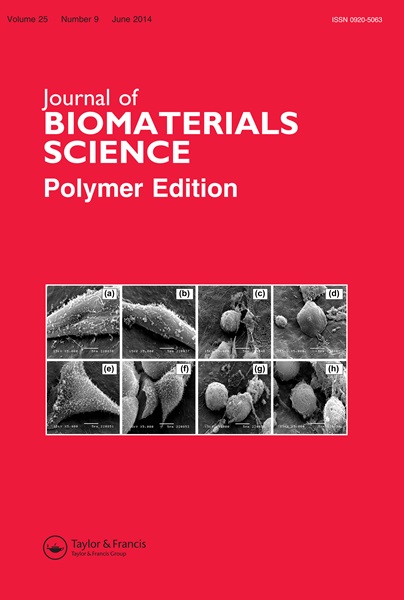
{"title":"Cell viability of chitosan-containing semi-interpenetrated hydrogels based on PCL-PEG-PCL diacrylate macromer.","authors":"Ai Ping Zhu, Mary B Chan-Park","doi":"10.1163/1568562053654149","DOIUrl":null,"url":null,"abstract":"<p><p>Chitosan-modified biodegradable hydrogels were prepared by UV irradiation of solutions in mild aqueous acidic media of poly(caprolactone)-co-poly(ethylene glycol)-co-poly(caprolactone) diacrylate (PCL-PEG-PCL-DA) and chitosan. Hydrogels obtained were characterized using FT-IR, DSC, TGA and XPS. FT-IR, TGA and DSC revealed the semi-interpenetrating polymer network structure formed in the hydrogel. Though the water swelling degree of these chitosan-modified hydrogels was substantial in the range of 322-539%, it was found that fibroblasts could still attach, spread and grow on them; this is in contrast to the commonly investigated PEG-diacrylate hydrogel. The MTT assay demonstrated that cells could grow better on 3 or 6% chitosan-modified hydrogel than unmodified PCL-PEG-PCL-DA hydrogels or low-content (1%) chitosan-modified PCL-PEG-PCL-DA hydrogel. Increased chitosan content resulted in increased cell interaction and also decreased water swelling, both of which results in increased cell attachment and spread.</p>","PeriodicalId":15195,"journal":{"name":"Journal of Biomaterials Science, Polymer Edition","volume":"16 3","pages":"301-16"},"PeriodicalIF":3.6000,"publicationDate":"2005-01-01","publicationTypes":"Journal Article","fieldsOfStudy":null,"isOpenAccess":false,"openAccessPdf":"https://sci-hub-pdf.com/10.1163/1568562053654149","citationCount":"12","resultStr":null,"platform":"Semanticscholar","paperid":null,"PeriodicalName":"Journal of Biomaterials Science, Polymer Edition","FirstCategoryId":"5","ListUrlMain":"https://doi.org/10.1163/1568562053654149","RegionNum":4,"RegionCategory":"医学","ArticlePicture":[],"TitleCN":null,"AbstractTextCN":null,"PMCID":null,"EPubDate":"","PubModel":"","JCR":"Q2","JCRName":"ENGINEERING, BIOMEDICAL","Score":null,"Total":0}
引用次数: 12
Abstract
Chitosan-modified biodegradable hydrogels were prepared by UV irradiation of solutions in mild aqueous acidic media of poly(caprolactone)-co-poly(ethylene glycol)-co-poly(caprolactone) diacrylate (PCL-PEG-PCL-DA) and chitosan. Hydrogels obtained were characterized using FT-IR, DSC, TGA and XPS. FT-IR, TGA and DSC revealed the semi-interpenetrating polymer network structure formed in the hydrogel. Though the water swelling degree of these chitosan-modified hydrogels was substantial in the range of 322-539%, it was found that fibroblasts could still attach, spread and grow on them; this is in contrast to the commonly investigated PEG-diacrylate hydrogel. The MTT assay demonstrated that cells could grow better on 3 or 6% chitosan-modified hydrogel than unmodified PCL-PEG-PCL-DA hydrogels or low-content (1%) chitosan-modified PCL-PEG-PCL-DA hydrogel. Increased chitosan content resulted in increased cell interaction and also decreased water swelling, both of which results in increased cell attachment and spread.
期刊介绍:
The Journal of Biomaterials Science, Polymer Edition publishes fundamental research on the properties of polymeric biomaterials and the mechanisms of interaction between such biomaterials and living organisms, with special emphasis on the molecular and cellular levels.
The scope of the journal includes polymers for drug delivery, tissue engineering, large molecules in living organisms like DNA, proteins and more. As such, the Journal of Biomaterials Science, Polymer Edition combines biomaterials applications in biomedical, pharmaceutical and biological fields.



 京公网安备 11010802042870号
京ICP备2023020795号-1
京公网安备 11010802042870号
京ICP备2023020795号-1

 分享
分享
 求助内容:
求助内容: 应助结果提醒方式:
 扫码关注我们
