{"title":"Molecular docking, synthesis and anticancer activity of thiosemicarbazone derivatives against MCF-7 human breast cancer cell line","authors":"Belay Zeleke Sibuh , Sonia Khanna , Pankaj Taneja , Paratpar Sarkar , Neetu Kumra Taneja","doi":"10.1016/j.lfs.2021.119305","DOIUrl":null,"url":null,"abstract":"<div><h3>Background</h3><p><span>The aim of this study was to synthesize and evaluate anticancer activity of 2-hydroxy </span>benzaldehyde<span> and 4-hydroxy benzaldehyde thiosemicarbazone<span> (2-HBTSc and 4-HBTSc) against MCF-7 breast cancer cell line.</span></span></p></div><div><h3>Materials and methods</h3><p><span><span>The ligands were prepared and characterized by UV vis, IR and NMR. MTT assay was used to assess viability of cells. RNA isolation, extraction and cDNA synthesis were done. Then all groups were subjected to RT-qPCR using Gene expression specific primers. Also, </span>western blot<span> protein expression and </span></span>molecular docking were done. Two-way ANOVA with Tukey post-hoc test was employed to test the significance using GraphPad Prism.</p></div><div><h3>Results</h3><p>The IC<sub>50</sub><span><span><span> values were 3.36μg/ml and 3.60μg/ml for 2-HBTSc and 4-HBTSc treated MCF-7 tumor cells respectively. Tumor cell growth inhibition ranged from 38 to 49.27% in 4-HBTSc treated cells, and 19 to 25% in 2-HBTSc treated cells with increase in doses 5 μg/ml to 20 μg/ml. The protein and gene expression result showed a significant upregulation in tumor suppressor and apoptosis inducing genes while, oncogene activity was significantly downregulated. Specifically, </span>BRCA2<span> and pRB gene showed the highest expression in 4-HBTSc and 2-HBTSc treated cells respectively. Conversely, RAS oncogene was downregulated significantly. Docking result showed that both 2-HBTSc and 4-HBTSc have the potential to inhibit Estrogen Receptor Alpha<span> Ligand Binding<span> Domain, Human 17-Beta-hydroxysteroid dehydrogenase type 1 mutant protein and Human </span></span></span></span>Topoisomerase II alpha that are expressed more during Breast Cancer.</span></p></div><div><h3>Conclusion</h3><p>The findings of this study imply that the test compound has potential for further study.</p></div>","PeriodicalId":18122,"journal":{"name":"Life sciences","volume":"273 ","pages":"Article 119305"},"PeriodicalIF":5.1000,"publicationDate":"2021-05-15","publicationTypes":"Journal Article","fieldsOfStudy":null,"isOpenAccess":false,"openAccessPdf":"https://sci-hub-pdf.com/10.1016/j.lfs.2021.119305","citationCount":"15","resultStr":null,"platform":"Semanticscholar","paperid":null,"PeriodicalName":"Life sciences","FirstCategoryId":"3","ListUrlMain":"https://www.sciencedirect.com/science/article/pii/S0024320521002903","RegionNum":2,"RegionCategory":"医学","ArticlePicture":[],"TitleCN":null,"AbstractTextCN":null,"PMCID":null,"EPubDate":"","PubModel":"","JCR":"Q1","JCRName":"MEDICINE, RESEARCH & EXPERIMENTAL","Score":null,"Total":0}
引用次数: 15
Abstract
Background
The aim of this study was to synthesize and evaluate anticancer activity of 2-hydroxy benzaldehyde and 4-hydroxy benzaldehyde thiosemicarbazone (2-HBTSc and 4-HBTSc) against MCF-7 breast cancer cell line.
Materials and methods
The ligands were prepared and characterized by UV vis, IR and NMR. MTT assay was used to assess viability of cells. RNA isolation, extraction and cDNA synthesis were done. Then all groups were subjected to RT-qPCR using Gene expression specific primers. Also, western blot protein expression and molecular docking were done. Two-way ANOVA with Tukey post-hoc test was employed to test the significance using GraphPad Prism.
Results
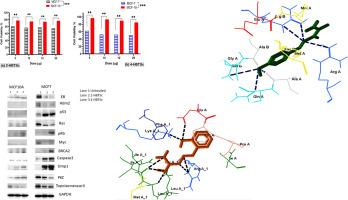
The IC50 values were 3.36μg/ml and 3.60μg/ml for 2-HBTSc and 4-HBTSc treated MCF-7 tumor cells respectively. Tumor cell growth inhibition ranged from 38 to 49.27% in 4-HBTSc treated cells, and 19 to 25% in 2-HBTSc treated cells with increase in doses 5 μg/ml to 20 μg/ml. The protein and gene expression result showed a significant upregulation in tumor suppressor and apoptosis inducing genes while, oncogene activity was significantly downregulated. Specifically, BRCA2 and pRB gene showed the highest expression in 4-HBTSc and 2-HBTSc treated cells respectively. Conversely, RAS oncogene was downregulated significantly. Docking result showed that both 2-HBTSc and 4-HBTSc have the potential to inhibit Estrogen Receptor Alpha Ligand Binding Domain, Human 17-Beta-hydroxysteroid dehydrogenase type 1 mutant protein and Human Topoisomerase II alpha that are expressed more during Breast Cancer.
Conclusion
The findings of this study imply that the test compound has potential for further study.
期刊介绍:
Life Sciences is an international journal publishing articles that emphasize the molecular, cellular, and functional basis of therapy. The journal emphasizes the understanding of mechanism that is relevant to all aspects of human disease and translation to patients. All articles are rigorously reviewed.
The Journal favors publication of full-length papers where modern scientific technologies are used to explain molecular, cellular and physiological mechanisms. Articles that merely report observations are rarely accepted. Recommendations from the Declaration of Helsinki or NIH guidelines for care and use of laboratory animals must be adhered to. Articles should be written at a level accessible to readers who are non-specialists in the topic of the article themselves, but who are interested in the research. The Journal welcomes reviews on topics of wide interest to investigators in the life sciences. We particularly encourage submission of brief, focused reviews containing high-quality artwork and require the use of mechanistic summary diagrams.



 京公网安备 11010802042870号
京ICP备2023020795号-1
京公网安备 11010802042870号
京ICP备2023020795号-1

 分享
分享
 求助内容:
求助内容: 应助结果提醒方式:
 扫码关注我们
