Physical properties of a sandy soil as affected by incubation with a synthetic root exudate: Strength, thermal and hydraulic conductivity, and evaporation
Wencan Zhang, Weida Gao, William Richard Whalley, Tusheng Ren
{"title":"Physical properties of a sandy soil as affected by incubation with a synthetic root exudate: Strength, thermal and hydraulic conductivity, and evaporation","authors":"Wencan Zhang, Weida Gao, William Richard Whalley, Tusheng Ren","doi":"10.1111/ejss.13007","DOIUrl":null,"url":null,"abstract":"<div>\n \n \n <section>\n \n <p>Plant roots release various organic materials that may modify soil structure and affect heat and mass transfer processes. The objective of this study was to determine the effects of a synthetic root exudate (SRE) on penetrometer resistance (PR), thermal conductivity (λ), hydraulic conductivity (<i>k</i>) and evaporation of water in a sandy soil. Soil samples, mixed with either distilled water or the SRE, were packed into columns at a designated bulk density and water content, and incubated for 7 days at 18°C. Soil PR, λ, <i>k</i> and evaporation rate were monitored during drying processes. Compared with those incubated with water, samples incubated with SRE had visible hyphae, greater PR (0.7–5.5 MPa in the water content range of 0.11 to 0.22 m<sup>3</sup> m<sup>−3</sup>) and λ (0.2–0.7 W m<sup>−1</sup> K<sup>−1</sup> from 0.05 to 0.22 m<sup>3</sup> m<sup>−3</sup>), and increased <i>k</i> in the wet region but decreased <i>k</i> in the dry region. SRE treatment also reduced the overall soil water evaporation rate and cumulative water loss. Analysis of X-ray computed tomography (CT) scanning showed that the SRE-treated samples had a greater proportion of small pores (<60 μm). These changes were attributed mainly to SRE-stimulated microbial activities.</p>\n </section>\n \n <section>\n \n <h3> Highlights</h3>\n \n <div>\n <ul>\n \n <li>The effects of incubating a sandy soil with a synthetic root exudate (SRE) on soil physical properties and evaporation are examined.</li>\n \n <li>SRE incubation increased the fraction of small pores.</li>\n \n <li>SRE incubation increased soil penetrometer resistance and thermal conductivity.</li>\n \n <li>Soil hydraulic conductivity was increased in the wet region but was reduced in the dry region.</li>\n \n <li>SRE incubation reduced the overall evaporation rate and cumulative water loss.</li>\n </ul>\n </div>\n </section>\n </div>","PeriodicalId":12043,"journal":{"name":"European Journal of Soil Science","volume":"72 2","pages":"782-792"},"PeriodicalIF":3.8000,"publicationDate":"2020-06-07","publicationTypes":"Journal Article","fieldsOfStudy":null,"isOpenAccess":false,"openAccessPdf":"https://sci-hub-pdf.com/10.1111/ejss.13007","citationCount":"15","resultStr":null,"platform":"Semanticscholar","paperid":null,"PeriodicalName":"European Journal of Soil Science","FirstCategoryId":"97","ListUrlMain":"https://onlinelibrary.wiley.com/doi/10.1111/ejss.13007","RegionNum":2,"RegionCategory":"农林科学","ArticlePicture":[],"TitleCN":null,"AbstractTextCN":null,"PMCID":null,"EPubDate":"","PubModel":"","JCR":"Q2","JCRName":"SOIL SCIENCE","Score":null,"Total":0}
引用次数: 15
Abstract
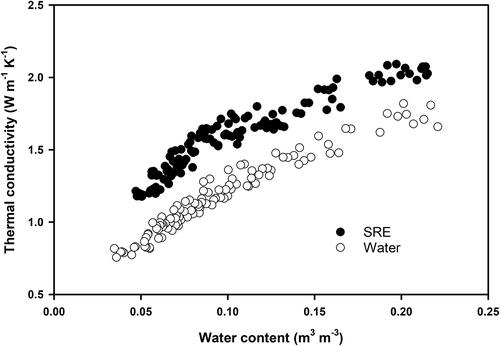
Plant roots release various organic materials that may modify soil structure and affect heat and mass transfer processes. The objective of this study was to determine the effects of a synthetic root exudate (SRE) on penetrometer resistance (PR), thermal conductivity (λ), hydraulic conductivity (k) and evaporation of water in a sandy soil. Soil samples, mixed with either distilled water or the SRE, were packed into columns at a designated bulk density and water content, and incubated for 7 days at 18°C. Soil PR, λ, k and evaporation rate were monitored during drying processes. Compared with those incubated with water, samples incubated with SRE had visible hyphae, greater PR (0.7–5.5 MPa in the water content range of 0.11 to 0.22 m3 m−3) and λ (0.2–0.7 W m−1 K−1 from 0.05 to 0.22 m3 m−3), and increased k in the wet region but decreased k in the dry region. SRE treatment also reduced the overall soil water evaporation rate and cumulative water loss. Analysis of X-ray computed tomography (CT) scanning showed that the SRE-treated samples had a greater proportion of small pores (<60 μm). These changes were attributed mainly to SRE-stimulated microbial activities.
Highlights
The effects of incubating a sandy soil with a synthetic root exudate (SRE) on soil physical properties and evaporation are examined.
SRE incubation increased the fraction of small pores.
SRE incubation increased soil penetrometer resistance and thermal conductivity.
Soil hydraulic conductivity was increased in the wet region but was reduced in the dry region.
SRE incubation reduced the overall evaporation rate and cumulative water loss.
期刊介绍:
The EJSS is an international journal that publishes outstanding papers in soil science that advance the theoretical and mechanistic understanding of physical, chemical and biological processes and their interactions in soils acting from molecular to continental scales in natural and managed environments.



 京公网安备 11010802042870号
京ICP备2023020795号-1
京公网安备 11010802042870号
京ICP备2023020795号-1

 分享
分享
 求助内容:
求助内容: 应助结果提醒方式:
 扫码关注我们
