Mahmood Shabanpour , Maedeh Daneshyar , Misagh Parhizkar , Manuel Esteban Lucas-Borja , Demetrio Antonio Zema
{"title":"Influence of crops on soil properties in agricultural lands of northern Iran","authors":"Mahmood Shabanpour , Maedeh Daneshyar , Misagh Parhizkar , Manuel Esteban Lucas-Borja , Demetrio Antonio Zema","doi":"10.1016/j.scitotenv.2019.134694","DOIUrl":null,"url":null,"abstract":"<div><p>This study evaluates the effects of land use and soil management on a combination of physico-chemical, biological and hydrological properties of soil, in order to assess its quality. Three land uses were selected at the Fuman area, near Masouleh (Iran), grouping soils covered by tea, garden crops and rice. A total of 24 soil samples (3 land uses × 4 replications × 2 soil layers, topsoil and sub-surface soil) was collected; microbial respiration, available water, stability of soil aggregates, pH, organic matter, cation exchange capacity and nutrient content (P, K, N, Mg and Ca) were determined in each land use/soil layer. In comparison with other land uses, garden showed the highest available water, aggregate stability, microbial respiration, nutrient contents and cation exchange capacity, whereas the latter three soil properties had the lowest values in soils covered by tea and rice crops. Based on these results, under the experimental conditions garden had the highest soil quality among the investigated land uses. Conversely, much caution must be paid to some soil properties of tea and rice crops, such as cation exchange capacity, microbial respiration and nutrient contents, which are the lowest among the investigated land uses. Moreover, the differences in the analysed soil properties between the two soil sampling depths were statistically significant (p < 0.05). Finally, a Principal Component Analysis clearly clustered soils covered by garden, tea and rice crops in three differentiated groups according to the sampled soil properties. This study provides a contribution in understanding the variability of soil properties under different land uses, indicating that some of these properties must be considered with caution, in order to avoid a decay of soil health.</p></div>","PeriodicalId":422,"journal":{"name":"Science of the Total Environment","volume":"711 ","pages":"Article 134694"},"PeriodicalIF":8.0000,"publicationDate":"2020-04-01","publicationTypes":"Journal Article","fieldsOfStudy":null,"isOpenAccess":false,"openAccessPdf":"https://sci-hub-pdf.com/10.1016/j.scitotenv.2019.134694","citationCount":"22","resultStr":null,"platform":"Semanticscholar","paperid":null,"PeriodicalName":"Science of the Total Environment","FirstCategoryId":"93","ListUrlMain":"https://www.sciencedirect.com/science/article/pii/S0048969719346856","RegionNum":1,"RegionCategory":"环境科学与生态学","ArticlePicture":[],"TitleCN":null,"AbstractTextCN":null,"PMCID":null,"EPubDate":"","PubModel":"","JCR":"Q1","JCRName":"ENVIRONMENTAL SCIENCES","Score":null,"Total":0}
引用次数: 22
Abstract
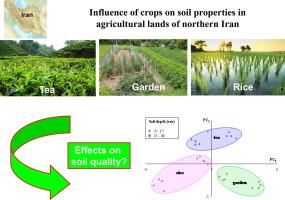
This study evaluates the effects of land use and soil management on a combination of physico-chemical, biological and hydrological properties of soil, in order to assess its quality. Three land uses were selected at the Fuman area, near Masouleh (Iran), grouping soils covered by tea, garden crops and rice. A total of 24 soil samples (3 land uses × 4 replications × 2 soil layers, topsoil and sub-surface soil) was collected; microbial respiration, available water, stability of soil aggregates, pH, organic matter, cation exchange capacity and nutrient content (P, K, N, Mg and Ca) were determined in each land use/soil layer. In comparison with other land uses, garden showed the highest available water, aggregate stability, microbial respiration, nutrient contents and cation exchange capacity, whereas the latter three soil properties had the lowest values in soils covered by tea and rice crops. Based on these results, under the experimental conditions garden had the highest soil quality among the investigated land uses. Conversely, much caution must be paid to some soil properties of tea and rice crops, such as cation exchange capacity, microbial respiration and nutrient contents, which are the lowest among the investigated land uses. Moreover, the differences in the analysed soil properties between the two soil sampling depths were statistically significant (p < 0.05). Finally, a Principal Component Analysis clearly clustered soils covered by garden, tea and rice crops in three differentiated groups according to the sampled soil properties. This study provides a contribution in understanding the variability of soil properties under different land uses, indicating that some of these properties must be considered with caution, in order to avoid a decay of soil health.
期刊介绍:
The Science of the Total Environment is an international journal dedicated to scientific research on the environment and its interaction with humanity. It covers a wide range of disciplines and seeks to publish innovative, hypothesis-driven, and impactful research that explores the entire environment, including the atmosphere, lithosphere, hydrosphere, biosphere, and anthroposphere.
The journal's updated Aims & Scope emphasizes the importance of interdisciplinary environmental research with broad impact. Priority is given to studies that advance fundamental understanding and explore the interconnectedness of multiple environmental spheres. Field studies are preferred, while laboratory experiments must demonstrate significant methodological advancements or mechanistic insights with direct relevance to the environment.



 京公网安备 11010802042870号
京ICP备2023020795号-1
京公网安备 11010802042870号
京ICP备2023020795号-1

 分享
分享
 求助内容:
求助内容: 应助结果提醒方式:
 扫码关注我们
