Lukas Stemper , Bernhard Mitas , Thomas Kremmer , Steffen Otterbach , Peter J. Uggowitzer , Stefan Pogatscher
{"title":"Age-hardening of high pressure die casting AlMg alloys with Zn and combined Zn and Cu additions","authors":"Lukas Stemper , Bernhard Mitas , Thomas Kremmer , Steffen Otterbach , Peter J. Uggowitzer , Stefan Pogatscher","doi":"10.1016/j.matdes.2019.107927","DOIUrl":null,"url":null,"abstract":"<div><p>This study investigates the age-hardening of AlMg alloys with Zn and combined Zn and Cu additions. Two AlMg5Mn1 alloys modified with Zn and Cu were processed by high pressure die casting (HPDC) and different heat treatment strategies. Single step artificial aging, artificial aging with pre-aging and the effect of the quenching rate were studied via hardness measurements and transmission electron microscopy (TEM). Single-step artificial aging resulted in an increase in hardness of 58% in peak aged condition for the Zn-only modified alloy and of 56% for the Zn- and Cu-containing alloy. Pre-aging treatments either reduce the necessary aging time or increase the hardness, depending on the parameters used. Microstructural investigations indicate a significant change in the S- or T-phase precursors, and in precipitation density with pre-aging. The alloys have high potential for use as complex structural HPDC components in lightweight transport applications, but are also of general interest for components which require high strength and formability.</p></div>","PeriodicalId":383,"journal":{"name":"Materials & Design","volume":"181 ","pages":"Article 107927"},"PeriodicalIF":7.9000,"publicationDate":"2019-11-05","publicationTypes":"Journal Article","fieldsOfStudy":null,"isOpenAccess":false,"openAccessPdf":"https://sci-hub-pdf.com/10.1016/j.matdes.2019.107927","citationCount":"39","resultStr":null,"platform":"Semanticscholar","paperid":null,"PeriodicalName":"Materials & Design","FirstCategoryId":"88","ListUrlMain":"https://www.sciencedirect.com/science/article/pii/S026412751930365X","RegionNum":2,"RegionCategory":"材料科学","ArticlePicture":[],"TitleCN":null,"AbstractTextCN":null,"PMCID":null,"EPubDate":"","PubModel":"","JCR":"Q1","JCRName":"MATERIALS SCIENCE, MULTIDISCIPLINARY","Score":null,"Total":0}
引用次数: 39
Abstract
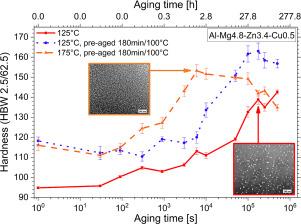
This study investigates the age-hardening of AlMg alloys with Zn and combined Zn and Cu additions. Two AlMg5Mn1 alloys modified with Zn and Cu were processed by high pressure die casting (HPDC) and different heat treatment strategies. Single step artificial aging, artificial aging with pre-aging and the effect of the quenching rate were studied via hardness measurements and transmission electron microscopy (TEM). Single-step artificial aging resulted in an increase in hardness of 58% in peak aged condition for the Zn-only modified alloy and of 56% for the Zn- and Cu-containing alloy. Pre-aging treatments either reduce the necessary aging time or increase the hardness, depending on the parameters used. Microstructural investigations indicate a significant change in the S- or T-phase precursors, and in precipitation density with pre-aging. The alloys have high potential for use as complex structural HPDC components in lightweight transport applications, but are also of general interest for components which require high strength and formability.
期刊介绍:
Materials and Design is a multi-disciplinary journal that publishes original research reports, review articles, and express communications. The journal focuses on studying the structure and properties of inorganic and organic materials, advancements in synthesis, processing, characterization, and testing, the design of materials and engineering systems, and their applications in technology. It aims to bring together various aspects of materials science, engineering, physics, and chemistry.
The journal explores themes ranging from materials to design and aims to reveal the connections between natural and artificial materials, as well as experiment and modeling. Manuscripts submitted to Materials and Design should contain elements of discovery and surprise, as they often contribute new insights into the architecture and function of matter.



 京公网安备 11010802042870号
京ICP备2023020795号-1
京公网安备 11010802042870号
京ICP备2023020795号-1

 分享
分享
 求助内容:
求助内容: 应助结果提醒方式:
 扫码关注我们
