{"title":"MicroRNA expression in response to bisphenol A is associated with high blood pressure","authors":"Jin Hee Kim , Yoon Hee Cho , Yun-Chul Hong","doi":"10.1016/j.envint.2020.105791","DOIUrl":null,"url":null,"abstract":"<div><p>Bisphenol A (BPA) is a ubiquitous environmental contaminant that is known to be associated with the risk of arterial hypertension. However, the underlying mechanisms describing how BPA exposure leads to high blood pressure (BP) and the role of epigenetics are still unclear. Therefore, we evaluated associations among BPA exposure, microRNA (miRNA) expression, and BP in a randomized crossover trial with 45 non-smoking females over 60 years of age. The participants visited the study site 3 times and were dose-dependently exposed to BPA. Two hours after exposure to BPA, urine and whole blood were collected for BPA measurement and miRNA profiling, and BP was measured. Relationships among urinary BPA level, miRNA expression, and BP were estimated using the mixed effect model. Decreases in miR-30a-5p, miR-580-3p, miR-627-5p, and miR-671-3p and increases in miR-636 and miR-1224-3p attributable to BPA exposure were associated with high BP. The core functional network from BPA exposure to increased BP was found to be on the pathway through these six miRNAs and their predicted BP-related target genes. Our results suggest that epigenetic biomarkers for BPA exposure and hypertension provide mechanistic data to explain hypertension exacerbation as well as key information for predicting the health effects of BPA exposure.</p></div>","PeriodicalId":308,"journal":{"name":"Environment International","volume":"141 ","pages":"Article 105791"},"PeriodicalIF":9.7000,"publicationDate":"2020-08-01","publicationTypes":"Journal Article","fieldsOfStudy":null,"isOpenAccess":false,"openAccessPdf":"https://sci-hub-pdf.com/10.1016/j.envint.2020.105791","citationCount":"13","resultStr":null,"platform":"Semanticscholar","paperid":null,"PeriodicalName":"Environment International","FirstCategoryId":"93","ListUrlMain":"https://www.sciencedirect.com/science/article/pii/S0160412020303196","RegionNum":1,"RegionCategory":"环境科学与生态学","ArticlePicture":[],"TitleCN":null,"AbstractTextCN":null,"PMCID":null,"EPubDate":"","PubModel":"","JCR":"Q1","JCRName":"ENVIRONMENTAL SCIENCES","Score":null,"Total":0}
引用次数: 13
Abstract
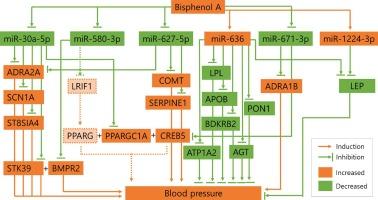
Bisphenol A (BPA) is a ubiquitous environmental contaminant that is known to be associated with the risk of arterial hypertension. However, the underlying mechanisms describing how BPA exposure leads to high blood pressure (BP) and the role of epigenetics are still unclear. Therefore, we evaluated associations among BPA exposure, microRNA (miRNA) expression, and BP in a randomized crossover trial with 45 non-smoking females over 60 years of age. The participants visited the study site 3 times and were dose-dependently exposed to BPA. Two hours after exposure to BPA, urine and whole blood were collected for BPA measurement and miRNA profiling, and BP was measured. Relationships among urinary BPA level, miRNA expression, and BP were estimated using the mixed effect model. Decreases in miR-30a-5p, miR-580-3p, miR-627-5p, and miR-671-3p and increases in miR-636 and miR-1224-3p attributable to BPA exposure were associated with high BP. The core functional network from BPA exposure to increased BP was found to be on the pathway through these six miRNAs and their predicted BP-related target genes. Our results suggest that epigenetic biomarkers for BPA exposure and hypertension provide mechanistic data to explain hypertension exacerbation as well as key information for predicting the health effects of BPA exposure.
期刊介绍:
Environmental Health publishes manuscripts focusing on critical aspects of environmental and occupational medicine, including studies in toxicology and epidemiology, to illuminate the human health implications of exposure to environmental hazards. The journal adopts an open-access model and practices open peer review.
It caters to scientists and practitioners across all environmental science domains, directly or indirectly impacting human health and well-being. With a commitment to enhancing the prevention of environmentally-related health risks, Environmental Health serves as a public health journal for the community and scientists engaged in matters of public health significance concerning the environment.



 京公网安备 11010802042870号
京ICP备2023020795号-1
京公网安备 11010802042870号
京ICP备2023020795号-1

 分享
分享
 求助内容:
求助内容: 应助结果提醒方式:
 扫码关注我们
