Cu-Ni-CoSex quaternary porous nanocubes as enhanced Pt-free electrocatalysts for highly efficient dye-sensitized solar cells and hydrogen evolution in alkaline medium
{"title":"Cu-Ni-CoSex quaternary porous nanocubes as enhanced Pt-free electrocatalysts for highly efficient dye-sensitized solar cells and hydrogen evolution in alkaline medium","authors":"Yudi Niu, Xing Qian, Chong Xu, Hongyu Liu, Weimin Wu, Linxi Hou","doi":"10.1016/j.cej.2018.09.116","DOIUrl":null,"url":null,"abstract":"<div><p>A series of porous cubic nanomaterials have been prepared through a facile one-step selenylation process, in which Cu-Ni-Co, Ni-Co and Cu-Co Prussian-blue analog nanocubes transformed to Cu-Ni-CoSe<sub>x</sub>, Ni-CoSe<sub>x</sub> and Cu-CoSe<sub>x</sub> nanocubes, respectively. Among these samples, the quaternary porous nanocubes (Cu-Ni-CoSe<sub>x</sub>) proved to be the excellent bifunctional electrocatalysts in dye-sensitized solar cells and hydrogen evolution reactions. Under the standard irradiation, Cu-Ni-CoSe<sub>x</sub> nanocubes exhibited a high power conversion efficiency of 9.74% in solar cells, which was much superior than that of Pt (8.19%). Cu-Ni-CoSe<sub>x</sub> nanocubes also delivered superb hydrogen evolution performance in terms of a low overpotential (50.2 mV) under the current density of 10 mA cm<sup>−2</sup> and a low Tafel slope (49.6 mV dec<sup>−1</sup>) in alkaline medium. The outstanding characteristics of Cu-Ni-CoSe<sub>x</sub> nanocubes were benefited from their uniform sizes, porous morphologies, high surface area, low charge transfer resistances and good synergies among multiple elements.</p></div>","PeriodicalId":270,"journal":{"name":"Chemical Engineering Journal","volume":"357 ","pages":"Pages 11-20"},"PeriodicalIF":13.2000,"publicationDate":"2019-02-01","publicationTypes":"Journal Article","fieldsOfStudy":null,"isOpenAccess":false,"openAccessPdf":"https://sci-hub-pdf.com/10.1016/j.cej.2018.09.116","citationCount":"39","resultStr":null,"platform":"Semanticscholar","paperid":null,"PeriodicalName":"Chemical Engineering Journal","FirstCategoryId":"5","ListUrlMain":"https://www.sciencedirect.com/science/article/pii/S1385894718318321","RegionNum":1,"RegionCategory":"工程技术","ArticlePicture":[],"TitleCN":null,"AbstractTextCN":null,"PMCID":null,"EPubDate":"2018/9/17 0:00:00","PubModel":"Epub","JCR":"Q1","JCRName":"ENGINEERING, CHEMICAL","Score":null,"Total":0}
引用次数: 39
Abstract
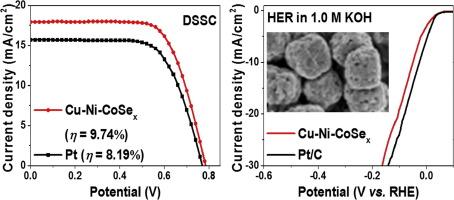
A series of porous cubic nanomaterials have been prepared through a facile one-step selenylation process, in which Cu-Ni-Co, Ni-Co and Cu-Co Prussian-blue analog nanocubes transformed to Cu-Ni-CoSex, Ni-CoSex and Cu-CoSex nanocubes, respectively. Among these samples, the quaternary porous nanocubes (Cu-Ni-CoSex) proved to be the excellent bifunctional electrocatalysts in dye-sensitized solar cells and hydrogen evolution reactions. Under the standard irradiation, Cu-Ni-CoSex nanocubes exhibited a high power conversion efficiency of 9.74% in solar cells, which was much superior than that of Pt (8.19%). Cu-Ni-CoSex nanocubes also delivered superb hydrogen evolution performance in terms of a low overpotential (50.2 mV) under the current density of 10 mA cm−2 and a low Tafel slope (49.6 mV dec−1) in alkaline medium. The outstanding characteristics of Cu-Ni-CoSex nanocubes were benefited from their uniform sizes, porous morphologies, high surface area, low charge transfer resistances and good synergies among multiple elements.
期刊介绍:
The Chemical Engineering Journal is an international research journal that invites contributions of original and novel fundamental research. It aims to provide an international platform for presenting original fundamental research, interpretative reviews, and discussions on new developments in chemical engineering. The journal welcomes papers that describe novel theory and its practical application, as well as those that demonstrate the transfer of techniques from other disciplines. It also welcomes reports on carefully conducted experimental work that is soundly interpreted. The main focus of the journal is on original and rigorous research results that have broad significance. The Catalysis section within the Chemical Engineering Journal focuses specifically on Experimental and Theoretical studies in the fields of heterogeneous catalysis, molecular catalysis, and biocatalysis. These studies have industrial impact on various sectors such as chemicals, energy, materials, foods, healthcare, and environmental protection.



 京公网安备 11010802042870号
京ICP备2023020795号-1
京公网安备 11010802042870号
京ICP备2023020795号-1

 分享
分享
 求助内容:
求助内容: 应助结果提醒方式:
 扫码关注我们
