{"title":"Decoupling the scholarly journal.","authors":"Jason Priem, Bradley M Hemminger","doi":"10.3389/fncom.2012.00019","DOIUrl":null,"url":null,"abstract":"<p><p>Although many observers have advocated the reform of the scholarly publishing system, improvements to functions like peer review have been adopted sluggishly. We argue that this is due to the tight coupling of the journal system: the system's essential functions of archiving, registration, dissemination, and certification are bundled together and siloed into tens of thousands of individual journals. This tight coupling makes it difficult to change any one aspect of the system, choking out innovation. We suggest that the solution is the \"decoupled journal (DcJ).\" In this system, the functions are unbundled and performed as services, able to compete for patronage and evolve in response to the market. For instance, a scholar might deposit an article in her institutional repository, have it copyedited and typeset by one company, indexed for search by several others, self-marketed over her own social networks, and peer reviewed by one or more stamping agencies that connect her paper to external reviewers. The DcJ brings publishing out of its current seventeenth-century paradigm, and creates a Web-like environment of loosely joined pieces-a marketplace of tools that, like the Web, evolves quickly in response to new technologies and users' needs. Importantly, this system is able to evolve from the current one, requiring only the continued development of bolt-on services external to the journal, particularly for peer review.</p>","PeriodicalId":12363,"journal":{"name":"Frontiers in Computational Neuroscience","volume":"6 ","pages":"19"},"PeriodicalIF":2.3000,"publicationDate":"2012-04-05","publicationTypes":"Journal Article","fieldsOfStudy":null,"isOpenAccess":false,"openAccessPdf":"https://sci-hub-pdf.com/10.3389/fncom.2012.00019","citationCount":"76","resultStr":null,"platform":"Semanticscholar","paperid":null,"PeriodicalName":"Frontiers in Computational Neuroscience","FirstCategoryId":"3","ListUrlMain":"https://doi.org/10.3389/fncom.2012.00019","RegionNum":4,"RegionCategory":"医学","ArticlePicture":[],"TitleCN":null,"AbstractTextCN":null,"PMCID":null,"EPubDate":"2012/1/1 0:00:00","PubModel":"eCollection","JCR":"Q2","JCRName":"MATHEMATICAL & COMPUTATIONAL BIOLOGY","Score":null,"Total":0}
引用次数: 76
Abstract
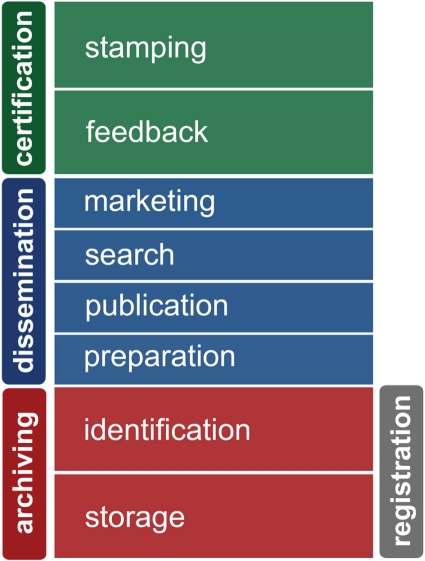
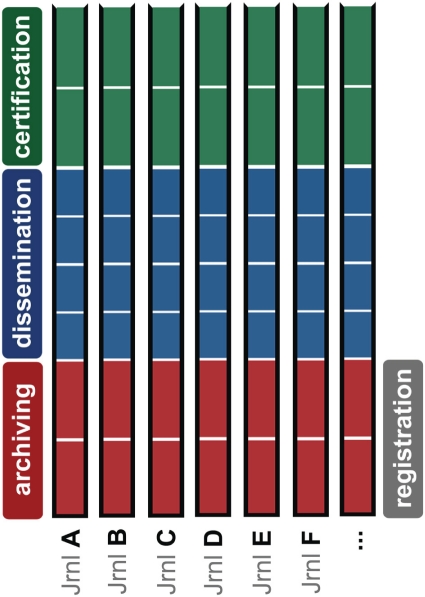
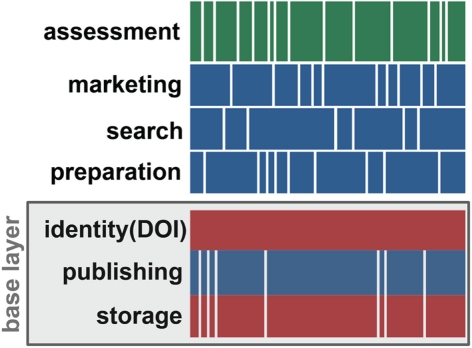
Although many observers have advocated the reform of the scholarly publishing system, improvements to functions like peer review have been adopted sluggishly. We argue that this is due to the tight coupling of the journal system: the system's essential functions of archiving, registration, dissemination, and certification are bundled together and siloed into tens of thousands of individual journals. This tight coupling makes it difficult to change any one aspect of the system, choking out innovation. We suggest that the solution is the "decoupled journal (DcJ)." In this system, the functions are unbundled and performed as services, able to compete for patronage and evolve in response to the market. For instance, a scholar might deposit an article in her institutional repository, have it copyedited and typeset by one company, indexed for search by several others, self-marketed over her own social networks, and peer reviewed by one or more stamping agencies that connect her paper to external reviewers. The DcJ brings publishing out of its current seventeenth-century paradigm, and creates a Web-like environment of loosely joined pieces-a marketplace of tools that, like the Web, evolves quickly in response to new technologies and users' needs. Importantly, this system is able to evolve from the current one, requiring only the continued development of bolt-on services external to the journal, particularly for peer review.
期刊介绍:
Frontiers in Computational Neuroscience is a first-tier electronic journal devoted to promoting theoretical modeling of brain function and fostering interdisciplinary interactions between theoretical and experimental neuroscience. Progress in understanding the amazing capabilities of the brain is still limited, and we believe that it will only come with deep theoretical thinking and mutually stimulating cooperation between different disciplines and approaches. We therefore invite original contributions on a wide range of topics that present the fruits of such cooperation, or provide stimuli for future alliances. We aim to provide an interactive forum for cutting-edge theoretical studies of the nervous system, and for promulgating the best theoretical research to the broader neuroscience community. Models of all styles and at all levels are welcome, from biophysically motivated realistic simulations of neurons and synapses to high-level abstract models of inference and decision making. While the journal is primarily focused on theoretically based and driven research, we welcome experimental studies that validate and test theoretical conclusions.
Also: comp neuro




 京公网安备 11010802042870号
京ICP备2023020795号-1
京公网安备 11010802042870号
京ICP备2023020795号-1

 分享
分享
 求助内容:
求助内容: 应助结果提醒方式:
 扫码关注我们
