Temporal evolution of plutonium concentrations and isotopic ratios in the Ukedo - Takase Rivers draining the Difficult-To-Return zone in Fukushima, Japan (2013–2020)
{"title":"Temporal evolution of plutonium concentrations and isotopic ratios in the Ukedo - Takase Rivers draining the Difficult-To-Return zone in Fukushima, Japan (2013–2020)","authors":"Aurélie Diacre , Thomas Chalaux Clergue , Soazig Burban , Caroline Gauthier , Amélie Hubert , Anne-Claire Humbert , Irène Lefevre , Anne-Laure Fauré , Fabien Pointurier , Olivier Evrard","doi":"10.1016/j.envpol.2022.120963","DOIUrl":null,"url":null,"abstract":"<div><p><span>In 2011, the Fukushima Dai-Ichi Nuclear Power Plant (FDNPP) accident released significant quantities of radionuclides into the environment. Japanese authorities decided to progressively reopen the Difficult-To-Return Zone after the </span>decontamination<span> of priority reconstruction zones. These areas include parts of the initially highly contaminated municipalities located to the north of the FDNPP, including Namie Town, an area drained by the Ukedo and Takase Rivers. Eleven years after the accident, research focused on the spatial distribution of plutonium (Pu) and radiocesium (Cs) isotopes at contrasted individual locations. To complement previous results, the current research was conducted on flood sediment deposits collected at the same locations after major flooding events during eleven fieldwork campaigns organised between 2013 and 2020 at the outlet of the Ukedo and Takase Rivers (n = 22).</span></p><p>The results highlighted a global decrease of the Pu and <sup>137</sup>Cs contents in sediment with time during the abandonment phase in the region, from 2013 (238.20 fg g<sup>−1</sup>) to 2020 (4.28 fg g<sup>−1</sup>). Furthermore, based on the analysis of the <sup>240</sup>Pu/<sup>239</sup><span>Pu isotopic ratios, the plutonium transiting these rivers (range: 0.166 – 0.220) essentially originated from the global fallout (0.180 ± 0.014 (Kelley et al., 1999)). Sediment showed contrasted properties in the two investigated rivers, which is likely mainly the result of the occurrence of Ogaki Dam on upper sections of the Ukedo River as it strongly impacts the material supply from this river to the Pacific Ocean. A statistical analysis highlighted the strong correlation between Pu activity concentrations and </span><sup>137</sup>Cs activities in both rivers, confirming that both radionuclides are transported with a similar pathway. Despite it was detected early after the accident (2011–2013), the current research demonstrates that plutonium originating from FDNPP is no longer detected in these rivers draining the Difficult-To-Return Zone at the onset of the reopening of the area to its former inhabitants.</p></div>","PeriodicalId":311,"journal":{"name":"Environmental Pollution","volume":"319 ","pages":"Article 120963"},"PeriodicalIF":7.3000,"publicationDate":"2023-02-15","publicationTypes":"Journal Article","fieldsOfStudy":null,"isOpenAccess":false,"openAccessPdf":"","citationCount":"1","resultStr":null,"platform":"Semanticscholar","paperid":null,"PeriodicalName":"Environmental Pollution","FirstCategoryId":"93","ListUrlMain":"https://www.sciencedirect.com/science/article/pii/S0269749122021789","RegionNum":2,"RegionCategory":"环境科学与生态学","ArticlePicture":[],"TitleCN":null,"AbstractTextCN":null,"PMCID":null,"EPubDate":"","PubModel":"","JCR":"Q1","JCRName":"ENVIRONMENTAL SCIENCES","Score":null,"Total":0}
引用次数: 1
Abstract
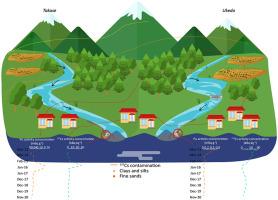
In 2011, the Fukushima Dai-Ichi Nuclear Power Plant (FDNPP) accident released significant quantities of radionuclides into the environment. Japanese authorities decided to progressively reopen the Difficult-To-Return Zone after the decontamination of priority reconstruction zones. These areas include parts of the initially highly contaminated municipalities located to the north of the FDNPP, including Namie Town, an area drained by the Ukedo and Takase Rivers. Eleven years after the accident, research focused on the spatial distribution of plutonium (Pu) and radiocesium (Cs) isotopes at contrasted individual locations. To complement previous results, the current research was conducted on flood sediment deposits collected at the same locations after major flooding events during eleven fieldwork campaigns organised between 2013 and 2020 at the outlet of the Ukedo and Takase Rivers (n = 22).
The results highlighted a global decrease of the Pu and 137Cs contents in sediment with time during the abandonment phase in the region, from 2013 (238.20 fg g−1) to 2020 (4.28 fg g−1). Furthermore, based on the analysis of the 240Pu/239Pu isotopic ratios, the plutonium transiting these rivers (range: 0.166 – 0.220) essentially originated from the global fallout (0.180 ± 0.014 (Kelley et al., 1999)). Sediment showed contrasted properties in the two investigated rivers, which is likely mainly the result of the occurrence of Ogaki Dam on upper sections of the Ukedo River as it strongly impacts the material supply from this river to the Pacific Ocean. A statistical analysis highlighted the strong correlation between Pu activity concentrations and 137Cs activities in both rivers, confirming that both radionuclides are transported with a similar pathway. Despite it was detected early after the accident (2011–2013), the current research demonstrates that plutonium originating from FDNPP is no longer detected in these rivers draining the Difficult-To-Return Zone at the onset of the reopening of the area to its former inhabitants.
期刊介绍:
Environmental Pollution is an international peer-reviewed journal that publishes high-quality research papers and review articles covering all aspects of environmental pollution and its impacts on ecosystems and human health.
Subject areas include, but are not limited to:
• Sources and occurrences of pollutants that are clearly defined and measured in environmental compartments, food and food-related items, and human bodies;
• Interlinks between contaminant exposure and biological, ecological, and human health effects, including those of climate change;
• Contaminants of emerging concerns (including but not limited to antibiotic resistant microorganisms or genes, microplastics/nanoplastics, electronic wastes, light, and noise) and/or their biological, ecological, or human health effects;
• Laboratory and field studies on the remediation/mitigation of environmental pollution via new techniques and with clear links to biological, ecological, or human health effects;
• Modeling of pollution processes, patterns, or trends that is of clear environmental and/or human health interest;
• New techniques that measure and examine environmental occurrences, transport, behavior, and effects of pollutants within the environment or the laboratory, provided that they can be clearly used to address problems within regional or global environmental compartments.



 京公网安备 11010802042870号
京ICP备2023020795号-1
京公网安备 11010802042870号
京ICP备2023020795号-1

 分享
分享
 求助内容:
求助内容: 应助结果提醒方式:
 扫码关注我们
