Carlijn de Roos, Ricky Greenwald, Margien den Hollander-Gijsman, Eric Noorthoorn, Stef van Buuren, Ad de Jongh
{"title":"A randomised comparison of cognitive behavioural therapy (CBT) and eye movement desensitisation and reprocessing (EMDR) in disaster-exposed children.","authors":"Carlijn de Roos, Ricky Greenwald, Margien den Hollander-Gijsman, Eric Noorthoorn, Stef van Buuren, Ad de Jongh","doi":"10.3402/ejpt.v2i0.5694","DOIUrl":null,"url":null,"abstract":"<p><strong>Background: </strong>Building on previous research with disaster-exposed children and adolescents, a randomised clinical trial was performed in the treatment of trauma-related symptoms. In the current study two active treatments were compared among children in a broad age range and from a wide diversity of ethnic populations.</p><p><strong>Objective: </strong>The primary aim was to compare the effectiveness and efficiency of Cognitive Behavioural Therapy (CBT) and Eye Movement Desensitisation and Reprocessing (EMDR).</p><p><strong>Design: </strong>Children (n=52, aged 4-18) were randomly allocated to either CBT (n=26) or EMDR (n=26) in a disaster mental health after-care setting after an explosion of a fireworks factory. All children received up to four individual treatment sessions over a 4-8 week period along with up to four sessions of parent guidance. Blind assessment took place pre- and post-treatment and at 3 months follow-up on a variety of parent-rated and self-report measures of post-traumatic stress disorder symptomatology, depression, anxiety, and behaviour problems. Analyses of variance (general linear model repeated measures) were conducted on the intention-to-treat sample and the completers.</p><p><strong>Results: </strong>Both treatment approaches produced significant reductions on all measures and results were maintained at follow-up. Treatment gains of EMDR were reached in fewer sessions.</p><p><strong>Conclusion: </strong>Standardised CBT and EMDR interventions can significantly improve functioning of disaster-exposed children.</p>","PeriodicalId":12055,"journal":{"name":"European Journal of Psychotraumatology","volume":"2 ","pages":""},"PeriodicalIF":4.1000,"publicationDate":"2011-01-01","publicationTypes":"Journal Article","fieldsOfStudy":null,"isOpenAccess":false,"openAccessPdf":"https://sci-hub-pdf.com/10.3402/ejpt.v2i0.5694","citationCount":"131","resultStr":null,"platform":"Semanticscholar","paperid":null,"PeriodicalName":"European Journal of Psychotraumatology","FirstCategoryId":"3","ListUrlMain":"https://doi.org/10.3402/ejpt.v2i0.5694","RegionNum":2,"RegionCategory":"医学","ArticlePicture":[],"TitleCN":null,"AbstractTextCN":null,"PMCID":null,"EPubDate":"2011/4/6 0:00:00","PubModel":"Epub","JCR":"Q1","JCRName":"PSYCHIATRY","Score":null,"Total":0}
引用次数: 131
Abstract
Background: Building on previous research with disaster-exposed children and adolescents, a randomised clinical trial was performed in the treatment of trauma-related symptoms. In the current study two active treatments were compared among children in a broad age range and from a wide diversity of ethnic populations.
Objective: The primary aim was to compare the effectiveness and efficiency of Cognitive Behavioural Therapy (CBT) and Eye Movement Desensitisation and Reprocessing (EMDR).
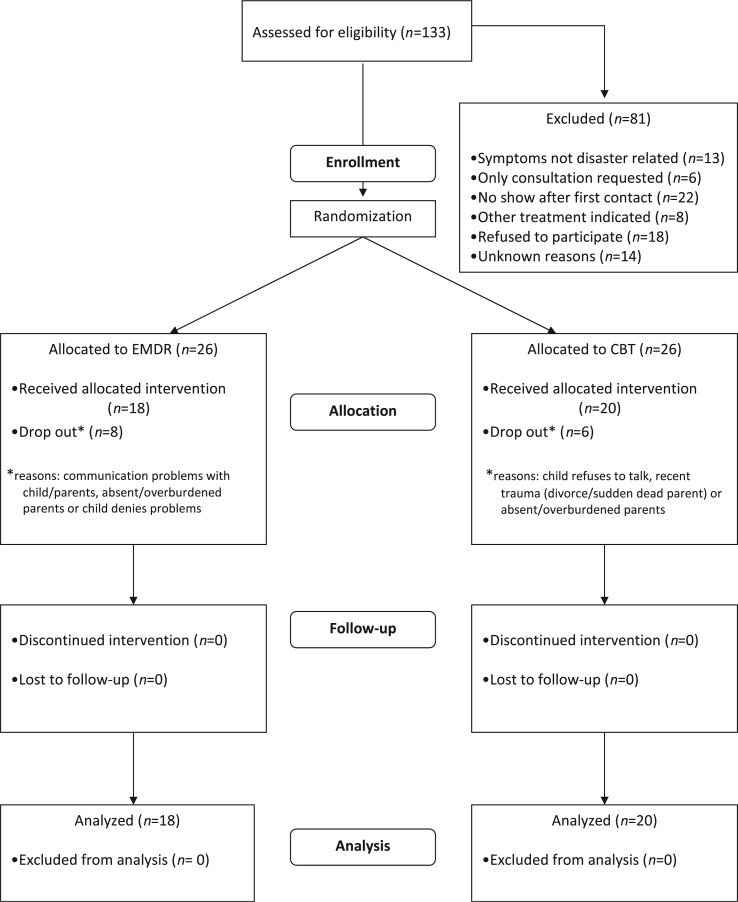
Design: Children (n=52, aged 4-18) were randomly allocated to either CBT (n=26) or EMDR (n=26) in a disaster mental health after-care setting after an explosion of a fireworks factory. All children received up to four individual treatment sessions over a 4-8 week period along with up to four sessions of parent guidance. Blind assessment took place pre- and post-treatment and at 3 months follow-up on a variety of parent-rated and self-report measures of post-traumatic stress disorder symptomatology, depression, anxiety, and behaviour problems. Analyses of variance (general linear model repeated measures) were conducted on the intention-to-treat sample and the completers.
Results: Both treatment approaches produced significant reductions on all measures and results were maintained at follow-up. Treatment gains of EMDR were reached in fewer sessions.
Conclusion: Standardised CBT and EMDR interventions can significantly improve functioning of disaster-exposed children.
期刊介绍:
The European Journal of Psychotraumatology (EJPT) is a peer-reviewed open access interdisciplinary journal owned by the European Society of Traumatic Stress Studies (ESTSS). The European Journal of Psychotraumatology (EJPT) aims to engage scholars, clinicians and researchers in the vital issues of how to understand, prevent and treat the consequences of stress and trauma, including but not limited to, posttraumatic stress disorder (PTSD), depressive disorders, substance abuse, burnout, and neurobiological or physical consequences, using the latest research or clinical experience in these areas. The journal shares ESTSS’ mission to advance and disseminate scientific knowledge about traumatic stress. Papers may address individual events, repeated or chronic (complex) trauma, large scale disasters, or violence. Being open access, the European Journal of Psychotraumatology is also evidence of ESTSS’ stand on free accessibility of research publications to a wider community via the web. The European Journal of Psychotraumatology seeks to attract contributions from academics and practitioners from diverse professional backgrounds, including, but not restricted to, those in mental health, social sciences, and health and welfare services. Contributions from outside Europe are welcome. The journal welcomes original basic and clinical research articles that consolidate and expand the theoretical and professional basis of the field of traumatic stress; Review articles including meta-analyses; short communications presenting new ideas or early-stage promising research; study protocols that describe proposed or ongoing research; case reports examining a single individual or event in a real‑life context; clinical practice papers sharing experience from the clinic; letters to the Editor debating articles already published in the Journal; inaugural Lectures; conference abstracts and book reviews. Both quantitative and qualitative research is welcome.



 京公网安备 11010802042870号
京ICP备2023020795号-1
京公网安备 11010802042870号
京ICP备2023020795号-1

 分享
分享
 求助内容:
求助内容: 应助结果提醒方式:
 扫码关注我们
