Meiying Jia , Weiping Xiong , Zhaohui Yang , Jiao Cao , Yanru Zhang , Yinping Xiang , Haiyin Xu , Peipei Song , Zhengyong Xu
{"title":"Metal-organic frameworks and their derivatives-modified photoelectrodes for photoelectrochemical applications","authors":"Meiying Jia , Weiping Xiong , Zhaohui Yang , Jiao Cao , Yanru Zhang , Yinping Xiang , Haiyin Xu , Peipei Song , Zhengyong Xu","doi":"10.1016/j.ccr.2021.213780","DOIUrl":null,"url":null,"abstract":"<div><p>Artificial photosynthesis based on photoelectrochemical (PEC) strategy is another solar-to-chemical energy conversion method besides photocatalysis. Owing to the diversity of structure and the adjustability of synthesis, the metal-organic frameworks (MOFs) can enrich this important research field in the form of constructing a photoelectrode. In addition to solving the problems of difficult recovery for powder and the easy recombination for carriers in photocatalysis, MOFs and their derivatives-modified photoelectrodes can reasonably adjust the PEC activity at the molecular level and increase the contact area between the electrolyte and electrode, thereby facilitating the diffusion of electrolyte and reaction substrate in the electrode. In this review, we comprehensively reviewed representative studies in this area. Firstly, functions of MOFs in photoelectrodes are outlined, and the various synthesis strategies of MOFs-modified photoelectrodes are elaborated. Subsequently, special attention has been paid to the application and mechanism of MOFs-modified photoelectrodes (MIL, ZIF, UiO and PCN) in photo-electrochemistry. And we discuss the stability, reproducibility and reusability of MOFs-modified photoelectrodes. Finally, the challenges and improvements of MOFs-modified photoelectrodes in promoting practical application are proposed. Overall, MOFs and their derivatives-modified photoelectrodes achieved the integration of adsorption, photocatalysis and electrocatalysis. Notably, the research in this field is in infancy, many improvements are required before practical applications.</p></div>","PeriodicalId":289,"journal":{"name":"Coordination Chemistry Reviews","volume":"434 ","pages":"Article 213780"},"PeriodicalIF":23.5000,"publicationDate":"2021-05-01","publicationTypes":"Journal Article","fieldsOfStudy":null,"isOpenAccess":false,"openAccessPdf":"https://sci-hub-pdf.com/10.1016/j.ccr.2021.213780","citationCount":"38","resultStr":null,"platform":"Semanticscholar","paperid":null,"PeriodicalName":"Coordination Chemistry Reviews","FirstCategoryId":"92","ListUrlMain":"https://www.sciencedirect.com/science/article/pii/S001085452100014X","RegionNum":1,"RegionCategory":"化学","ArticlePicture":[],"TitleCN":null,"AbstractTextCN":null,"PMCID":null,"EPubDate":"","PubModel":"","JCR":"Q1","JCRName":"CHEMISTRY, INORGANIC & NUCLEAR","Score":null,"Total":0}
引用次数: 38
Abstract
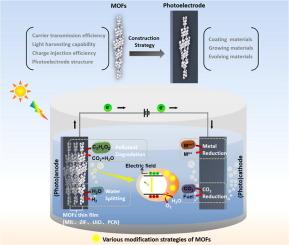
Artificial photosynthesis based on photoelectrochemical (PEC) strategy is another solar-to-chemical energy conversion method besides photocatalysis. Owing to the diversity of structure and the adjustability of synthesis, the metal-organic frameworks (MOFs) can enrich this important research field in the form of constructing a photoelectrode. In addition to solving the problems of difficult recovery for powder and the easy recombination for carriers in photocatalysis, MOFs and their derivatives-modified photoelectrodes can reasonably adjust the PEC activity at the molecular level and increase the contact area between the electrolyte and electrode, thereby facilitating the diffusion of electrolyte and reaction substrate in the electrode. In this review, we comprehensively reviewed representative studies in this area. Firstly, functions of MOFs in photoelectrodes are outlined, and the various synthesis strategies of MOFs-modified photoelectrodes are elaborated. Subsequently, special attention has been paid to the application and mechanism of MOFs-modified photoelectrodes (MIL, ZIF, UiO and PCN) in photo-electrochemistry. And we discuss the stability, reproducibility and reusability of MOFs-modified photoelectrodes. Finally, the challenges and improvements of MOFs-modified photoelectrodes in promoting practical application are proposed. Overall, MOFs and their derivatives-modified photoelectrodes achieved the integration of adsorption, photocatalysis and electrocatalysis. Notably, the research in this field is in infancy, many improvements are required before practical applications.
期刊介绍:
Coordination Chemistry Reviews offers rapid publication of review articles on current and significant topics in coordination chemistry, encompassing organometallic, supramolecular, theoretical, and bioinorganic chemistry. It also covers catalysis, materials chemistry, and metal-organic frameworks from a coordination chemistry perspective. Reviews summarize recent developments or discuss specific techniques, welcoming contributions from both established and emerging researchers.
The journal releases special issues on timely subjects, including those featuring contributions from specific regions or conferences. Occasional full-length book articles are also featured. Additionally, special volumes cover annual reviews of main group chemistry, transition metal group chemistry, and organometallic chemistry. These comprehensive reviews are vital resources for those engaged in coordination chemistry, further establishing Coordination Chemistry Reviews as a hub for insightful surveys in inorganic and physical inorganic chemistry.




 京公网安备 11010802042870号
京ICP备2023020795号-1
京公网安备 11010802042870号
京ICP备2023020795号-1

 分享
分享
 求助内容:
求助内容: 应助结果提醒方式:
 扫码关注我们
