Melchor Sánchez-Mendiola, Luis F Kieffer-Escobar, Salvador Marín-Beltrán, Steven M Downing, Alan Schwartz
{"title":"Teaching of evidence-based medicine to medical students in Mexico: a randomized controlled trial.","authors":"Melchor Sánchez-Mendiola, Luis F Kieffer-Escobar, Salvador Marín-Beltrán, Steven M Downing, Alan Schwartz","doi":"10.1186/1472-6920-12-107","DOIUrl":null,"url":null,"abstract":"<p><strong>Background: </strong>Evidence-Based Medicine (EBM) is an important competency for the healthcare professional. Experimental evidence of EBM educational interventions from rigorous research studies is limited. The main objective of this study was to assess EBM learning (knowledge, attitudes and self-reported skills) in undergraduate medical students with a randomized controlled trial.</p><p><strong>Methods: </strong>The educational intervention was a one-semester EBM course in the 5th year of a public medical school in Mexico. The study design was an experimental parallel group randomized controlled trial for the main outcome measures in the 5th year class (M5 EBM vs. M5 non-EBM groups), and quasi-experimental with static-groups comparisons for the 4th year (M4, not yet exposed) and 6th year (M6, exposed 6 months to a year earlier) groups. EBM attitudes, knowledge and self-reported skills were measured using Taylor's questionnaire and a summative exam which comprised of a 100-item multiple-choice question (MCQ) test.</p><p><strong>Results: </strong>289 Medical students were assessed: M5 EBM=48, M5 non-EBM=47, M4=87, and M6=107. There was a higher reported use of the Cochrane Library and secondary journals in the intervention group (M5 vs. M5 non-EBM). Critical appraisal skills and attitude scores were higher in the intervention group (M5) and in the group of students exposed to EBM instruction during the previous year (M6). The knowledge level was higher after the intervention in the M5 EBM group compared to the M5 non-EBM group (p<0.001, Cohen's d=0.88 with Taylor's instrument and 3.54 with the 100-item MCQ test). M6 Students that received the intervention in the previous year had a knowledge score higher than the M4 and M5 non-EBM groups, but lower than the M5 EBM group.</p><p><strong>Conclusions: </strong>Formal medical student training in EBM produced higher scores in attitudes, knowledge and self-reported critical appraisal skills compared with a randomized control group. Data from the concurrent groups add validity evidence to the study, but rigorous follow-up needs to be done to document retention of EBM abilities.</p>","PeriodicalId":51234,"journal":{"name":"BMC Medical Education","volume":"12 ","pages":"107"},"PeriodicalIF":3.2000,"publicationDate":"2012-11-06","publicationTypes":"Journal Article","fieldsOfStudy":null,"isOpenAccess":false,"openAccessPdf":"https://sci-hub-pdf.com/10.1186/1472-6920-12-107","citationCount":"47","resultStr":null,"platform":"Semanticscholar","paperid":null,"PeriodicalName":"BMC Medical Education","FirstCategoryId":"3","ListUrlMain":"https://doi.org/10.1186/1472-6920-12-107","RegionNum":2,"RegionCategory":"医学","ArticlePicture":[],"TitleCN":null,"AbstractTextCN":null,"PMCID":null,"EPubDate":"","PubModel":"","JCR":"Q1","JCRName":"EDUCATION & EDUCATIONAL RESEARCH","Score":null,"Total":0}
引用次数: 47
Abstract
Background: Evidence-Based Medicine (EBM) is an important competency for the healthcare professional. Experimental evidence of EBM educational interventions from rigorous research studies is limited. The main objective of this study was to assess EBM learning (knowledge, attitudes and self-reported skills) in undergraduate medical students with a randomized controlled trial.
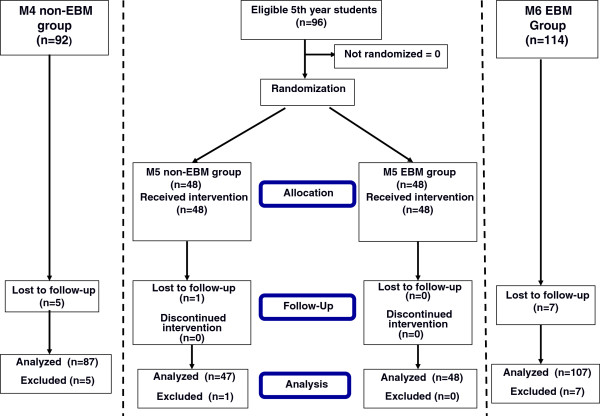
Methods: The educational intervention was a one-semester EBM course in the 5th year of a public medical school in Mexico. The study design was an experimental parallel group randomized controlled trial for the main outcome measures in the 5th year class (M5 EBM vs. M5 non-EBM groups), and quasi-experimental with static-groups comparisons for the 4th year (M4, not yet exposed) and 6th year (M6, exposed 6 months to a year earlier) groups. EBM attitudes, knowledge and self-reported skills were measured using Taylor's questionnaire and a summative exam which comprised of a 100-item multiple-choice question (MCQ) test.
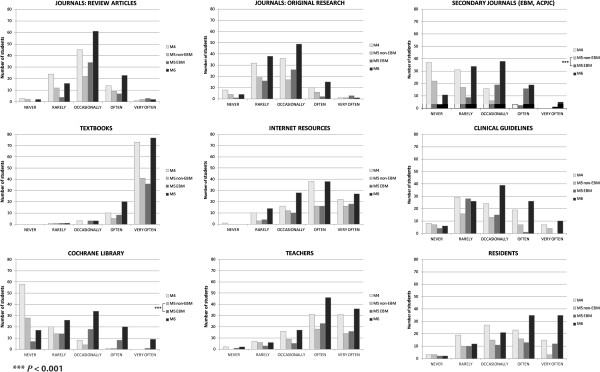
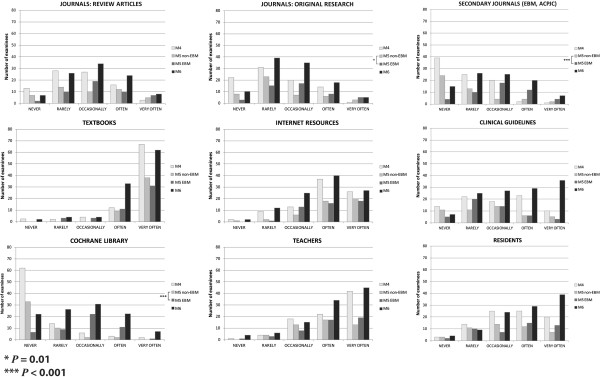
Results: 289 Medical students were assessed: M5 EBM=48, M5 non-EBM=47, M4=87, and M6=107. There was a higher reported use of the Cochrane Library and secondary journals in the intervention group (M5 vs. M5 non-EBM). Critical appraisal skills and attitude scores were higher in the intervention group (M5) and in the group of students exposed to EBM instruction during the previous year (M6). The knowledge level was higher after the intervention in the M5 EBM group compared to the M5 non-EBM group (p<0.001, Cohen's d=0.88 with Taylor's instrument and 3.54 with the 100-item MCQ test). M6 Students that received the intervention in the previous year had a knowledge score higher than the M4 and M5 non-EBM groups, but lower than the M5 EBM group.
Conclusions: Formal medical student training in EBM produced higher scores in attitudes, knowledge and self-reported critical appraisal skills compared with a randomized control group. Data from the concurrent groups add validity evidence to the study, but rigorous follow-up needs to be done to document retention of EBM abilities.
背景:循证医学(EBM)是医疗保健专业人员的一项重要能力。严谨的研究表明,循证医学教育干预的实验证据是有限的。本研究的主要目的是通过随机对照试验来评估本科医学生的循证医学学习(知识、态度和自我报告的技能)。方法:采用墨西哥一所公立医学院五年级一学期的循证医学课程进行教育干预。研究设计为实验平行组随机对照试验,对5年级(M5 EBM组与M5非EBM组)的主要结果进行测量,并对4年级(M4,尚未接触)和6年级(M6,接触6个月至一年前)组进行准实验静态组比较。实证医学的态度、知识和自我报告的技能是用泰勒的问卷和一个由100道选择题(MCQ)组成的总结性考试来衡量的。结果:共对289名医学生进行了评估,其中M5为有循证医学的48人,M5为无循证医学的47人,M4为87人,M6为107人。干预组使用Cochrane图书馆和二级期刊的报告较高(M5 vs. M5非ebm)。干预组(M5)和前一年接受循证医学教学的学生(M6)的批判性评价技能和态度得分较高。M5 EBM组干预后的知识水平高于M5非EBM组(结论:正规EBM训练的医学生在态度、知识和自我报告的批判性评价技能方面得分高于随机对照组。来自并发组的数据为研究增加了有效性证据,但需要进行严格的随访以证明EBM能力的保留。
期刊介绍:
BMC Medical Education is an open access journal publishing original peer-reviewed research articles in relation to the training of healthcare professionals, including undergraduate, postgraduate, and continuing education. The journal has a special focus on curriculum development, evaluations of performance, assessment of training needs and evidence-based medicine.



 京公网安备 11010802042870号
京ICP备2023020795号-1
京公网安备 11010802042870号
京ICP备2023020795号-1

 分享
分享
 求助内容:
求助内容: 应助结果提醒方式:
 扫码关注我们
